- March 25, 2026

-
-
Loading
Loading
When George Balanchine, the Russian emigre of Georgian descent who became the father of American ballet, choreographed “Stars and Stripes” in 1958, it was a time of unbridled optimism in the U.S.
America and its Allies had defeated Fascism and Nazism in World War II, while Balanchine’s homeland was under the Soviet Union’s totalitarian thumb.
At that moment in time, New York, not European capitals like London and Paris, represented the pinnacle of cutting-edge culture. Around the world, American consumer goods — Coca-Cola, Levi’s jeans and Marlboro cigarettes — symbolized freedom with a capital “F,” and rock ’n’ roll was here to stay.
Against this backdrop, Balanchine created “Stars and Stripes” as a love letter to America, the country where he found success and stability after an early life marked by upheaval.
Set to rousing marches John Philip Sousa wrote in the late 19th century, around the time when Teddy Roosevelt led his Rough Riders to victory in the Spanish-American War, Balanchine’s 29-minute ballet is unapologetically patriotic.
So leave any cynicism at the door of the Van Wezel Performing Arts Hall, where the Sarasota Ballet will perform “Stars and Stripes” as part of its “Life and Liberty” program March 27-28.
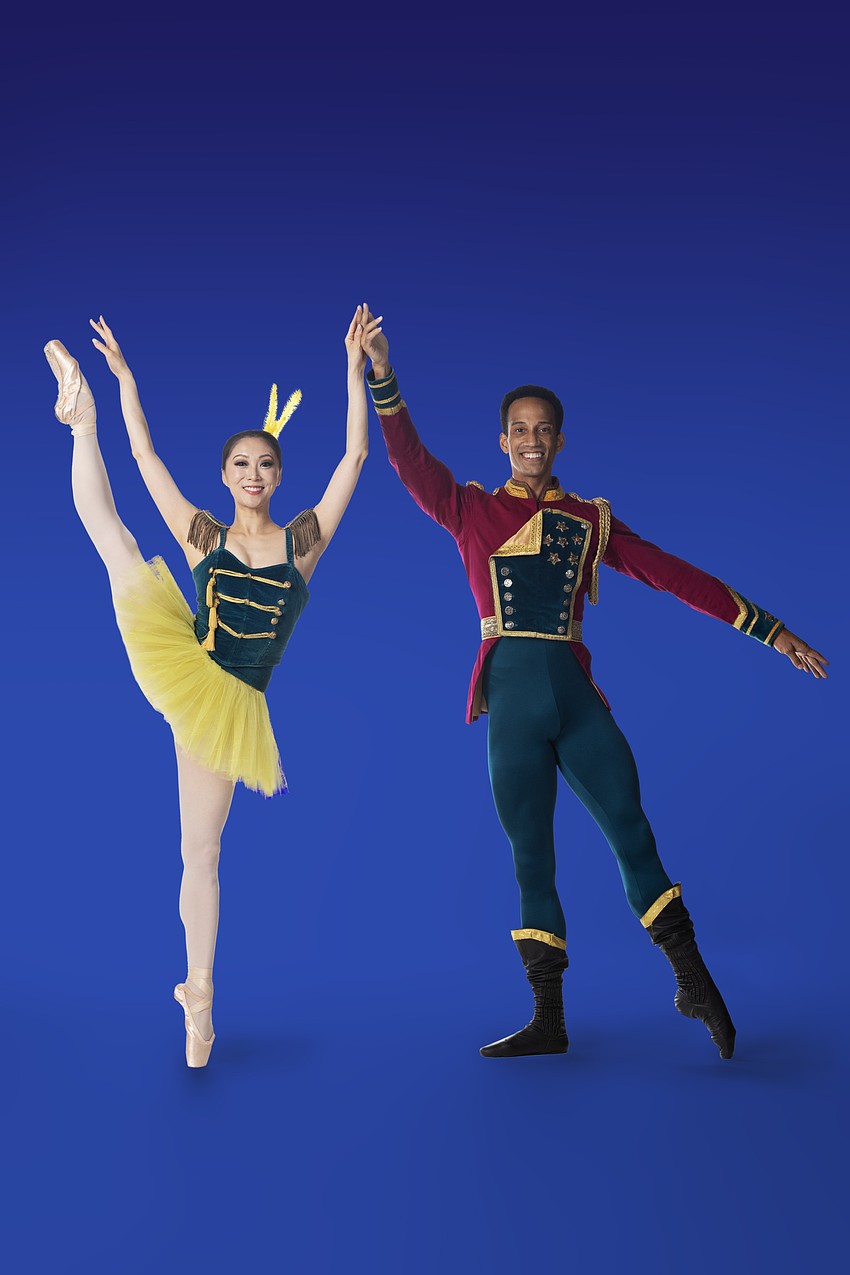
“Stars and Stripes” has the kind of martial pageantry more commonly found in a military parade or a football halftime show. In fact, Sarasota Ballet principal dancer Ricardo Rhodes, who plays the male lead, El Capitan, likens it to a Super Bowl halftime show.
Was the New England Patriots cap Rhodes wore during an interview at Sarasota Ballet’s offices a sign of his football loyalties or a broader patriotic statement? We forgot to ask.
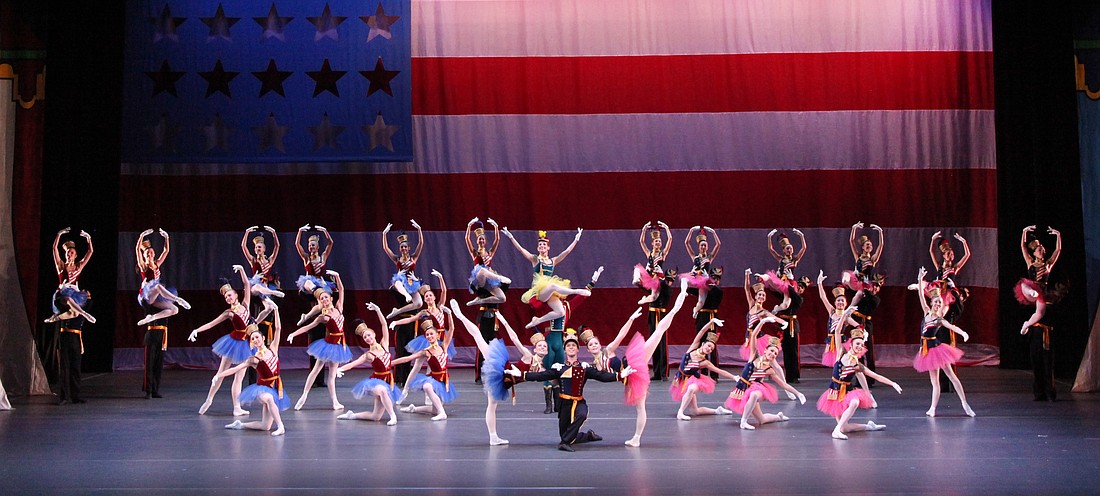
During “Stars and Stripes,” as a live orchestra plays Sousa marches we all know, more than 40 dancers in red, white and blue costumes inspired by soldiers’ uniforms execute awe-inspiring footwork with military precision.
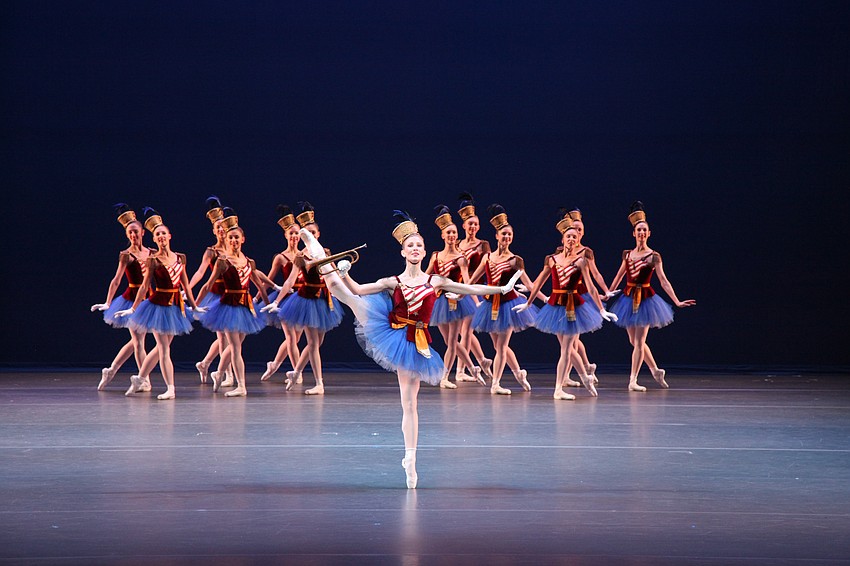
Some of the props, such as a trumpet and a baton (more about that later), help create a Fourth of July parade on steroids, perfectly timed for America’s semiquincentennial this year. In some quarters, this over-the-top ode might seem corny or campy, but its joy is undeniable.
Lest the audience miss the militaristic point, Balanchine calls “Stars and Stripes” a “ballet in five campaigns” in which dancers are divided into groups of four “regiments.”
In the finale of Balanchine’s patriotic extravaganza, a huge American flag takes up the back of the stage as the full cast pulls out the stops to the Sousa march, “Stars and Stripes Forever.”
Rhodes, who also played El Capitan in Sarasota Ballet’s 2019 production of “Stars and Stripes,” calls it “controlled chaos.”
“Stars and Stripes” first burst onto the scene with its New York City premiere on Jan. 17, 1958, five days before Balanchine’s 54th birthday. It was dedicated to Mayor Fiorello La Guardia.
Over the years, it was performed by the New York City Ballet on historic occasions. Among them were the inauguration of New York Gov. Nelson Rockefeller in 1959, the opening of NYCB’s new home in Lincoln Center (now the David H. Koch Theatre) in 1964 and when the American hostages were released from Iran in 1981, in a surprise encore.
In 1973, “Stars and Stripes” was one of 15 ballets filmed for TV in West Berlin, at that time a free city surrounded by the Soviet Union’s satellite state, East Germany. In those days, American culture was seen as a potent weapon against communism. For the Berlin performances, NYCB dancers were troupers, making do with concrete floors in the UFA film studios, a triumph that can be seen on a blurry YouTube video.
To make sure “Stars and Stripes” is performed in Sarasota as it was originally choreographed, Sarasota Ballet Director Iain Webb reached out to former NYCB principal and ballet coach Sandra Jennings.
Known as a “répétiteur,” Jennings works on a contract basis for the George Balanchine Trust. She has traveled the world since 1985 helping to stage Balanchine works, including several at the Sarasota Ballet.
Jennings is based in San Francisco, but she seemingly lives out of a suitcase. After helping to stage “Stars and Stripes” in Sarasota, she was heading to Berlin and then to Rome.
“I’ll be back in San Francisco in the summer. Then I’ll be in Vienna in September, La Scala (Venice) in October and November. Then next February, I’m in Paris for two-and-a-half months with the ‘Jewels’ calendar,” she said in a February interview.
In 2010 and 2012, Jennings was hired by ballet companies in Balanchine’s native Russia, the Bolshoi and the Mariinsky, respectively, to help stage his works.
Before coming to Sarasota this time, Jennings helped the San Francisco Ballet mount “Stars and Stripes” for its January season opener. When she arrived here, the production was fresh in her mind.
Also easing the staging process was the happy coincidence that Misa Kuranaga, currently a resident guest principal for Sarasota Ballet, danced the Liberty Bell role for the San Francisco Ballet, where she is a principal.
Kuranaga will dance the female lead again at the Van Wezel, alternating with Marijana Dominis, Sarasota Ballet principal dancer.
Jennings knows “Stars and Stripes” inside and out because she danced the ballet herself, first as a member of the corps des ballet and then as principal of the First Regiment.
Much like a drum majorette, this role calls for the dancer to twirl a baton and to catch one. “Back in the 1970s, people twirled batons, but people don’t twirl batons anymore, so I’m working with them,” Jennings says, referring to the Sarasota Ballet.
“There’s not so much twirling, but having to catch the baton can be a worry,” she says.
One of the other challenges in “Stars and Stripes,” both back at NYCB in her day and today at Sarasota Ballet, is keeping the noise down when the female dancers wearing pointe shoes execute the many jumps in the production. “Mr. B (Balanchine’s nickname) threatened to make us wear men’s shoes if we made a lot of noise,” Jennings recalls.
“Stars and Stripes” proved to be “somewhat controversial” recently in San Francisco, Jennings notes. The program designed to celebrate America’s 250th birthday was scheduled for Jan. 14, just days after the death of Renee Good in Minneapolis during an ICE operation to arrest undocumented immigrants.
When one of the San Francisco Ballet dancers expressed misgivings about embracing full-throttle patriotism so soon after the tragedy, Jennings says she told them, “This is our flag. The flag belongs to us. Embrace it.”
In the end, the “Stars and Stripes” premiere in San Francisco turned into a diversity lovefest as the dancers waved small flags representing their national heritage or personal affinity during the curtain call. The sea of flags “was the idea of one of the dancers, and it was beautiful,” Jennings says.
But some of the naysayers in San Francisco may have been missing the real message of “Stars and Stripes.” Sarasota Ballet principals Rhodes and Dominis both expressed their belief that first and foremost, “Stars and Stripes” represents fun.
“We can be serious, but we can have personality,” Rhodes says. “What’s fun about this ballet is that you look around the company and everyone is from everywhere in the world. This ballet represents that melting pot. We’re all patriots and we all love this country.”
Dominis chimes in. “The footwork requires serious precision,” she says. “But we have so much fun, especially in the finale, which is like fireworks in ballet form.”
With so many dancers on stage at the same time, Dominis is looking forward to performing at the Van Wezel, which is much larger than the Sarasota Ballet’s other venues, including Sarasota Opera House and FSU Center for the Performing Arts.
Not long after Sousa penned his patriotic marches that form the score of “Stars and Stripes,” George M. Cohan wrote his now classic patriotic ditty, “You’re a Grand Old Flag.” Written in 1906 for Cohan’s musical, “George Washington Jr.,” it became the first song from a musical to sell more than 1 million copies of sheet music.
Every heart beats true
Under Red, White and Blue
Where there’s never a boast or brag
But should auld acquaintance be forgot
Keep your eye on that grand old flag
With “Stars and Stripes,” Balanchine exults in America’s greatness, but never boasts or brags. There’s no need to. The ballet’s star-spangled virtuosity speaks for itself.