- March 16, 2026

-
-
Loading
Loading
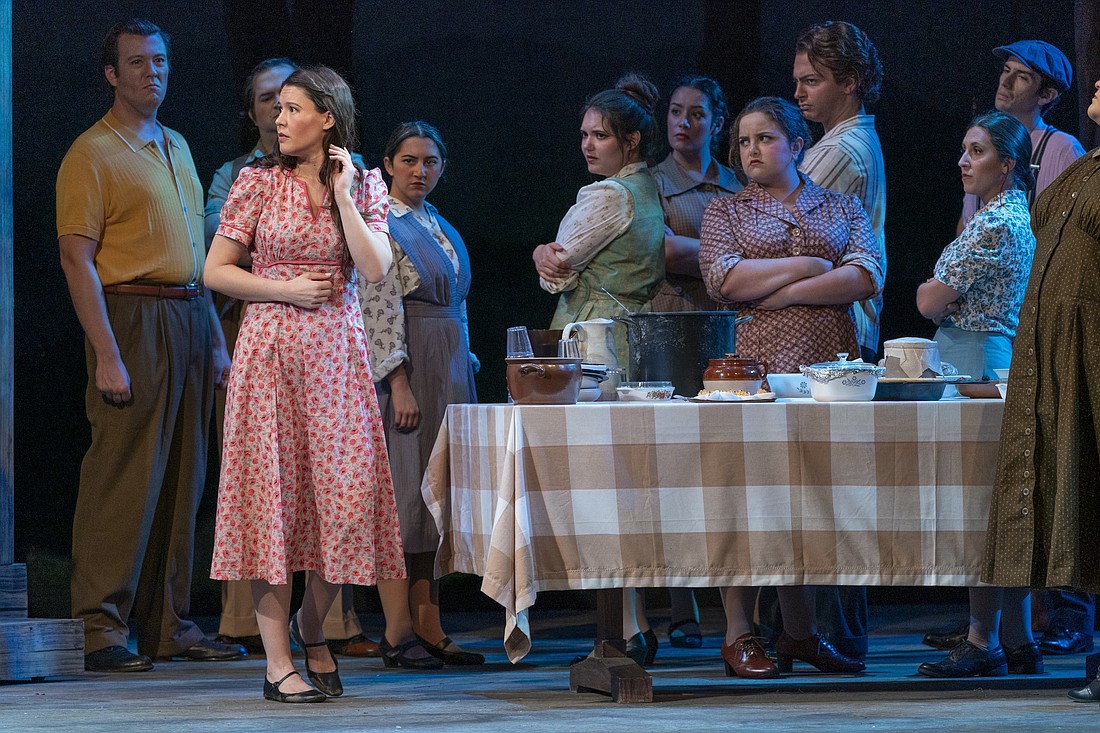
In 1955, composer Carlisle Floyd premiered his opera “Susannah” on the stage of Florida State University in Tallahassee before the work moved on to New York City Opera and ultimately became part of the American repertoire. Now, 70 years later and back again on a Florida stage, Sarasota Opera’s latest production reminds us why Floyd’s stark American tragedy continues to resonate.
Set in a rural Appalachian community gripped by suspicion and moral certainty, “Susannah” unfolds as a chilling portrait of how quickly righteousness can curdle into cruelty. The intimate scale of Sarasota Opera House serves the work well. Director Martha Collins wisely avoids grand gesture, allowing Floyd’s plainspoken vernacular libretto and folk-inflected score to carry the story with devastating clarity.
The production is exceptionally well cast, beginning with Hanna Brammer in the title role. With her lithe voice and girlish figure, Brammer is entirely convincing as the lighthearted teen Susannah Polk. From her first appearance she embodies the innocence that makes the character’s later isolation so painful to witness.
Opposite her is tenor Jeremy Brauner as Susannah’s protective older brother, Sam Polk. Brauner’s warmly lyrical tenor conveys the brother’s fierce loyalty, particularly in the tender moments the two share. Their early duet recalling their father through the simple “Jaybird” tune is one of the opera’s gentlest passages, and the siblings’ affection provides a poignant emotional anchor that resonates tragically by the end of the evening.
We first encounter the townspeople gathered for a dance outside the church on the eve of a revival meeting. Susannah and the young men dance to a lively fiddle tune while the church elders and matronly ladies observe with stern disapproval.
These church women deserve particular recognition for their sharply drawn characterizations. Studio artists Lindsey Polcyn, Krista Renée Pape, Mary Burke Barber and Gabrielle Barkidjija bring vivid personality to their roles, with Polcyn’s Mrs. McLean unforgettable as the chief moral battleaxe.
Floyd’s libretto wastes no time in showing how quickly a tight-knit society can transform suspicion into condemnation. When Floyd wrote “Susannah,” the U.S. was living through the twitchy years of the Cold War and the McCarthy trials, when mere accusation could destroy reputations and livelihoods.
In this Appalachian community’s own version of such trials, the church elders — Brian Kontes, David Freides, Nathaniel Catasca and Drew Comer — become unwilling witnesses to Susannah’s youthful vitality. While they watch her dance, the women quickly redirect blame toward the girl herself, projecting their husbands’ wandering eyes onto Susannah’s supposed moral failing.
Into this atmosphere arrives the visiting revival preacher, the Rev. Olin Blitch. Bass-baritone Jason Zacher cuts an imposing figure, projecting both charisma and authority. His arrival is greeted with eager anticipation for a harvest of sinners during the upcoming revival. Yet, even Blitch, the community’s moral arbiter, proves susceptible to the same temptation he condemns in others. When he cuts in to dance with Susannah, his interest is unmistakable.
Susannah’s innocence finds its most lyrical expression when Dylan Schang’s shy and devoted Little Bat McLean walks her home. Left alone beneath the night sky, she sings the opera’s best-known aria, quietly marveling, “Ain’t it a pretty night?”
Floyd’s music here draws directly on Appalachian folk idioms. Brammer’s clear soprano floats effortlessly over the orchestra, capturing the character’s wonder at the natural world. The scene is beautifully staged with towering tree trunks rising into the fly loft, giving the impression of a mountain forest stretching endlessly overhead.
It is a moment of peace before the storm.
The next morning brings the turning point of the drama. As Susannah bathes in a creek near her cabin, the church elders stumble upon her. Unable — or unwilling — to avert their eyes, they quickly transform their own voyeurism into moral outrage. In one of Floyd’s most powerful scenes, the four men stand staring offstage, condemning Susannah while wrestling silently with their own desires. Their self-righteous outrage soon echoes through the town: “She’s sinful! She’s unclean!”
Susannah’s heartbreak is palpable when she learns of the accusations against her. Brammer allows the character’s confidence to collapse visibly, her spirit dimming as the curtain falls on the act.
Act II finds the entire community gathered in the church for the revival meeting. Zacher’s Blitch delivers his sermon with fervor, though the staging of the congregation remains somewhat restrained. The pews are filled, but the revival never quite reaches the fever pitch that might make the moment more explosive. Still, when the entire congregation slowly turns to stare at Susannah sitting in the back, the chill in the room is unmistakable.
Soon comes the emotional heart of the opera. Sitting alone on the porch of her cabin, Susannah sings the haunting aria “The trees on the mountain are cold and bare.” Brammer’s interpretation captures the desolation at the core of the music and her heart. The aria feels less like a lament than a quiet premonition of tragedy.
From this point forward, the opera’s course feels inevitable. Blitch’s attempt to redeem Susannah ultimately reveals his own moral weakness. His transformation from righteous preacher to broken hypocrite is handled convincingly by Zacher, who allows the character’s confidence to unravel in the wake of his actions.
The production itself reflects Sarasota Opera’s consistently high standards. Collins’ stage direction remains unobtrusive and grounded in realism, allowing the story to unfold naturally. Scenic designer R. Keith Brumley’s rustic sets evoke the isolation of the Appalachian landscape. Costumes by Howard Tsvi Kaplan and lighting by Ken Yunker further support the production’s grounded aesthetic, while chorus master Artyam Pak ensures the ensemble’s musical precision.
Under conductor Jessé Martins, the Sarasota Opera orchestra provides the musical fabric that sustains the drama. Floyd’s score, with its transparent textures and folk-inspired melodies, is rendered with sensitivity and balance. The orchestra never overwhelms the singers, instead reinforcing the emotional atmosphere of each scene.
Floyd’s opera reminds us how easily the defense of morality can become its opposite. In the end, the town that feared Susannah’s corruption becomes the force that creates it.