- March 15, 2026

-
-
Loading
Loading
Two exhibitions are now open in Sarasota documenting the town’s heyday as an artist colony. One is at Ringling College of Art and Design. The other is at the downtown offices of Michael Saunders & Co.
Ringling College’s “Origins: Sarasota Artist Colony, 1945-1965” was co-curated by Tim Jaeger, Ringling College's chief curator, and Bill Hartman, the son of William Hartman, a member of the colony. It’s a fascinating origin story. Florida’s filled with beach communities. This ambitious historical exhibition reveals how Sarasota became an arts community. But it’s not the whole picture.
At Ringling College, historical wall notes put the artworks in context. The effect is like walking into a giant art history book. The illustrations are actual drawings and paintings.
World War II is the overarching context. It planted the seeds of Sarasota’s growing artist colony in the post-war years.
In the two decades after World War II, Sarasota attracted artists from around the country. With great weather and cheap rent, it’s easy to see why. The GI Bill kicked the process into overdrive — and an influx of talented veterans took advantage of it.
The Ringling School of Art, the predecessor to today’s college, provided many with training and a reason to stay. Their budding arts community transformed the larger community. “About 1,000 artists were living in a town of roughly 15,000 people,” notes Jaeger. “One out of every 15 Sarasotans was creating original art.”
While these artists lived and worked in Sarasota, they had no regional style. These rugged individualists marched to different drummers. This exhibit celebrates their parade with 36 creations from Sarasota’s artist colony days.
Jon Corbino’s “Refugees” (1937) is a storm-tossed scene of desperate people clinging to a tiny boat. His broad, vivid brushwork is ideal for this violent vignette; it’s painterly, muscular and gestural.
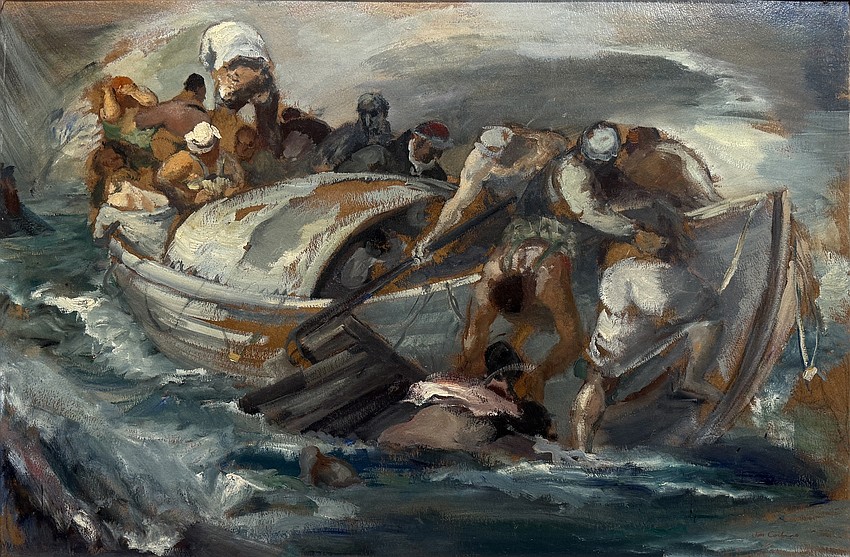
Corbino blocks in the survivors with limited, earthy colors; his blurry figures merge with sea and sky. This tempestuous scene is representational, but it works as an abstraction. While Corbino’s painting pre-dates Abstract Expressionism, he’s moving in that direction.
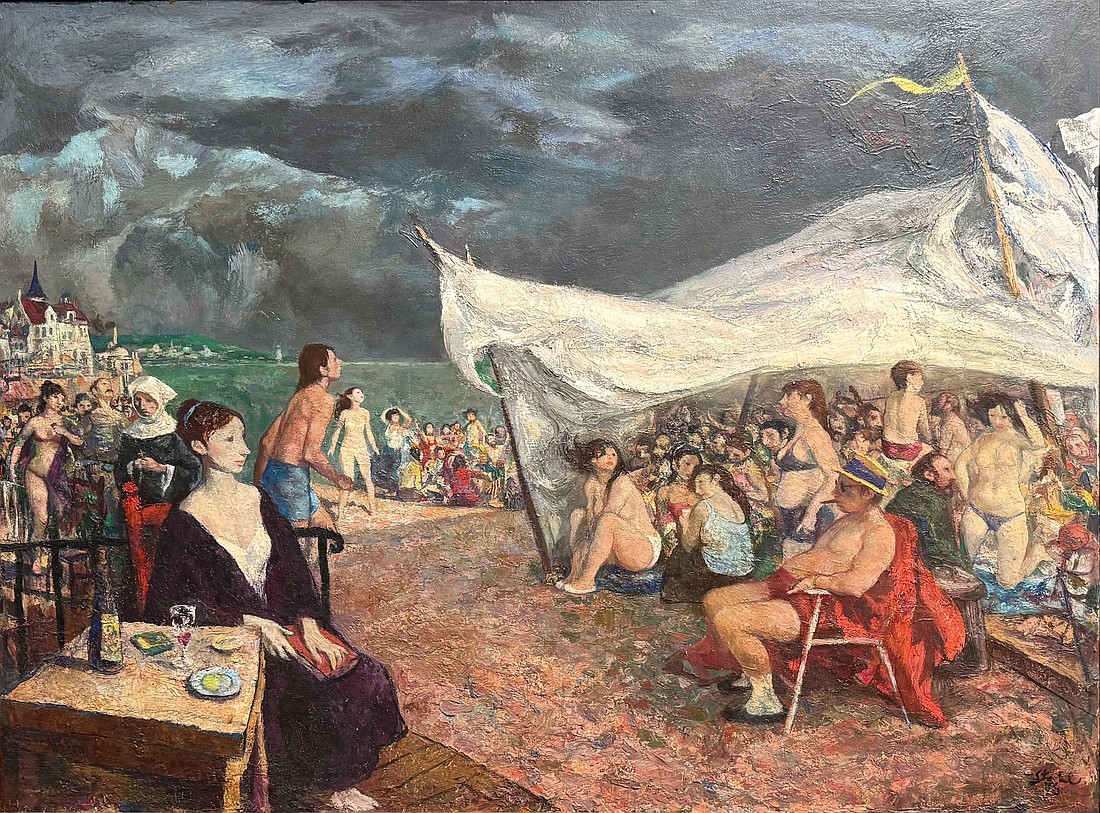
Ben Stahl’s undated “Thunder on the Beach” also crackles with stormy weather. In his dramatic painting, the storm hasn’t hit yet. You see a cross-section of humanity — on what looks like an Italian beach. Modest nuns, topless women, a cigar-smoking man in a beach chair — you see all kinds. Many huddle for shelter under a billowing canopy. Others (like the serene woman enjoying a bottle of wine) don’t mind getting wet.
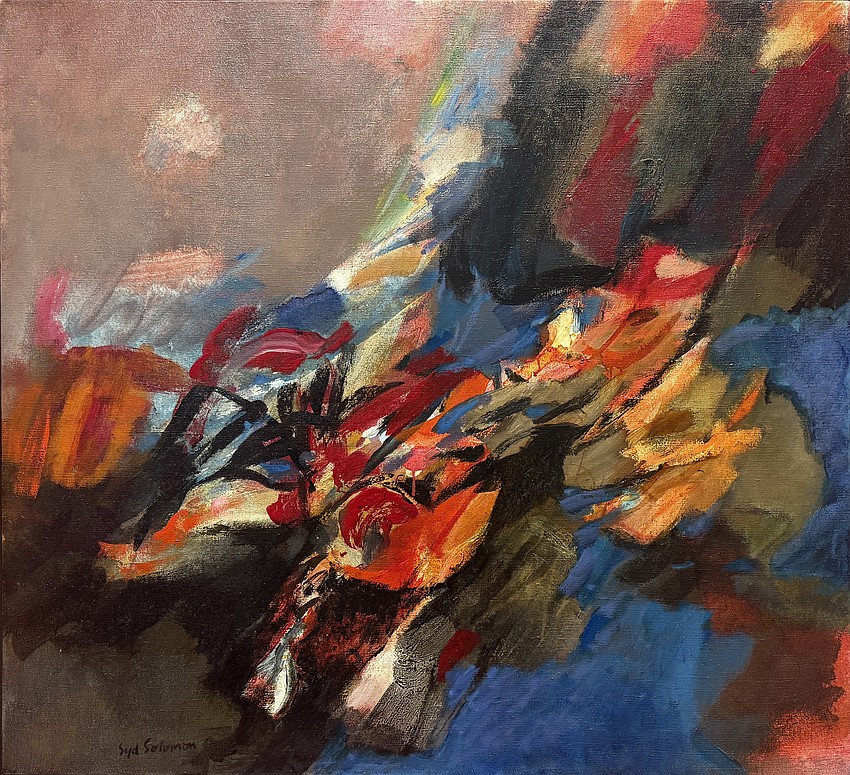
Syd Solomon’s “Resurge” (1961) is an abstract piece, but it’s stormy in its own right. A turbulent color field of forceful brushstrokes. A diagonal composition. The energy slashes up from left to right. Solomon painted this before the hard-edge abstractions of his later work. Those evoked a cool sense of oceanic depths and labyrinths of coral caves. This is more like a firestorm.
Craig Rubadoux’s “Man with Lion” is high and dry. This dreamy painting depicts a wide-eyed bald man (clown or harlequin?) holding a surprised-looking lion. A brilliant use of negative space — he stands in one corner, with no background behind him. Who is this man? Why is he holding a lion? With his signature surreal wit, Rubadoux lets the mystery be.
That’s just a sample of what these mid-20th-century artists created. Other artists included in the Ringling College exhibit are Judy Axe, Robert Chase, Shirley Clement, Jerry Farnsworth, Glenna Finch, Martha and William Hartman, Robert Larsen, Sidney Laufman, Hilton and Dorothy Leech, George Kaiser, Roy Nichols, Al Parker, Nike Parton, Elden Rowland, Helen Sawyer, Harold Slingerland, Thornton Utz, Loran Wilford and Eugene White.
But they didn’t do it alone.
Without sacrificing individuality, these Sarasota talents empowered each other. Visual artists formed close friendships and collaborations. They also joined or created artistic organizations such as The Ringling School of Art and The Sarasota Art Association (now Art Center Sarasota) along with The Petticoat Painters, a group of women’s artists.
In addition to creating art, they had a lot of fun and a lot of parties.
Visual artists also joined forces with architects, authors and circus artists. Until 1960, Sarasota was the winter headquarters of The Ringling Brothers and Barnum & Bailey Circus. “The Greatest Show on Earth” often needed artists to paint its wagons, banners and displays. Artists like Corbino and Wilfred Berg returned the compliment by making circus life the subject of their paintings.
These creative collaborations transformed Sarasota into a subtropical arts colony. The two decades following World War II were its glory days. But that’s all history now. Preserving that history is the point of the Ringling College and Michael Saunders initiatives.
“Origins” at Ringling College illustrates Sarasota’s artist colony history with historical art. At Michael Saunders & Co., a new installation, “Legacy in the Making: Sarasota’s Visual Arts History 1945-65,” unfolds that history with a timeline of historical images. Curated by Jaeger, this 200-foot mural wall is suitably larger than life. SarasotaLegacy.art puts Sarasota’s artistic glory days online in exquisite detail. It includes a video tour.
An exhibition. A mural. A website.
Putting them together was a Herculean task. Why go to so much trouble?
“We need to preserve Sarasota’s artistic heritage,” explains Jaeger. “We want to hold onto this work. We need to keep telling stories about the artists who created it. Newcomers and future generations need to hear it.”
Jaeger notes that many area residents aren’t aware of Sarasota’s post-war arts legacy. “Economic forces have created a cultural amnesia,” he says. “We want to reverse that. Sarasota was a true artist colony in the past. If we hold onto that memory, we just might be an artist colony in the future.”