- January 28, 2026

-
-
Loading
Loading
Longtime wisdom has it that when things go wrong or sideways inside a business or an organization, more often than not, the root of the misfiring and mistakes can be traced to this: communication. Actually, it can be traced to misinterpretations, miscommunication or simply lack of communication.
“You didn’t tell me to do that.” “Why didn’t you tell me you needed this?” “I’m sorry, I thought you meant … ” “Why did you hide that from me?”
Or: “You need to be more transparent.”
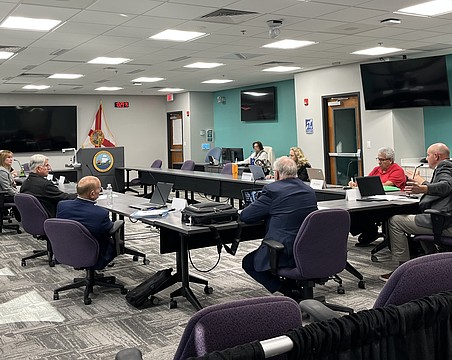
In Florida government, at all levels, transparency has been a hallmark of good government for 60 years. In 1967, the Legislature enacted Florida’s Government-in-the-Sunshine Law, at that time the nation’s most advanced legislation requiring open meetings and prohibiting public officials from conducting deals in the proverbial back, smoke-filled rooms.
It’s safe to say if you polled most elected county, municipal and school board officials, they likely would tell you they hate Florida’s Sunshine Laws. The laws most definitely inhibit the officials’ ability to negotiate with each other and discuss sensitive ideas in private. But at the same time, they likely also would admit Florida’s Sunshine Laws, government transparency and public notice laws are essential to good government.
Altogether, these laws benefit the state’s citizens and businesses. They are crucial to an informed electorate and a functioning democracy. Sunshine, the saying goes, is a great antiseptic. These laws should be safeguarded and protected vigilantly.
And yet, the trends for transparency over the past two decades have been headed in the opposite direction — in Florida and nationwide. Most especially in one specific area: public notice.
And it’s all because of the internet — and too many lawmakers losing sight of what is more important.
Government transparency is about 360 years old. The London Gazette in 1665 was the first newspaper to begin publishing notices from the king’s court. A century later, in 1789, the Acts of the First Session of the First U.S. Congress required the secretary of state to publish all “bills, orders, resolutions and congressional votes” in at least three publicly available newspapers.
Ever since then, newspapers in the U.S. and U.K. have been the primary and most effective repositories and distributors for governments to serve public notices to their constituents.
And it has always been a logical, fair business transaction. Governments paid newspapers for the ink, paper and distribution of vital government information to keep their constituents informed.
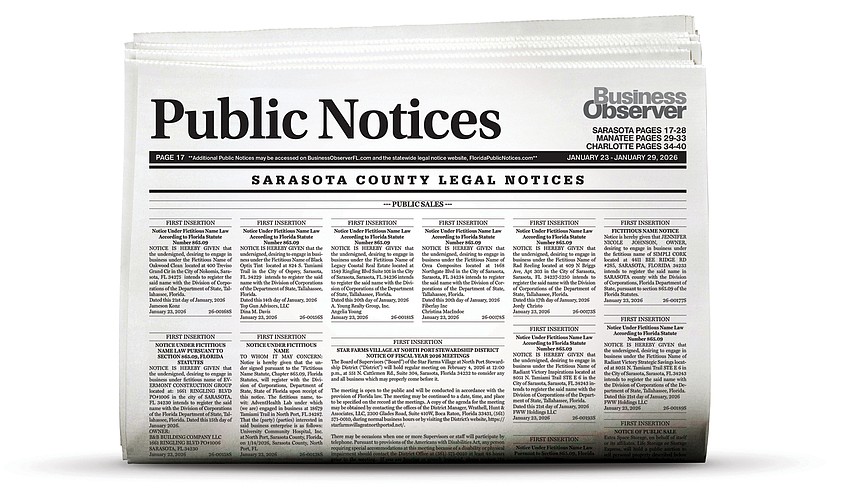
But 30 years ago, the internet mushroomed, and over that time — especially in the past decade — readership of print newspapers declined precipitously. These days, when you hear any legislator talk about newspapers, the standard line is “nobody reads print newspapers any more.” (That’s false, by the way.)
That certainly was evident last week during two hearings of the House Civil Justice and Claims Committee in Tallahassee. The committee overwhelmingly passed two bills that would give all government agencies and storage center owners the ability to publish their public and legal notices on any government or publicly accessible website.
The bill would still include newspapers as an option, but legislation has no regard for standards that lawmakers applied to newspaper public notices for decades.
The arguments for doing this were today’s mantras: 1) No one reads print newspapers. 2) “We’re modernizing,” said Rep. David Smith, R-Seminole. 3) Requiring notices in newspapers (in print or online) is just a subsidy for newspapers. 4) Allowing public notices on government (or any other) websites will be a huge money saver for taxpayers.
The last argument is always the closer for the lawmakers. Eliminating legal and public notices in print newspapers is going to save taxpayers gazillions of dollars, they claim. Mind you, never, ever in that argument in the 25 years of watching this dance have we seen one lawmaker produce an actual dollar figure showing the proclaimed wonderful savings. But in Florida’s Republican-dominated Legislature, it’s just standard political correctness to sound fiscally conservative without proof.
When Rep. Philip Wayne Griffitts Jr., R-Bay County, sponsor of one of the bills, was asked what would be the criteria for, say, a tax collector to post his or her legal notices on a public website or in a local newspaper and its website, Griffitts responded: “See what’s cheaper.”
Which takes us back to the beginning — communication.
Here is the key question: What is the best and most effective way for state and local governments in Florida to communicate important government actions to Floridians?
You never hear that discussion. Indeed, what are the objectives of public notice? Transparency and communicating effectively to the broadest and relevant constituents.
Granted, this issue is not a life-or-death. And contrary to what legislators constantly say, nor is it a money issue. Public and legal notices about government actions and budgets, about foreclosure sales and storage center sales are issues that directly affect Floridians’ lives, pocketbooks and property. And those matters deserve the most effective notice, not just the cheapest.
Over the past two decades, our company has argued for a more competitive and market-based approach to public notices. It makes sense to give government agencies, banks, lawyers and storage center owners choices.
But rather than just say let there be a free-for-all and race to the lowest cost, there are compelling arguments for traditions and guardrails that would take effectiveness into account.
Tradition: For nearly two-and-a-half centuries, Americans have been accustomed to seeing their governments’ public notices in newspapers. People in tune with government know that is where you will find government notices.
At the same time, newspapers have adapted — publishing notices not just in print but also mandated to post them on their websites (for free).
There is a lot of value in that newspaper tradition.
Admittedly, print newspaper readership has plummeted. But there still are many communities, particularly in small towns, where the local weekly print edition is a lifeblood of community information. And in those communities, public notice advertising is one of the sources of income that helps sustain those papers.
If shifted completely to government or obscure websites, you easily can end up with what is spreading nationwide: Local news deserts. No one watchdogging local government. In those towns, crime goes up. Voter apathy rises; voter engagement declines. The small-town economy suffers.
Our company is an anomaly. Our print readership remains near historic highs. Indeed, we’re planning to expand one of our print editions 50% in 2026.
Likewise, the readership of our newspapers’ websites continues to grow. In 2025, our seven papers around Florida had weekly online audiences of 205,000 readers.
Indeed, if you made a chart of the number of readers who go to the websites of their local newspapers, you would find newspaper websites to be the top or one of the top sources for disseminating local news.
Many newspapers are still pillars in their communities, but in a different, “modernized” way.
Now consider what lawmakers are advocating — that important public and legal notices be allowed on any government agency or any publicly accessible website designated by an agency. No big deal? There are more than 2,500 government agencies in Florida. Imagine if they all posted their public notices on their sites.
Hardly anyone would see them — ever. No one wakes up in the morn-ing and fires up his phone or laptop to search, say, the West Coast Inland Navigation District’s website for its public notices. Even now, with agencies allowed to publish on their county’s website, readership is minimal.
Here’s the point: With the proliferation of websites (177,000 websites created per day worldwide), dispersing public and legal notices to myriad obscure, little-known, hard-to-find government websites is not improving or broadening transparency. It will make government less transparent.
There is a counter to this less-transparency movement.
Self-serving as this may sound, the Florida Press Association more than a dozen years ago created FloridaPublicNotices.com. It is the largest public notice website and database in the state and has the largest audience. It’s easy to find; free to access; and the press association is investing to make it even more user friendly and effective.
The press association is “modernizing” — not just to be the cheapest, but to maintain and improve transparency.
Every year for more than 25 years, legislators in Florida and around the country repeat the false mantra that newspapers are dead. So they want government to control public notices (like the fox running the henhouse).
But in their efforts to modernize and save taxpayers’ money, they of-ten overlook that public notice — broad-based and effectively targeted — serves as a vital ingredient to our democracy.
This is not a life-and-death issue, but it’s one that could benefit from a more thoughtful approach and discussion than what is proposed now. In this age of AI, the digital world and an upended media landscape, this issue deserves a worthy, in-depth discussion, a discussion that looks ahead and answers: What is and will be the most effective way for state and local governments to notify their citizenry in the AI age?
Public notice is transparency. Less transparency inevitably leads to distrust and trouble. In my world, this year’s public notice bills would be tabled.