- March 15, 2026

-
-
Loading
Loading
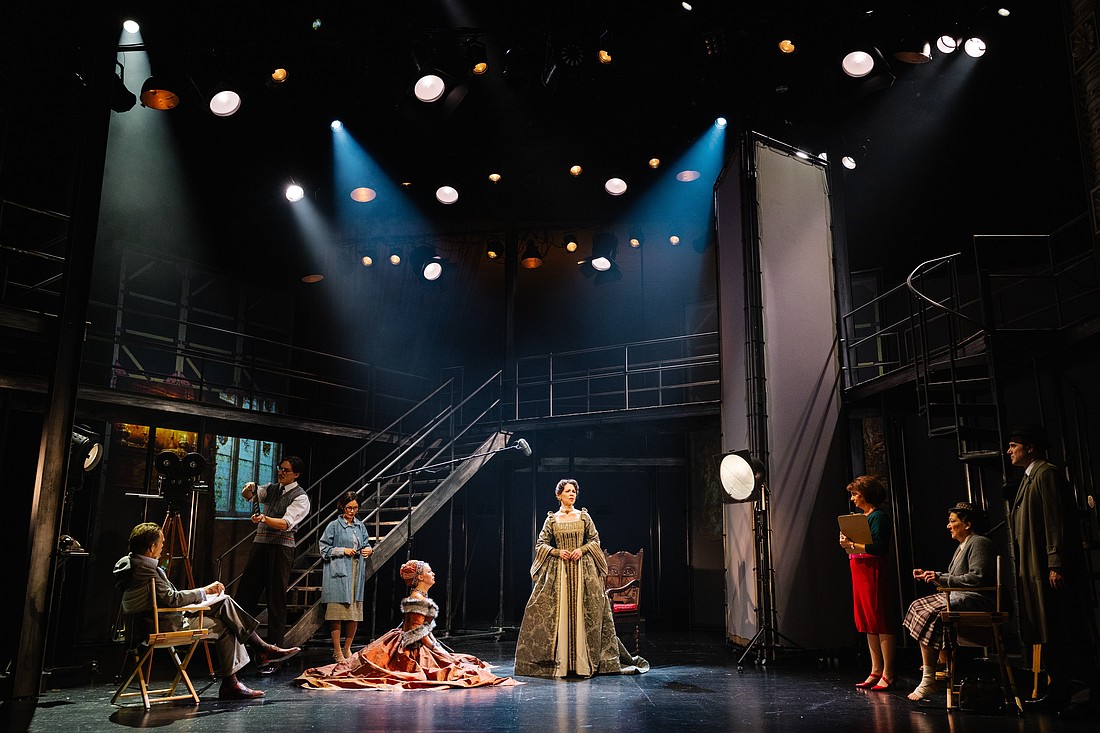
Rachel Wagstaff’s “The Mirror Crack’d” is Asolo Rep’s latest production. Her adaptation of Agatha Christie’s novel unfolds in the early 1960s in an English village — which happens to be a film location. A glamorous American film star disrupts small town life. When a guest is murdered at a charity ball, that’s even more disruptive. Fear not! Miss Marple is on the case — in her first theatrical appearance, no less. Michael Donald Edwards is directing, and it’s not his first rodeo. He’s the company’s former producing artistic director. Now he’s thrilled to return. What did Edwards find on the other side of the cracked looking glass? Here’s his take.
(Asolo Repertory Theatre Producing Artistic Director) Peter Rothstein wanted me to direct an Agatha Christie stage adaptation, and I’d never done one before. We looked at many titles — and Rachel Wagstaff’s play caught my eye. It was a brand-new adaptation, and that gave me room to reinvent it. So, I read the original novel and really liked it — and I liked the play as well. I’d never seen the movie, so I came to it with fresh eyes. Diving into this material has been thrilling.
She was a great observer of people. She dealt in strict parameters and classic tropes, but nobody was what they appeared to be. Christie had her thumb on human nature. We all project personas — socially, economically, politically. Beneath all of that, people are always more complicated. Christie knew it — and Miss Marple did too. There’s a moment where someone tells her, “You’re so clever.” She replies, “I’m not clever. I just know what people are like.” That’s profound. Christie understood that terrible behavior isn’t alien — it’s terribly human.
Very much so. She published her novel in 1962, when England was still recovering from the war. The aristocracy couldn’t afford great houses anymore. There was a housing shortage, a baby boom, and huge social and economic upheaval. That’s all reflected in the world of this mystery.
No, it isn’t. And that’s what she observed in this time. Christie was always interested in what was happening in society, though she’s often labeled as a conservative middle-class woman. Her work is quietly subversive. She insists that no one is exactly what they seem. Do you know what occupation she had listed on her passport?
She identified her profession as “housewife and mother.” I love that! To me, that’s definitely subversive. Christie was one of the 20th century’s most influential writers. But she refused the label of “author,” and didn’t present herself as extraordinary. I think that’s fascinating.
Yes — I was shocked by that. Everyone knows Miss Marple, but always through novels, films, and television — not theater. Wagstaff’s adaptation really claims her for the stage. She represents one of Christie’s most powerful ideas: the underestimated woman. That’s not just a mystery device — it’s her character. Miss Marple deliberately uses her age and social invisibility to disarm people.
That’s revealed in the piece, but I’m not telling you now. The audience needs to experience it and decide for themselves.
It’s largely driven by women — and that trope of the underestimated woman is central to Christie’s work. Poirot is underestimated too, in a very different way — or Columbo, for that matter. But Miss Marple is the classic example. She doesn’t solve her mysteries through cleverness. It’s all about perception.
Well, there’s a murderer on the loose, so that immediately puts the small town in a state of anxiety. Everyone stands in some relation to the crime. The characters might be innocent or guilty, but they’re connected in ways they’d rather not reveal. In a way, everyone must prove they’re not guilty. As the investigation proceeds, everyone with something to hide becomes nervous. They’re all under pressure — and that’s the mood.
I begin by knowing exactly what’s going on. I’ll then make sure the audience understands the story and each character’s narrative purpose. The clues must be clear, but not obvious. Maintaining that balance is always a challenge with a mystery.
It’s about casting well and giving the actors the tools they need to keep all those balls in the air. Our cast is presenting a living puzzle for the audience to solve. But they’re also deeply focused on who their characters are — their histories, their personalities and their places in postwar British society. Each actor must figure out who they are in the story and how they function within it. It’s a heavy load! But they’re excited by the challenge.
Design is critical. One of Rachel Wagstaff’s smartest choices was setting two scenes in a film studio, which doesn’t happen in Christie’s novel. Embracing that design choice gives us enormous imaginative freedom. Using the set itself as a film studio lets us tell the story in a more expressionistic, cinematic way.
Yes, exactly. This play moves very fast. That sense of being a few steps removed from reality pulls the audience into the action.
It’s been wonderful. During tech rehearsal, I told everyone that I felt surrounded by excellence and competence. Now that we’re in production, what I feel is a mix of nostalgia, pride, and excitement — and it’s a great feeling. Focusing on nothing but the work itself has also been a joy.
I hope theatergoers will get caught up in the mystery and actively try to solve it. By the end, I hope they’ll feel exhilarated — and that their moral assumptions will have been expanded a little. That’s what Christie does best.