- February 25, 2026

-
-
Loading
Loading
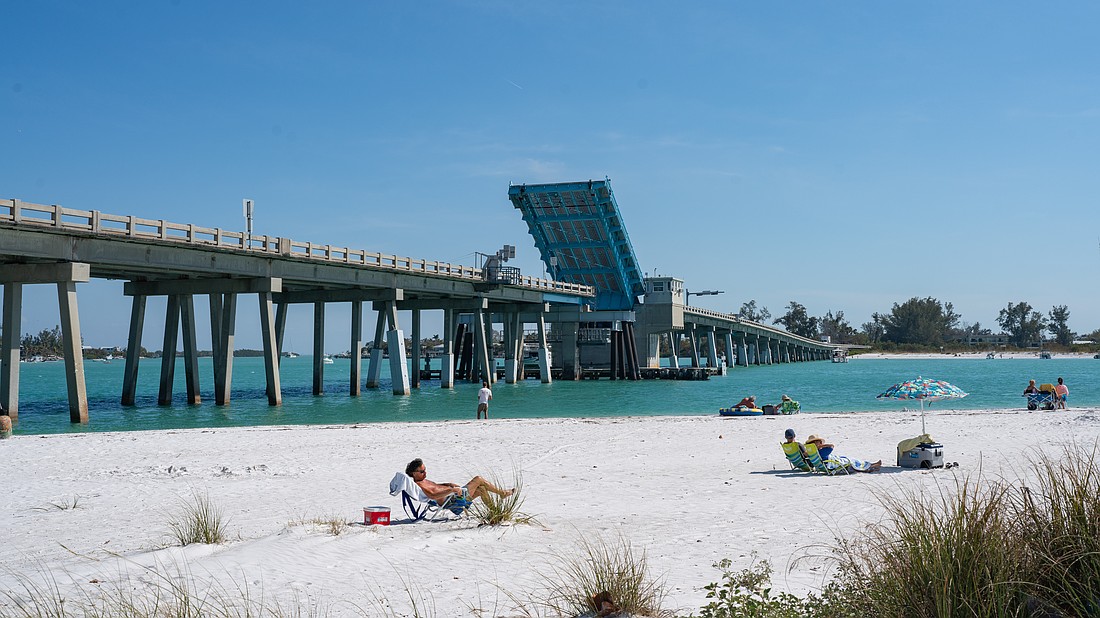
Leaving Longboat Key from the northern end will look much different in the coming years as two bridges on that route are set to be replaced.
One, though — the Cortez Bridge — is a lot further along in the replacement process than the other. With construction of the new bridge connecting Bradenton Beach to Cortez set to begin this year, drivers will be traveling on a new, fixed-span bridge in no time. Well, maybe “no time” isn’t the best phrasing … FDOT expects construction to take 1,200 days or 40 months. That would put its completion in fall 2029 at the earliest.
The Longboat Pass bridge has neither a finalized design nor construction funds secured, but public meetings scheduled in March could reveal what a replacement bridge may look like.
Both projects are years in the making and are huge investments. With costs reaching the nine-digit mark, bridges are meant to last at least five decades.
As Longboat Key Assistant Town Manager Isaac Brownman put it: “You don’t build bridges every day."
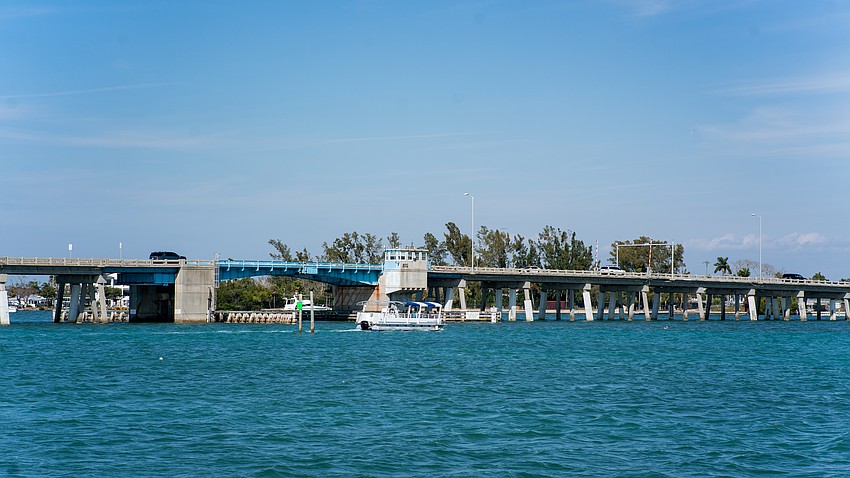
Built in 1956, the Cortez Bridge drawbridge turns 70 this year.
That’s two decades past its intended design life, according to an FDOT public meeting summary.
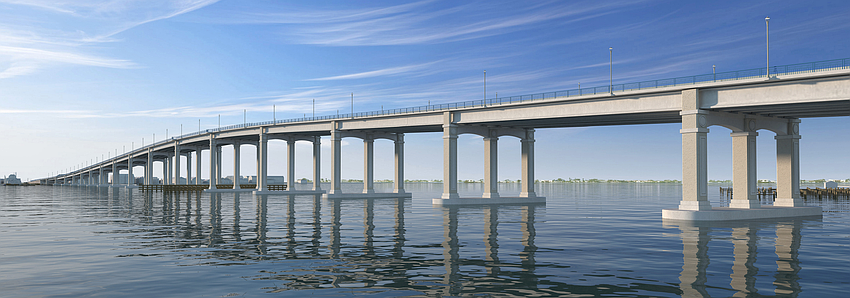
After years of studies and public meetings, FDOT selected a design for the project: a fixed-span bridge with a 65-foot clearance. The design phase of the project cost $6.7 million and is now 100% complete, FDOT spokesperson Patricia Pichette said.
The width of the bridge will increase from 37 feet, 5 inches wide to 68 feet, 3 inches wide. Despite the nearly doubled width, the number of vehicular traffic lanes will not increase with one eastbound and one westbound lane, each 12 feet wide. The width of the sidewalk, however, will double from five to 10 feet, and 10-foot shoulders and 1 foot, 4 inch wide concrete barriers will separate the sidewalk and travel lanes.
A bridge aesthetics committee — made up of Bradenton Beach and Cortez representatives from marinas, restaurants, an art studio, condo complex, a mobile home park and the Bradenton Beach mayor — held 11 meetings to come up with aesthetic design choices for the monumental bridge. Through that process, the group selected design elements such as pedestrian overlooks, a wave-patterned railing, a beachy color palette, multicolumn support structures and lantern-style lighting fixtures.
Next up is the bidding process for the project to construct the 0.9-mile project. That process begins March 25. Construction typically starts three to six months after, Pichette said.
The total cost of the project is not finalized until a bid is accepted, but FDOT spokesperson David Scarpelli said the bridge is expected to cost $135.3 million.
The existing drawbridge will remain open during construction as the new bridge is constructed just to the north of the current bridge.
“In the first phase of construction, traffic will continue to utilize the existing bridge while over half of the proposed bridge is constructed,” Pichette said. “After the first phase of construction is complete, traffic will be shifted onto the new bridge as part of the second phase of construction. Once traffic is on the portion of the bridge constructed in the first phase then the existing bridge will be removed.”
Connecting the barrier islands of Bradenton Beach and Longboat Key, the Longboat Pass drawbridge was built in 1957.
Now 69 years later, FDOT is looking to replace the bridge.
Longboaters are closely watching what design the state agency will choose. Public meetings in March 2024 included three design options: a 23-foot drawbridge, a 36-foot drawbridge or a 78-foot fixed-span bridge. One design option drew some criticism from residents and town leaders: the fixed-span bridge.
After the public meetings, the Longboat Key Town Commission penned a letter to FDOT stating its preference for a drawbridge, writing that Longboat is one of the few remaining residential communities immune to high-rises and has always been connected to its neighbors to the north and south by “modest drawbridges over relatively narrow passes.”
Publicly, FDOT has not yet revealed its preferred design, but newly published documents signify FDOT has a favored option.
“The proposed bridge is an undivided, two-lane high level fixed bridge (78 feet high) with one 12-foot-wide shared use path (SUP) on the southbound side and one 8-foot-wide sidewalk on the northbound side,” a preliminary engineering report states.
Why the fixed-span bridge? According to the engineering plan, the fixed-span design’s positives include less maintenance and continuous boat navigability. Fewer moving parts.
“The new structure will be designed to current FDOT and American Association of State Highway and Transportation Officials (AASHTO) design standards, providing a long-term, low-maintenance solution to replace the aging and operationally deficient bascule bridge,” the engineering report states. “In addition, the Preferred Alternative enhances multi-modal connectivity by including dedicated bicycle and pedestrian facilities on both sides of the bridge. The Preferred Alternative also enhances the reliability of the emergency evacuation route serving this area by eliminating bridge openings that currently restrict traffic flow during critical events.”
Another compelling reason is money. According to FDOT estimates, the two drawbridge options would cost $176 million and $183.8 million, respectively. The fixed-span bridge comes in more than $38 million cheaper with a price tag of $137.8 million.
“Obviously looking at these numbers, FDOT is preferring the high-span fixed bridge alternative,” Brownman said. “It’s just too much money for them to ignore in terms of the cost of building a drawbridge versus a high-span fixed bridge.”
The fixed-span design is a bit different than the design that was originally proposed two years ago, hence the “Preferred Alternative” terminology. Changes to the tentative design include a reduction in the width of the bridge from about 76 feet to 63 feet that includes a 12-foot-wide, barrier-protected shared use path on the west side of the bridge and an 8-foot-wide, barrier protected sidewalk on the east.
“These facilities improve connectivity to local points of interest, including parks, recreational areas, and residential neighborhoods, while providing safe and accessible routes for all users. The 12-foot-wide SUP and 8-foot-wide sidewalk represent a significant improvement over the existing bridge, which only provides narrow sidewalks (5 feet wide) with no bicycle accommodations,” the engineering report states.
Don’t expect to see a towering bridge on the north end of Longboat Key anytime soon, though. The project is wrapping up the Project Development and Environment portion, which comes before design and way before construction. And there is no money secured for construction. Brownman said the only timeframe he is aware of with this project is that it’s in FDOT’s 2050 long-range plan.
“None of us will be here by the time this is finally put in the ground,” said Town Commissioner BJ Bishop.
An in-person public meeting and a virtual public meeting are scheduled in March to gather input from interested residents. The in-person meeting will be held at 5 p.m., March 12 at Christ Church of Longboat Key, and the virtual meeting will be 5:30 p.m., March 17.
“I think one of the questions that came in is does FDOT recognize the significance of this to the town and the residents, and the answer is yes because they personally called (Town Manager Howard) Tipton and I to tell us this news before this information went out. They knew how Longboat, especially on the north end, may feel about this,” Brownman said. “They wanted to get this information out to us and alert us that there will be public meetings where they’re going to take in input from our community, Manatee County, etcetera.”