- April 4, 2026

-
-
Loading
Loading
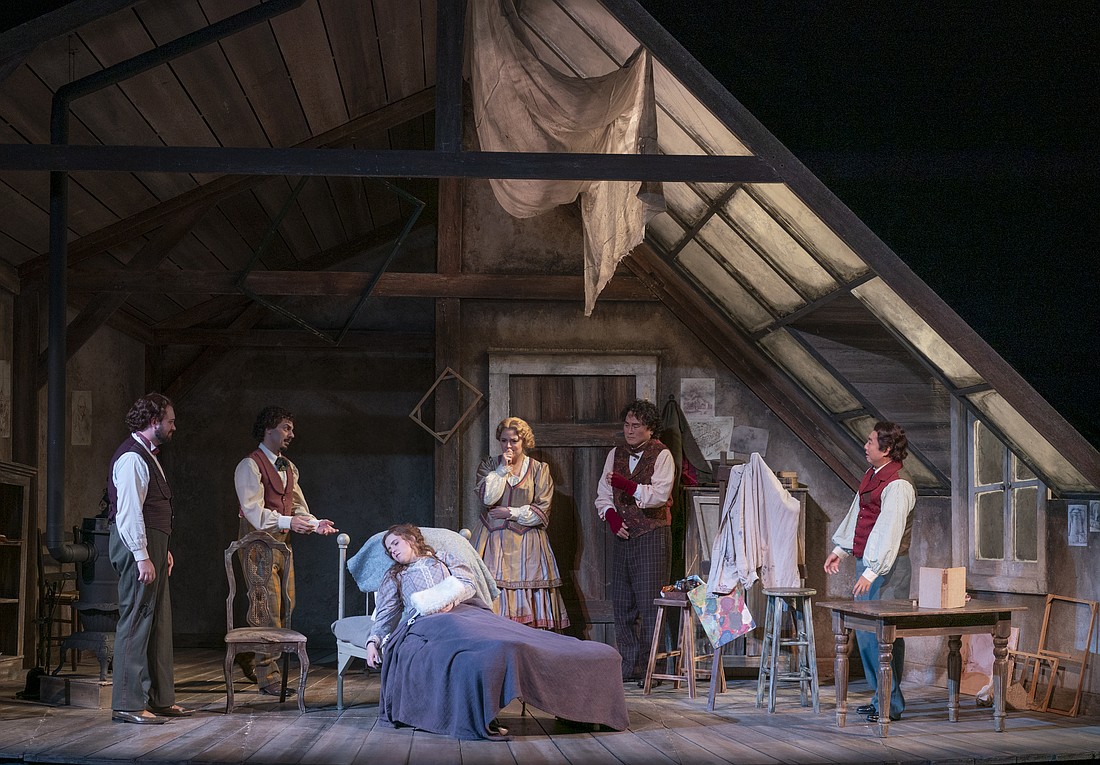
Sarasota Opera’s opening Winter Opera Festival production, “La bohème," provided warmth and deep feelings, as a gathering of longtime friends should.
We all know the score and the story is now baked into our culture. Those who follow this company also expect a production headlined by the conductor/stage director duo of Victor DeRenzi and Stephanie Sundine to be true to the composer’s vision and opera traditions. It is a formula many know and have come to love.
I found this production remarkable in its emphasis on natural intimacy. This is a conversational libretto underpinned by a lushly emotional score capable of obscuring the efforts of the actors if overdone.
Rather than overplay the gooey sentimentality, each on- and off-stage decision brought it down to earth. This is just a story about a group of starving artists looking for love and getting by.
Those friends, a solid cast of singer-actors, were likable and believable. WooYoung Yoon and Filippo Fontana, the struggling roommates Rodolfo, the poet, and Marcelo, the painter, remained jovial as they burned a manuscript for warmth.
Joined by Young Bok Kim as Colline the philosopher, and Riley Findley as Schaunard the musician, this core four were determined to remain cheerful even while fending off their landlord Benoit (Brian Kontes). Playful and cheeky, they used their wits to avoid paying bills while enjoying life at its fullest.
While this scene establishes a context and tone, the moment we all anticipate is when Rodolfo meets Mimi. We had already enjoyed WooYoung Yoon’s brightly ringing tenor in high spirits, but he softens in the presence of Ashley Milanese, a shyly coy Mimi.
Each in their signature arias, "Che gelida manina" and "Mi chiamano Mimi," along with the concluding duet assured us of their budding love with expressive nuance and even timidity, despite having voices that easily fill the hall.
When all gather in the square outside Café Momus in Act II, we are treated to the best this company offers. The colorfully busy stage is teeming with brightly clad townsfolk, frolicking children, vendors selling their wares. The set here is in stark contrast to the spare attic room in which we first met our friends.
At risk of sensual overload, this act packs in so many elements beyond the music and singing with an impressive tour de force of stage direction. Adult and youth chorus singers ably contributed their part to this energetic tableau. A single element gone awry could upset the balance.
We want to follow the cooing between Mimi and Rodolfo, but Marcelo’s old flame Musetta enters and brings all eyes to her. Virginia Mims proved every bit as engaging as she was last season as Despina in "Così fan tutte."
Her star moment as Musetta is the aria "Quando me’n vo," where her vocal flexibility, magnetism and fearless comedic flair nearly stole the act. It must be said she also had her sugar daddy foil Alcindoro, mugged perfectly by Hans Tashjian, to toy with. Her sparkle turned to an emotional depth coming to the fore in the later acts.
Fontana’s portrayal of Marcelo reveals more depth as well, when caught in the Mimi-Rodolfo drama. He is a versatile singer/actor as we have already seen in previous Sarasota Opera productions, and it was a delight to enjoy his duet work with both Milanese and Yoon.
Back in the garret for Act IV, his duet with Yoon’s Rodolfo, "O Mimì, tu più non torni," balanced reminiscence with reality, exhibiting earnest sincerity and a beautiful blend of their voices.
When Mimi returns to the garret all the friends step forward as friends do. Young Bok Kim delivers the philosopher’s emotionally devastating summation on passing youth, life and his coat in "Vecchia zimarra, senti" with an authoritative gravitas.
While vocal delivery remained on point, the Mimi-Rodolfo chemistry did not strike where one might wish. Still, Mimi’s dying moments were well played and Rodolfo’s anguish broke hearts beyond the stage.
Of course, everyone knew Mimi would die, but the totality of resources in this production took us to that moment with a minimal sense of artifice. Not to minimize the considerable vocal talents of our leads Yoon and Milanese, but this time, it felt real.
The immediacy, the moment, is a fragile thing that takes a unity of vision to accomplish. A polished orchestra, artistic leadership, the talented singers, chorus and production staff move heaven and earth so that those of us in the seats might catch our breath or shed a tear. There is much to appreciate here.