- March 19, 2026

-
-
Loading
Loading
Nearly every person who has spent time on St. Armands Circle — residents, tourists, locals guiding out-of-town friends and family — has a memory about the retail and restaurant mecca. A lobster dinner at a fancy restaurant. A pair of shoes bought with friends. An ice cream cone.
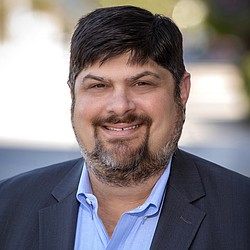
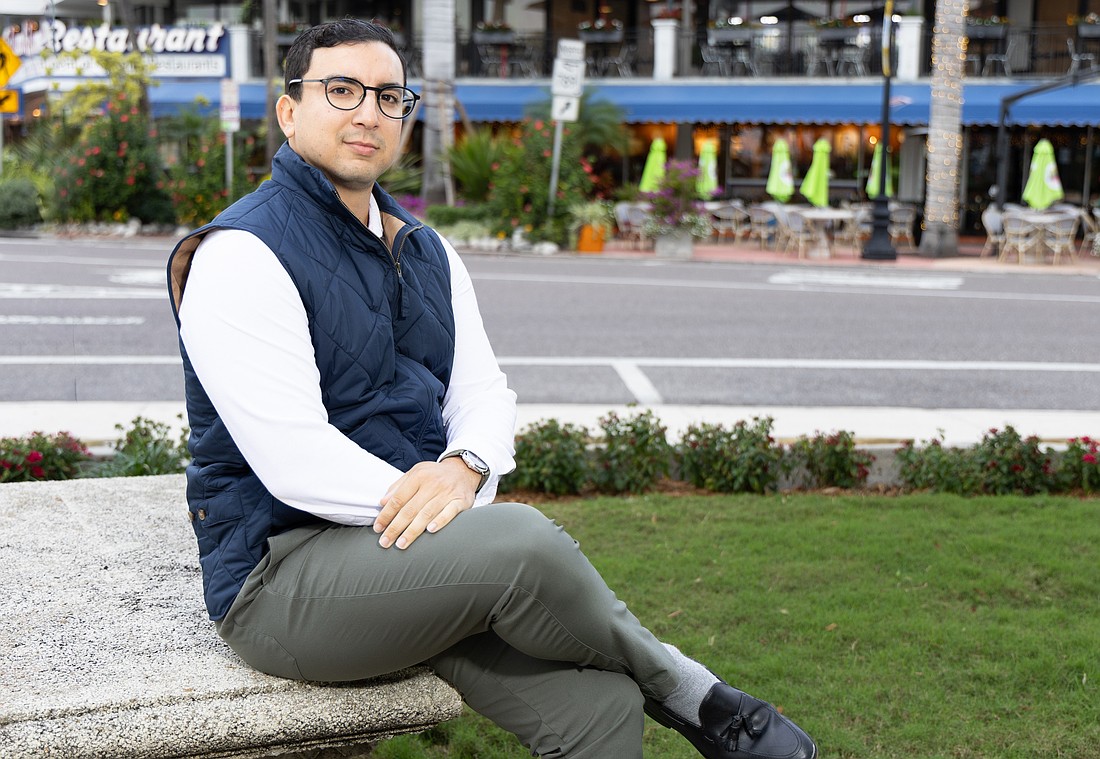
Sarasota resident and urban planner Philip DiMaria’s Circle story revolves around his parents. His dad was a police officer who worked at Ground Zero after 9/11 with the NYPD. The DiMaria family — young Philip was in elementary school — visited Sarasota for a much-needed vacation in 2002. His parents, in a not-so-unfamiliar story, loved the area so much they moved here soon after visiting. And in retelling their Sarasota origin story to their kids, they often cite the Circle as their favorite spot. “St. Armands is basically why my parents moved here,” says DiMaria, who attended middle school and high school in Lakewood Ranch and Sarasota, before going to University of Florida and graduating from Arizona State. Now, he’s a project manager with engineering, planning and design firm Kimley-Horn.
In the shadow of these memories, the Circle faces a conundrum: A trio of 2024 storms — Debby, Helene and Milton — led to a variety of flooding issues, causing millions of dollars in damage. Nearly every store was impacted. Some closed and reopened, others moved, others left for good.
While the Circle has flooded before, the crippling aftermath of those storms, and fresh memories, moved future structure resiliency to the top of the priority list for many connected to the Circle — store owners, landlords, city officials, residents and more. To cite one example, as 2025 came to a close, Sarasota city officials, backed by the town of Longboat Key, requested $24.5 million from Sarasota County to improve its resiliency to flooding; the money stems from Resilient SRQ, a $210 million federal grant the county controls.
The county ultimately granted St. Armands a little more than half that amount, $13.5 million. The funds are to be directed toward projects such as retrofitting pump stations and generators and installing tide check valves.
Into this breach steps DiMaria.
He chose St. Armands Circle as his topic for a 10x10 presentation last fall. Held at the Sarasota Art Museum and organized 15 years ago by local architect Michael Halflants, 10x10 events are buzzy and well-attended. They are designed to be a quick glance at a person, place or issue in the community. The gist: 10 community leaders get five minutes to present 10 slides. Each slide is up for 30 seconds.
For the Sept. 25 10x10 event, DiMaria chose St. Armands — and his 10 slides detailed a three-step resiliency plan. “I wanted to get this out in the community and say ‘we really have to do something there before (flooding) happens again,’” he says. “The storms (of 2024) offered the perfect opportunity for us to re-examine St. Armands. It would be a shame if we didn’t do something with this opportunity.”
DiMaria and his firm have done some work for clients on St. Armands. The firm also bid, unsuccessfully, on a St. Armands roadwork project the city put out a Request for Proposals on. Beyond that, DiMaria recently worked on a comp plan for St. Pete Beach and has worked on resiliency projects in Pinellas County. DiMaria’s St. Armands ideas even go back to New York, where he analyzed how the city responded to Hurricane Sandy in 2012. “I was aware of and studied these concepts,” he says.
In an interview with Key Life a few months after his 10x10 presentation, DiMaria stresses his slideshow is a theory, not a total solution, and the ideas are based on his experience, not for a client. He realizes there will be naysayers, especially in Sarasota, where just about every project proposal seemingly draws some kind of opposition.
That context is key for the first step: Because St. Armands is basically built in a bowl, DiMaria says it’s crucial to floodproof the buildings. The problem is how. Lifting everything on stilts is a hard no, for that, he says, would ruin “the retail experience.”
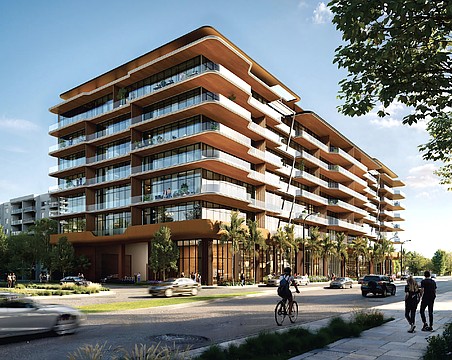
A solution, DiMaria points out on one slide, is to go up. That means raising the sidewalk elevation 2 to 3 feet and the base flood elevation of the current buildings 7 to 8 feet. A few developers have recently floated the idea of three-story buildings on St. Armands — and were met with heavy pushback. So DiMaria knows going up is a big ask for many on the Circle. “The key challenge,” he says, “is how do you incentivize people to raise the infrastructure? You have to find a solution to that.”
The second step in DiMaria’s plan is to better utilize the city-owned, 521-spot parking garage on the Circle that opened in 2019. The garage’s occupancy dropped from 66% in 2024 to 25% in 2025, DiMaria points out on one 10x10 slide, and at the same time, shopowners and landlords are required by zoning rules to have on-site parking spots. That rule, what DiMaria calls “idiosyncratic zoning,” can be curtailed, he suggests, freeing up more space on the Circle for resilient building improvements. And that parking, he says, can be shifted to the underused garage.
The third step in DiMaria’s plan is to activate and reinvest in the Circle. In a go-big-or-go-home moment, this step includes building an observation deck on the Circle in the middle of St. Armands. He’s inspired by an observation deck in Seville, Spain, where you can walk around and see multiple views. With the Gulf around multiple Circle corners, a viewing area, to DiMaria, is a no-brainer. “I know it’s a bit out there,” he says, “but there is such a unique opportunity here to be as creative as we want to be.”
At least one St. Armands leader, Rachel Burns, executive director of the St. Armands Circle Association, disagreed with some of DiMaria’s 10x10 presentation, especially with his views on the parking garage and zoning. Burns, whose husband, Jason, owns a restaurant on the Circle, Lynches Pub, spoke with DiMaria about those issues after the 10x10 event.
But while they differ on specifics, they agree St. Armands is a jewel worth the time and effort — and resources. “We have to look at priorities,” says Burns, who has been at the helm since 2021 of the 100-member association that supports commerce, merchants and events on the Circle.
DiMaria acknowledges he doesn’t have all the answers, while also acknowledging the axiom that “if you don’t change what you’re doing, you’re just gonna repeat the same mistakes.”
“There is a great opportunity here,” DiMaria adds, “for St. Armands to evolve and become incredible again.”