- March 19, 2026

-
-
Loading
Loading
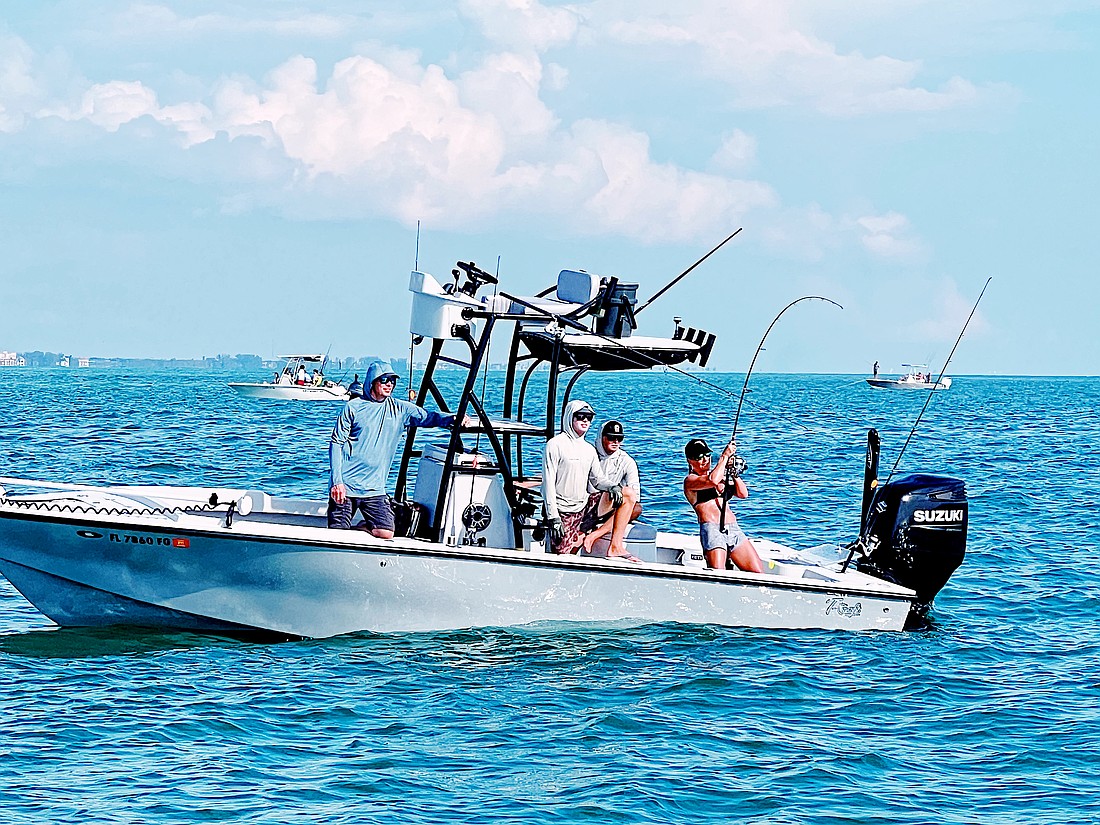
Following a six-month pause in the wake of damage to county park gulf and bay access boat launch facilities, the Sarasota County Commission on Jan. 27 unanimously approved implementing a pilot program that requires charter boat captains to purchase permits to operate at county-owned ramps and seawalls.
In June 2025, commissioners suspended the program to enable fishing and sight-seeing charters to recover in the aftermath of the 2024 hurricane season. On her last day as director of the county Park, Recreation and Natural Resources Department, new Assistant County Administrator Nicole Rissler said the issues that led to development of the program still persist in public parks where unauthorized charters have operated for decades, spiking in the Covid and post-pandemic years.
Those issues include passengers occupying limited parking spaces and conflicts with charter businesses that have followed requirements to lawfully operate in the parks.
Pre-storm ramp, bulkhead and seawall boat access remains reduced as the county continues recovery efforts — Nokomis Beach Public Boat Ramp and Loreto Court Bay Access remain closed — and lingering damage at other facilities has reduced capacity.
“We continue to see unauthorized or non-permitted activity within our parks. It happens everywhere. It's always going to happen,” Rissler told commissioners. “Our observations are it’s definitely down a bit, but when you have half of the seawall at Nokomis available, it makes sense that you're going to have less. We still receive complaints from citizens that there's no parking at Nora Patterson, but nobody's in the park because everyone's taken up the parking because they're on boats.”
To remedy that, commissioners approved implementation of the program adopted in October 2024, only instead of 124 permits — or medallions — they reduced that number to 60. Medallions are obtained through a bid process that begins at $1,200 but is anticipated to go much higher. Rissler presented a program revenue scenario at upwards of $5,000 per medallion. Operators would also be limited to two permits for the North Zone and two for the South Zone. The Mid-County zone of Nokomis Beach Park and Loreto Court facilities are not included in the one-year trial run.
Charter operator permit program permits per zone | |||
| Park | Original Plan Permits | Current Plan Permits | |
| North County Zone | Nora Patterson Park | 20 | 20 |
| Turtle Beach Boat Ramp | 17 | 10 | |
| Mid-County Zone | Nokomis Beach Park | 25 | 0 |
| Loreto Court Bay Access | 3 | 0 | |
| South County Zone | Snook Haven Park | 21 | 0 |
| Indian Mound Park | 11 | 5 | |
| Marina Park and Boat Ramp | 7 | 5 | |
| Nokomis Beach Boat Ramp* | 20 | 20 | |
| Totals | 124 | 60 | |
| *Moved from mid-county to south ounty designationc | |||
A small number stakeholders told commissioners that it remains inappropriate to place an additional financial burden — or completely run out of business — charter operators as the tourism-attracting industry continues to struggle toward recovery.
Sherman Baldwin, who served on the commission-appointed summer 2024 task force to draft a county policy, appealed for further delay of the program. Although he opposed the framework, he did vote in favor of the final draft because it was “watered down” from earlier versions.
There is less of a problem today, he said, because there are fewer operators.
“Even in that form, I believe it placed real financial pressure on small, independent operators,” Baldwin said of the approved policy. “The charter fishing reservations are down close to 70% still, 40% to 60% of small charter operators actually are gone — boats sold, businesses shuttered, livelihoods lost. The problem this policy was designated to address largely no longer exists. Reintroducing this now is not thoughtful governance. It is disconnected from grounded reality.”
Anticipated RevenueAs with any government-operated program, there are revenue and expense considerations. Here are revenues anticipated by minimum permit and anticipated permit bids. | ||
| Minimum | Anticipated | |
| Annual per-vessel permit | $1,200 | $5,000 |
| Vessels | 60 | 60 |
| Estimated gross revenue | $72,000 | $300,000 |
| Estimated tax | -$5,040 | -$5,040 |
| Estimated net annual revenue | $66,960 | $294,960 |
Estimated expenses | |
| Expense | Cost |
| Full-time equivalent employee | $112,476 |
| Contract services | $80,000 |
| Vessel medallions | $1,000 |
| Communications | $4,000 |
| General supplies | $2,000 |
| Uniform | $500 |
| Signage | $2,000 |
| Park/program enhancements | $5,000 |
| Total | $206,976 |
Retired captain Johnny Walker, the middle of three generations of charter operators, said the industry is already burdened by required state and local licenses, fees and taxes.
“It's getting to where their profit margin is not very much. When I first started, there were no controls like that. You just fished, there was no problem and you could go from anywhere you wanted. There are these rules now where you can't pick them up here and you can't pick them up there. I don't know how they're going to make it.”
Now approved, the timeline for implementation is two to four months for program development, a three- to four-month bid process and program launch three months afterward.