- March 19, 2026

-
-
Loading
Loading
A little more than a year after feeling the double wallop of back-to-back hurricanes, the Sarasota Sailing Squadron is rebuilding. And few are better suited to judge its progress than a Boston sailor in town for a December weekend.
“It’s incredible,” Cole Constantineau tells Susan Clark, the general manager of the squadron, as he works on his Viper class sailboat two weeks before Christmas.
“Have you seen the club?” she asks him.
“I haven’t been in yet.”
“Go!” she says. “You’ve got to see it.”
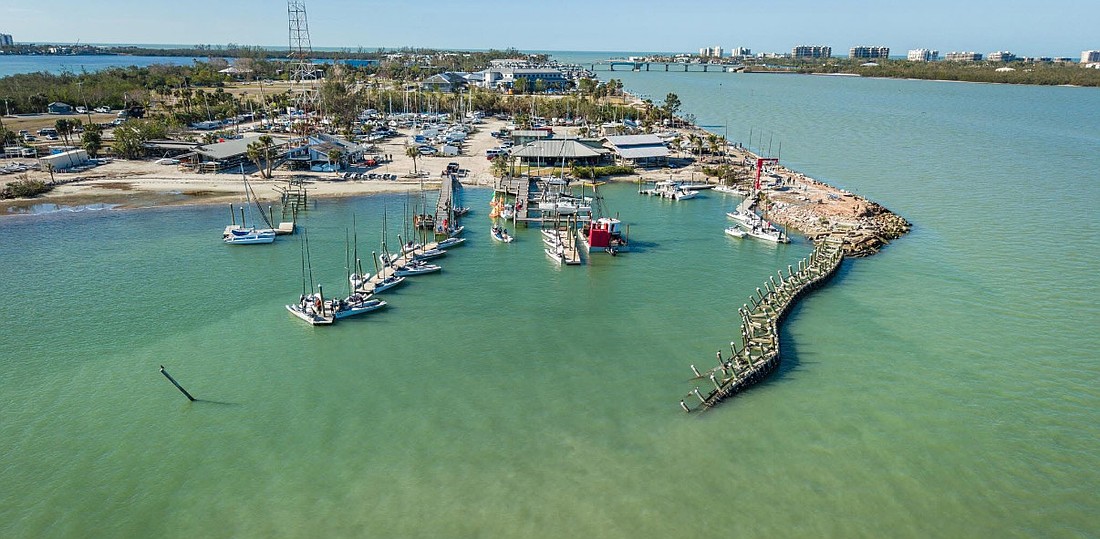
The members-only Sarasota Sailing Squadron sits on a 6.2-acre stretch of land on the tip of City Island. It’s easy to spot from the water on Sarasota Bay but a bit tougher from Ken Thompson Parkway. One way to tell you’ve reached it by land is finding the lot packed tight with sailboats.
The squadron, says Clark, has made great progress since facing the fury of Hurricanes Milton and Helene in 2024. That left about $4 million in needed repairs. The progress for the organization, with a mission to promote the sport of sailing and other non-motorized water sports with instruction and education activities, can be seen in multiple ways.
Financially, for one. It has restructured as a 501(c)3, which became effective Jan. 1, and it recently received a 30-year lease extension on its property from the city of Sarasota.
Physically, it’s come a long way, too. Its damaged docks have been repaired; its clubhouse has been redone; and new digital systems have been put in place to back up records, among other work.
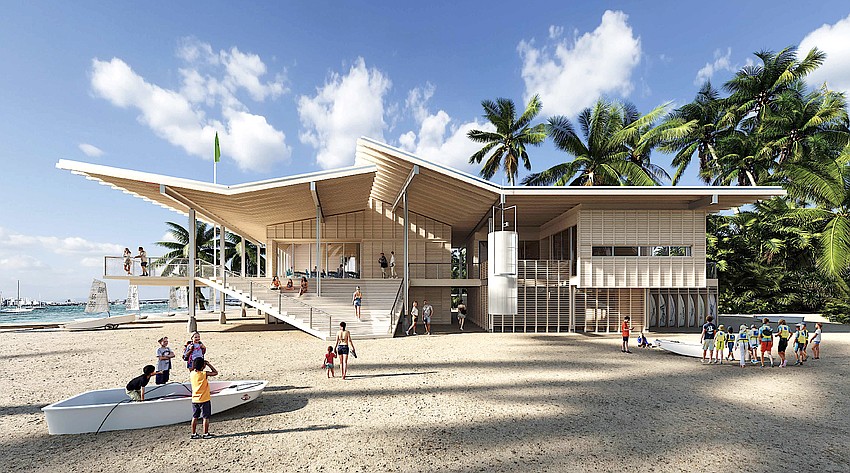
But walking around the property, one can still see there is debris in certain spots; some of the docks and pilings remain in need of repair or replacement and the building for the Sarasota Youth Sailing awaits city approvals to be rebuilt.
(Sarasota’s Planning Department in December delayed a hearing on the plans for the sailing school. Despite that, Dustin Domer, the executive director of the youth program, says new software systems are being put in place and that the plan is to soon start a capital campaign with the goal of raising $7 million.)
Of all the damage, the most noticeable is the wave fence that protects the basin from rushing water. It now stretches out into the bay twisted, folding into the water at its outer reach like a strand of DNA. There are studies being done to see how best to repair it, and the cost could top $1 million, says Clark.
A big help to fuel, and fund, the remaining work and prepare the squadron for its future was earning the 501(c)3 status, an IRS designation allowing it to operate as a tax-exempt organization for public benefit.
The squadron had been a 501(c)7 before — a tax exempt status for social clubs, according to the IRS.
Clark says the new designation will help with the fundraising and, eventually, help fund youth and other programs she has in mind.
Members had been discussing the change for several years, but the hurricanes “really set it in motion.”
Walking around the squadron property on a chilly Thursday afternoon in December, Clark, working with Facilities Manager David Hobbs on the repairs, is upbeat when discussing the progress the club has made over the past year.
She remembers the early days, soon after the hurricanes hit, sometimes not sure which of the two caused which bit of damage. But she knows Milton, a direct hit, was the most devastating.
“It was boom, boom, but it was the second one that did the most damage,” she says.
The squadron lost 28 boats, with one of its own winding up on Bird Key. The property was flooded under about 3 feet of water, destroying the clubhouse, bathrooms and club records. A crane had to eventually be brought in to clean up the basin.
Just how bad was it? There were “millions and millions of stainless-steel screws” spread out across the property because a repair shed was ripped out during the storm.
“I had to have members walk through every inch of this yard with a Home Depot bucket,” Clark says. And you couldn’t use a metal detector because the screws were stainless steel. “No, they had to pick up everything by hand.”
It took months to find them all — assuming some are not still embedded in dirt somewhere.
Clark says that in the initial aftermath, membership suffered but has bounced back over time. Since the storms, members have logged more than 70,000 hours of volunteer time helping restore the property. “It was them that got us up and running.”
But to get a sense of just how far the squadron has come, one needs to go no further than Constantineau.
The Boston sailor is part of a Viper club that comes out to the squadron each December to compete in a regatta.
The group showed up in December 2024, about two months after Milton, unsure of what it would find.
“We were like, ‘There’s no way the squadron is going to pull this off,’” he says.
What the Viper club found were boats scattered all over the property, the destroyed clubhouse and screen doors that were still down. The docks, disconnected and floating around, had been taken over by birds and there was splintered wood and nails everywhere.
Worse, a crane that helped put the boats into the water was inoperable. There was a crew working on it, but the alternative would have been to put the boat in the water by car at a boat ramp. (It was repaired in time for the regatta.)
But sailing is a community, an oft-repeated message, and Constantineau and his fellow sailors pitched in to help with what they could while in town.
A year later, he was back at the Sarasota Sailing Squadron for another regatta. Clark stopped to chat as he did some work on his boat, still on its trailer. They talked logistics for the race weekend, and she let him know there would be a live band Friday night and a lighted Christmas boat parade Saturday.
Looking around, there were obvious signs of work that remained: a grill area to be rebuilt, the wave fence in need of repair. But for these two, at least, things were far on the way, if not all the way, back to normal.
“Now look at it,” Clark says.
“Yeah,” he answers, “it’s good.”