- April 9, 2026

-
-
Loading
Loading
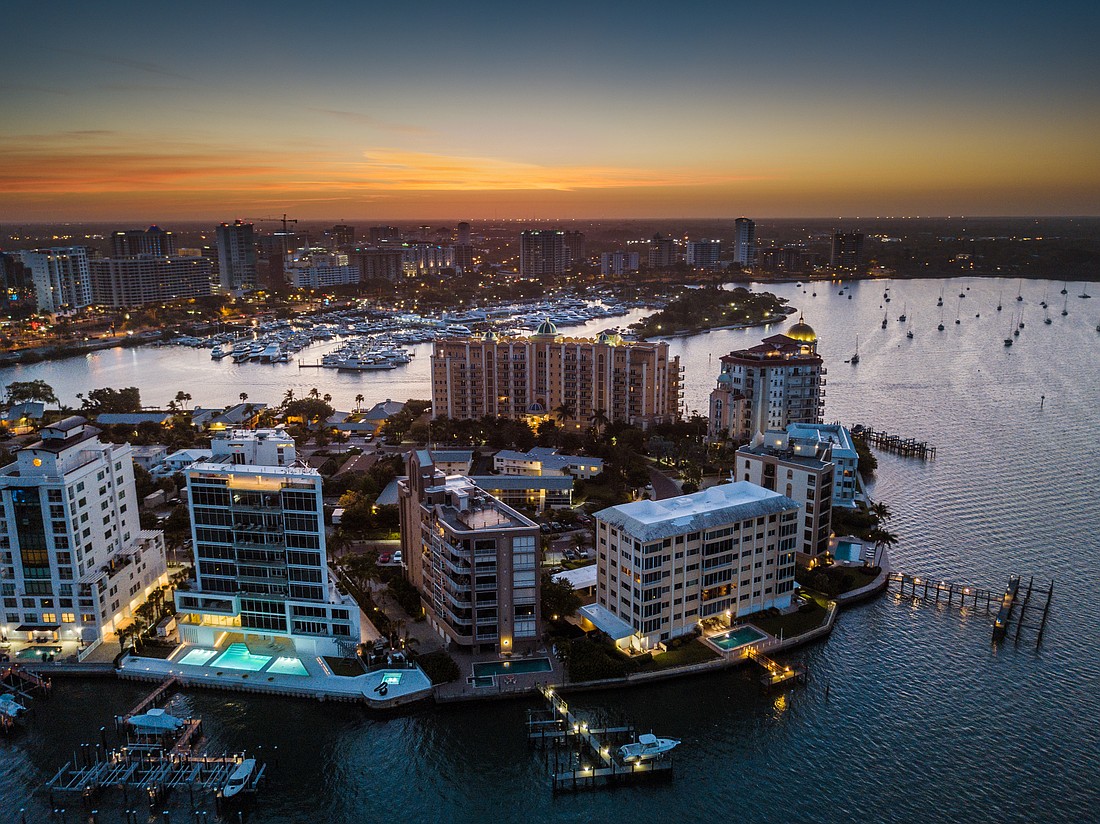 Photo by Jin
Whether the Florida Legislature approves placing a constitutional amendment referendum to fundamentally transform property taxes on the statewide ballot remains anyone’s guess. And even if so, whether it reaches the 60% voter approval threshold to be enacted is also unknown.
As former Sarasota City Commission candidate and regular meeting commenter Martin Hyde said at the commission’s March 23 meeting, “They couldn’t pass legalizing pot.”
Still, prudence dictates local jurisdictions begin thinking about how they might respond to a referendum approval that takes a significant bite out of their annual budgets and how — or even if — they may be able to make up the difference.
In Sarasota, residential property taxes generate just more than half of the revenues that comprise the city’s general fund, the tranche that pays for a litany of essential services the city provides.
At their March 23 meeting, commissioners heard from Interim City Manager Jennifer Jorgensen and Director of Financial Administration Kelly Strickland about the potential impact House Bill 203 might have should it be taken up and approved by the Florida Senate in time to make the November 2026 general election ballot.
The 2026 legislative session has ended, but the Senate can still call a special session to take up the matter, or it could be added to the agenda of an already scheduled session called for April 20-24 on redistricting.
House Bill 203 was the only one of several possible property tax reform proposals to receive a vote of the full house, passing by an 80-30 vote.
The city’s property tax rate is 3.2730 mils, which means for every $1,000 in tax value, a homeowner pays to the city $3.27 in annual property taxes. That’s minus the $50,000 homestead exemption enjoyed by city residents and other exemptions available to seniors and handicapped.
Strickland warned some possibilities to make up for the gap in revenue — which had it been implemented in the current fiscal year would amount to as much as $23.5 million of the $57 million total generated by property tax.
She further cautioned raising some taxes to fill the void fall outside the allocation jurisdiction of the city.
“If the property tax goes away, and we need taxes to be able to still fund cities and counties, what do those taxes look like?” Strickland said. “It could be potentially a sales tax. Well, sales tax is monitored and run by the state, so you're taking the ability to pass that tax and monitor that tax away from local cities.”
With spending authority under the auspices of state government, Strickland said the city loses the autonomy to determine how that money is allocated locally.
“It takes away the uniqueness that each city and county has to deal with in their own community," she said. "If those decisions move up to Tallahassee, we lose that ability to make those spending decisions and revenue decisions that are important to our local community.”
Special tax districts will also be impacted. Residents of Golden Gate Point, for example, pay an extra millage rate for its streetscape special district, this year receiving $280,000. The Bay park tax increment financing district applies $1.5 million annually toward debt that supports development of the park plus another $1.7 million bond for future capital projects. The Newtown Redevelopment Agency received $575,000 this fiscal year in special millage revenue.
All would be impacted by property tax reform.
And repayment of bond debt, Strickland told commissioners, is not optional.
“So we would have to pay them from salaries or some other area of the city,” Commissioner Jen Ahearn-Koch remarked. “We would have to pay them no matter what, right?”
“We're not going to default,” Strickland confirmed.
Potentially further clouding the future financial picture of the city is the likelihood some part-time homeowners who have not moved their official residency from their home state may do so should property tax reform in some shape or form be implemented.
“If the homestead exemption grows exponentially, I would assume there might be some people who are currently non-homesteaded who would look to become homesteaded,” Jorgensen told commissioners. “If our current (homesteaded population) is 41%, we would probably figure that would go up with people applying for homestead if the exemption is so great it makes sense for them financially to do that.
“That's going to skew our numbers a little bit as well.”