- April 2, 2026

-
-
Loading
Loading
Homeowners associations and resident groups eager to have the state’s transportation department pay for landscaping upgrades on adjacent state-maintained streets or highways might someday have to pay those maintenance costs themselves.
Sarasota County commissioners last week asked legal staffers to look into the possibility of perhaps establishing specific improvement districts, with connected tax levies, to pay for such things as watering, pruning, mowing and fertilizing.
Right now, the county’s transportation department is on the hook for maintaining landscaping built on state roads “in perpetuity,’’ said county Director of Transportation Spencer Anderson. In at least one example recently, a proposed median-beautification project along about a mile and a half of U.S. 301 from Myrtle Street to University Parkway was scuttled by the state over the county’s refusal to pick up the maintenance tab.
Anderson said that state officials require maintenance agreements be worked out before Florida Department of Transportation will agree to install the first tree or shrub. Without such contracts, no landscaping upgrades are made.
Routine mowing of grass, though, falls to the county with state payments covering about 66% of the cost, Anderson said, with Sarasota County workers typically accomplishing the work at a higher level than what the state would provide.
But once an upgrade to landscaping is made, all of the work becomes county responsibility.
“We’re having a tough time applying resources to our required level of service as it is on county roads and the portion of state roads that we do maintain under contract, so we have not been receptive to those,’’ Anderson said.
Accounting for roadway-landscaping upkeep is another example of how county leaders are more broadly looking at controlling costs as part of early discussions leading up to this summer’s budget hearings. Required by state law to maintain a balanced budget and facing projected slowdowns in property value increases, Sarasota County leaders have aimed to limit spending next budget year, which begins Oct. 1, to 1.6% growth. By holding growth to around 3.6% into 2030, balanced budgets should be possible.
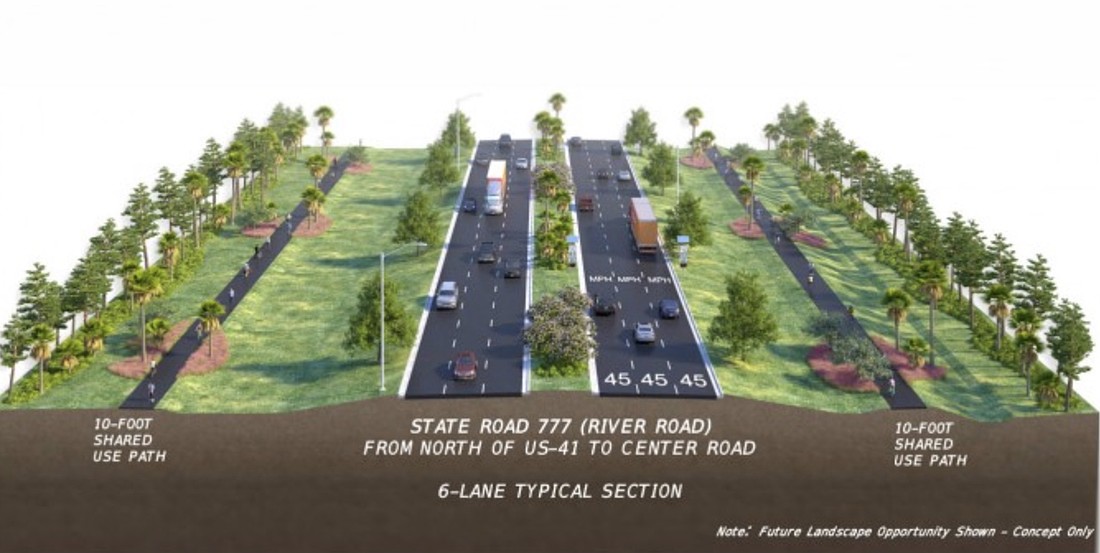
On a larger scale than the U.S. 301 proposal, designs for resident-requested and state-designed landscaping along a 6-mile stretch of River Road between Interstate 75 and U.S. 41 near Venice could change for the same reason. The county’s maintenance expenses for the proposed $3.2 million landscaping upgrades on that stretch were estimated at $420,000 a year in current dollars, Anderson said.
“It’s a pretty healthy construction project for landscaping, lots of trees, lots of shrubs in the median and on the shoulders,’’ he said. “So that was requested directly from residents along those subdivisions along River Road.’’
Similarly, a project on U.S. 41 in the Osprey area would add $60,000 a year to the county’s responsibility after the county already planned to spend about $700,000 to enhance landscaping along about a mile of highway.
“Construction is finite,’’ said Commissioner Mark Smith. “Maintenance is infinite.’’
Whether the establishment of an improvement district to cover ongoing landscaping costs is even possible is an open question, said County Administrator Jonathan Lewis.
“Funding-wise, we might have some problems creating a district on a state road where the associations already exist,’’ he said, adding the county’s legal staff will look into how and if such districts might work. Spencer said such a district could put the county in an awkward spot, acting as a middleman between the state and private citizens.
Though no projects required immediate action, county commissioners said they would wait to hear back on the improvement district idea on how proceed, potentially asking the state to scale back plussed-up landscaping plans in the future, or eliminate them all together, to curtail ongoing maintenance costs.
Commissioner Tom Knight recommended considering landscaping options more tolerant of Florida’s climate as one means of saving on costs.
Teresa Mast said in an either-or equation of spending money on years of maintenance or building new roads with no landscaping extras, the answer was simple.
“I’ve got roads to build, you’ve got roads to build, I love trees, I love to have things beautified, but I need the roads more than I need the trees,’’ she said.