- March 19, 2026

-
-
Loading
Loading
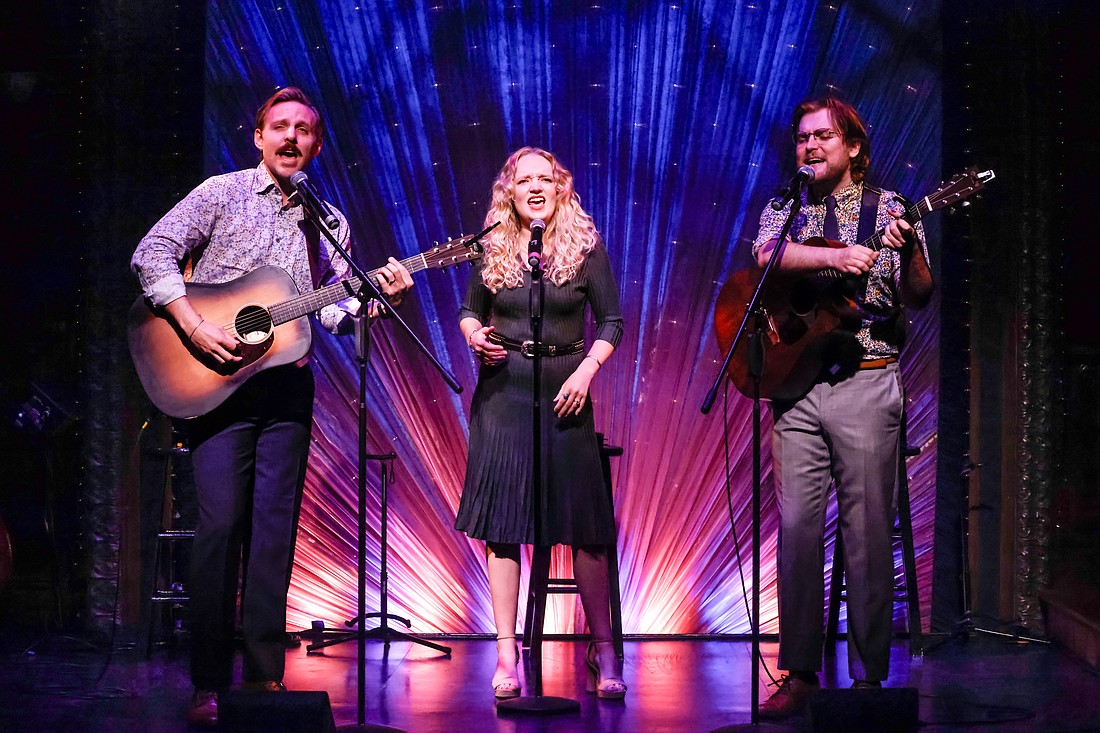
"A Band Called Honalee" is a magical, musical time trip at FST. The golden age of American folk is its temporal destination. The show’s packed with great tunes by “Peter, Paul and Mary... and friends” — but it’s not a musical.
“A Band Called Honalee” is a real band. Its musicians aren’t singing actors playing the parts of fictional characters or legends from the past. Here, they get to be themselves. And this show is their concert.
Brian Ott, Michael Grieve and Sigrid Wise take the spotlight on the FST cabaret stage. They’re an insanely talented trio. Ott and Grieve play dual lead guitars. All three sing. This lineup echoes Peter, Paul and Mary — without being an imitation. The band’s three rotating bass players stay outside the spotlight. (Bassist Bill Swartzbaugh performed on my night.)
A Band Called Honalee is the brainchild of Aaron Gandy. This music supervisor and producer (he spent nine years as assistant music director for Broadway’s “The Lion King”) created the band to keep the spirit of the 1960s folk revival alive. Evidently, he succeeded.
Wise, Ott and Grieve don’t approach folk music like a dusty artifact from the past. While they respect the folk tradition, they’re not slavishly deferential. They’re not a by-the-numbers tribute band serving up nostalgic fan service. They’re a trio of 21st-century folk musicians. They play from their hearts — and love what they play. They’re the real deal.
Folk music was hopeful in the early 1960s. The first act hits the right optimistic note. That resonates with the nostalgic crowd — who get permission to sing along.
The band opens with the hard-hitting “If I Had a Hammer.” Pete Seeger and Lee Hays wrote this song in 1949; Peter, Paul and Mary performed it at the Lincoln Memorial in 1963 during the “March for Jobs and Freedom” and it became an anthem of the civil rights movement, whose fellow travelers were often fans of what’s called “roots music” today — folk, gospel and blues.
“Hammer” is followed by another song of freedom — Bob Dylan’s pre-electric “Blowing in the Wind” (1962). The band’s guitars are acoustic but plugged into amps with suction-mics. Grieve points to the amps, and makes a joking aside about Dylan’s electrification, a controversial transition recently mined by Hollywood in the Oscar-nominated film “A Complete Unknown.”
After these initial political power ballads, the pendulum swings to the personal. Ott jokes that Peter, Paul and Mary’s “Lemon Tree” is “about unrequited love — and the ingredients of lemonade,” before launching into the bittersweet song, one of the lesser-known numbers in the band’s repertoire.
The Mamas and the Papas’ “I Dig Rock and Roll” (1967) is flavored with chart-topping snippets and gentle mockery of rich rock stars and their commercial compromises. (Wise winks on the line: “But if I really say it, the ra-di-o won’t play it.”)
One medley includes The Mamas and the Papas’ “California Dreaming” (1965) and The Beatles’ “Drive My Car” (1965). Wise’s sweet soprano rings out on “Both Sides Now” (1967). She never falters on Joni Mitchell’s high-wire act made famous by Judy Collins.
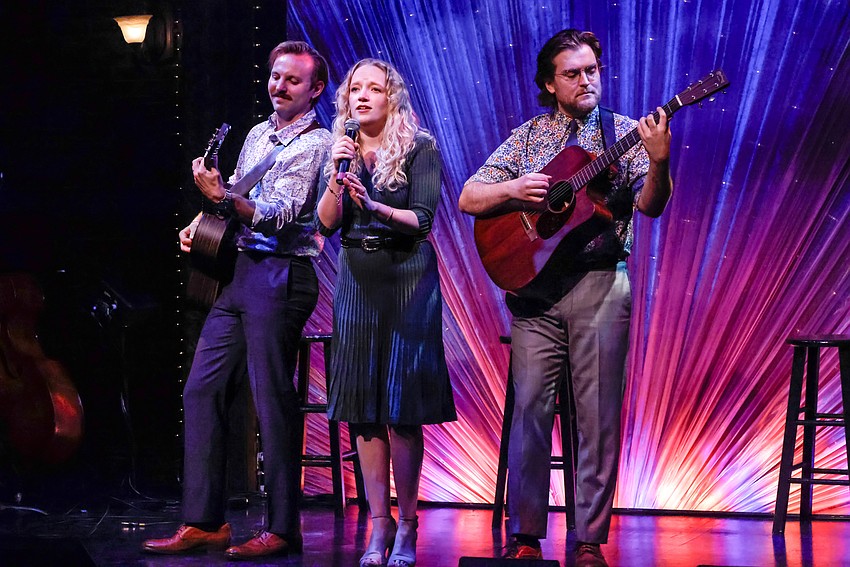
Grieve and Ott stand in for Simon and Garfunkel on “The 59th Street Bridge Song.” They get the whole crowd feeling groovy. Ott knows a little something about feeling groovy since he was recently on stage with FST’s cabaret, “59th Street Bridge” celebrating the music of Simon and Garfunkel and others.
“Leaving on a Jet Plane” (1969) was a hit for Peter, Paul and Mary — and a career boost for the songwriter, John Denver. The trio’s “Puff the Magic Dragon” (1963) sheds a tear for childhood’s end. (And gave the band its name.)
After 1965, the 60s counterculture hit the downhill slide. Folks across America were feeling less upbeat as American involvement in Vietnam escalated. Folk musicians were no exception. The second act reflects that vibe.
Bob Dylan’s “The Times They Are A-Changin’” (1963) celebrates the future victory of civil rights and the triumph of youth culture — and snarls at present-day resistance. Stephen Stills’ “For What It’s Worth” (1966) looks back in anger on LA’s Sunset Strip curfew riots. Young people marched, cops cracked heads, Peter Fonda got arrested and the authorities stripped the Sunset Strip’s clubs of youth permits.
When the public square becomes a battle zone, it’s easy to turn inward — which many did in the late 1960s. (Don’t protest, party! Or feel sorry for yourself.) A Mamas and Papas medley reflects that inward turn, weaving together “Monday, Monday” (1966), “Go Where You Want to Go” (1965) and “I Saw Her Again” (1966).
John Prine’s “Angel from Montgomery” (1971) looks homeward with sweet sadness. (Wise sweetly shares with the audience that she and Grieve were married in Montgomery, Alabama.)
When the streets get ugly, running away is another option. Two traveling songs evoke that breathless, homesick flight. Elizabeth Cotton wrote “Freight Train” in 1904. Her sad escape struck a nerve in the 1960s — when thousands fled their parents or the draft.
Hedy West’s “500 Miles” (1961) was a Peter, Paul and Mary hit — and another homesick odyssey.
The show’s last two songs are defiantly hopeful. Blind Willie Johnson’s “If I Had My Way” (1927) references Samson’s last stand. (Samson got a buzz cut. Like most longhairs, he took it badly.) Woody Guthrie’s “This Land Is Your Land” (1940) stakes a claim on the whole country. It’s all home. Why run?