- March 19, 2026

-
-
Loading
Loading

Cierra Dusenberry used to watch teenagers and young adults spend up to $80 a day on 7-hydroxymitagynine, commonly known as 7-OH, a recently banned opioid.
Dusenberry is the assistant manager at Wild Smoke Shop on State Road 64 near Interstate 75. The shop sells cigars, vapes, hookahs and an array of cannabidiol products and other supplements, including kratom.
7-OH is a concentrated form of kratom, which is a native tree in Southeast Asia.
When consumed in low doses, the leaves produce stimulant effects. In high doses, the leaves can act as a sedative and “can lead to psychotic symptoms and psychological and physiological dependence,” according to the Drug Enforcement Administration.
In July, Dr. Marty Makary, commissioner for the U.S. Food & Drug Administration, said in a press release that 7-OH can be more potent than morphine and recommended it be classified as a Schedule I controlled substance.
In August, Florida Attorney General James Uthmeier issued an emergency rule that made it illegal to sell, possess or distribute 7-OH in Florida. All products containing 7-OH were immediately taken off the shelves.
This month, Commissioner Amanda Ballard proposed also taking kratom and other “designer drug” products off the shelves in Manatee County.
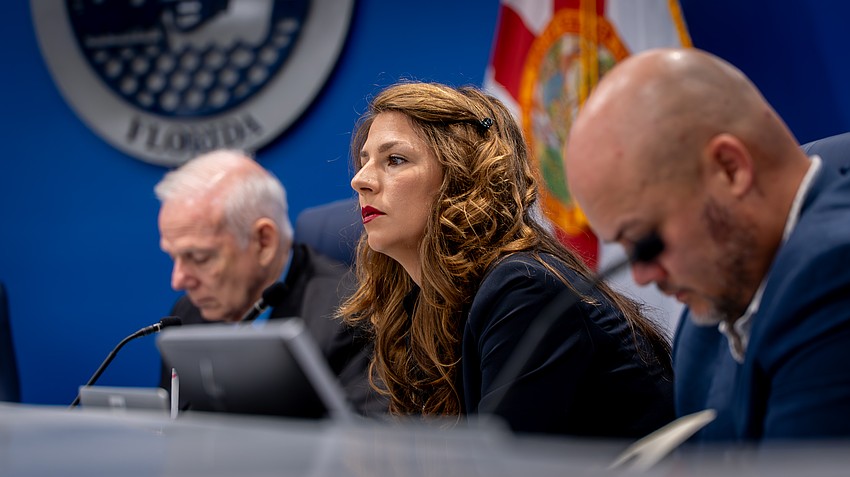
Commissioners voted 4-3 at the Sept. 2 commission meeting to direct staff to prepare a draft ordinance for the board to consider adopting.
Due to hesitancy from some board members, Ballard agreed to return with research studies and data on the effects of kratom to help better inform the commissioners when it comes time to vote next.
Sarasota passed an ordinance in 2014 that prohibits the sale and possession of “designer drugs,” which is a catchall for “any capsule, pill, powder, liquid, vegetative material, product or other substance, however constituted, including but not limited to any synthetic cannabis, substituted cathinone or kratom."
Sheriff Rick Wells wrote a letter to Manatee County commissioners Aug. 22 urging them to adopt the Sarasota ordinance “in its entirety” to streamline enforcement and take a unified regional approach to combatting the problem.
“Kratom, along with a growing list of synthetic and designer substances, poses a significant threat to public health and safety,” the letter reads. “As a law enforcement professional, I have witnessed firsthand the impact these substances have on individuals, families and our community.”
Wells' letter said the drugs cause addiction and unpredictable psychoactive effects.
Wild Smoke Shop sells kratom in several forms — powders, capsules, shots and seltzers. Dusenberry said the red strain is for sleep and sedation. Other strains are marketed as focus-enhancing and energizing.
Kratom was restricted to individuals 21 and older in July 2023. Dusenbury started working at the shop earlier that year, so she’s seen two waves of people being forced to switch from 7-OH to kratom. She described the effect as a “tapering off.”
“The 7-OH was getting out of hand,” she said. “I was okay with (that ban).”
Of course, it did result in a loss of revenue for the shop. If commissioners decide to ban kratom, Dusenberry estimates additional losses of up to 35%.

Commissioner Bob McCann is also a former emergency room doctor. He said he didn’t see issues with kratom in the ER. He saw several fentanyl and heroin overdoses.
Because kratom is currently a legal substance, he voted to deny the pursuit of any regulations.
Commission Chair George Kruse also voted in favor of denial. He doesn’t want to restrict people over the age of 21, and he questioned why a local ordinance is necessary in light of the state’s recent actions of banning 7-OH, the concentrated derivative.
Ballard said law enforcement doesn’t have the testing equipment to determine whether a substance is 7-OH or Kratom, so deputies are unable to effectively enforce the state law.
Ballard brought the issue to her fellow commissioners after a conversation with Judge Lon Arend, who has “significant concerns” about the impact kratom is having on the cases he’s seeing in drug court, specifically those of younger people.
Ballard said the Bradenton Police Department and the State Attorney’s Office are also in support of regulations.
“The ordinance in Sarasota has been in place for about 10 years; it’s battle tested,” she said. “It has done very, very well. I think it will go a long way in preventing some of these substances that are trying to be regulated at the state level, but what’s been done so far isn’t addressing the issue in a way that can be used at an on-the-ground level.”
A date has not yet been set for a final vote on the matter.