- March 19, 2026

-
-
Loading
Loading
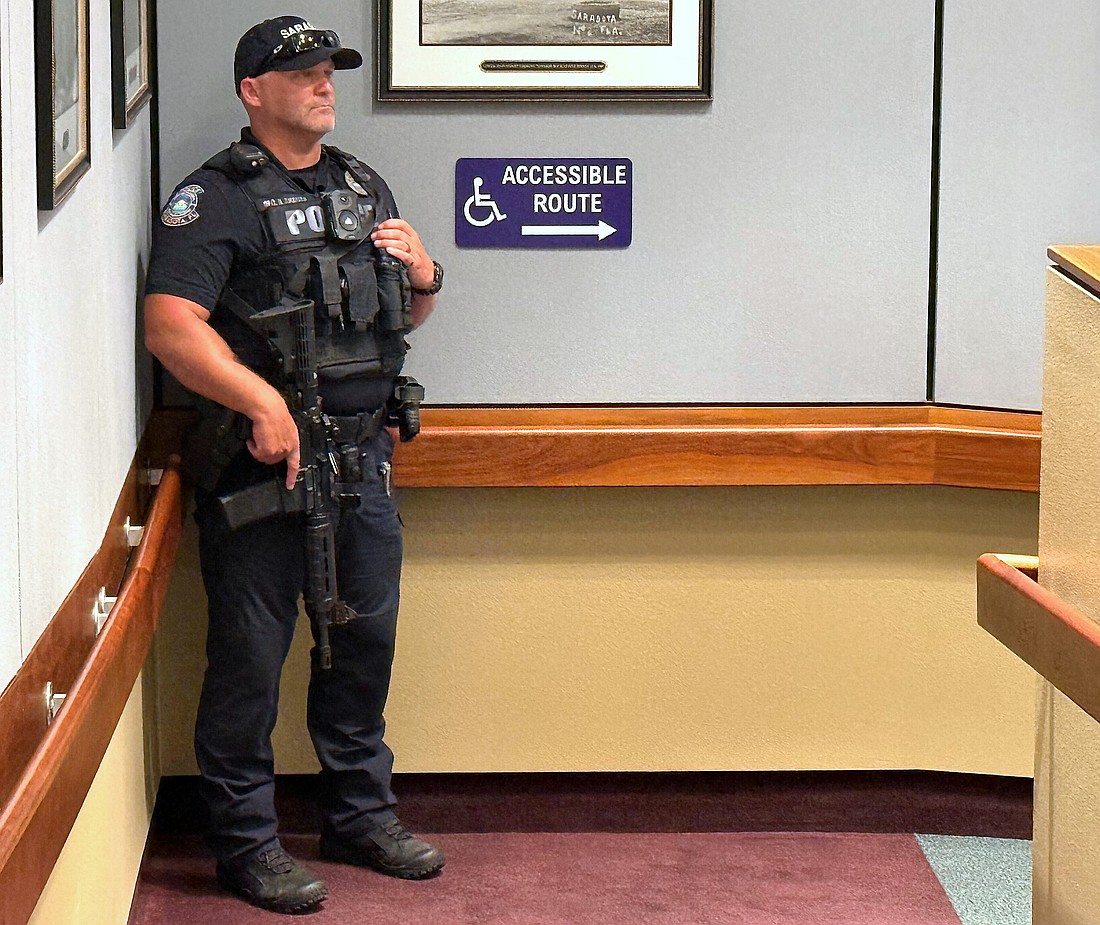
Sarasota residents attending City Commission meetings may be surprised to see extra security in the form of an officer posted in the meeting chamber clad in tactical gear and holding a long gun.
He isn’t there because of a specific threat or, for that matter, any threat at all. For the time being, at least, the Sarasota Police Department and city administration have him there because, thanks to the recent McDaniels v. State ruling by the Florida First District Court of Appeals in a case that struck down the state’s ban on open carry.
That means, pending further clarification or legislative action, anyone may enter the meeting chamber carrying a rifle.
The officer is there to remind everyone that law enforcement carries long guns as well.
“With the advent of the new stipulation under Florida state law that an individual can carry a long gun into a government facility, specifically the Commission Chamber,” said Deputy City Manager Patrick Robinson, “we felt it prudent to have additional security measures in place just to ensure that that nothing happens, and for the comfort of the individuals who come for the meeting, as well as the commissioners themselves.”
In a regulatory gap left open by the ruling, however, while long guns are permitted to be openly carried nearly anywhere either not explicitly prohibited concealed or openly carried firearms remain prohibited in the meeting chamber.
"I regret that added security appears to be necessary," said Vice Mayor Debbie Trice. "I don’t know the details of the court decision that prompted it, but I hope that further clarification of what SPD can and cannot enforce will enable the commission meetings to resume without fear of disruption by gunfire."
Commissioner Kyle Battie said he was surprised to see the extra armed presence beginning at the Oct. 6 meeting, but he doesn't find it alarming.
"It was surprising to see the gentleman standing in the corner holding a long gun, but after finding out it was because of a loophole in a court ruling it was not alarming," Battie said. "I can understand how it might be unnerving to people attending the meeting, but I guess you have to take that extra precaution when you're allowing long guns in a city building."
That a rifle may be carried into a government meeting but a handgun may not, may lead to confusion.
“No prohibition exists against openly carrying a long gun into the very same locations where persons are forbidden from openly carrying handguns and carrying firearms in a concealed manner,” reads guidance provided to officers of the Sarasota Police Department by Deputy Police Chief Scott Mayforth.
Sarasota County government has not mirrored the city’s action by placing additional armed sheriff’s deputies in the meeting chamber, although two officers are on duty there during meetings.
Confused about who can openly carry and where? Robinson said you’re probably not alone. Shortly following the McDaniels ruling, Florida Attorney General James Uthmeier issued guidance for local law enforcement on how to interact with law-abiding citizens who are otherwise eligible to possess a firearm.
That’s where the guidance from Tallahassee shared with officers by Mayforth is significant. According to Robinson, a former officer and detective whose office oversees the SPD, officers’ interactions with open carriers may deviate somewhat from routine.
“That is based on the on the predicate of what's going on, and obviously what information the officer receives when they're on their way to the call,” he said. “In my years on the road and as a detective, it wouldn't be out of the ordinary to ask somebody if they have a weapon on them. The issue now is they're absolutely allowed to be carrying, and most folks will either carry it openly, or if they are carrying concealed, they're trained and they'll self-disclose.
"Every scenario, every call for service, is an armed encounter, because the officer brings a firearm with them. It's just the acknowledgement of the fact that there is a secondary firearm in place.”
While law enforcement officers are provided clear guidance on any perceived ambiguities surrounding the McDaniels ruling and Florida law, residents are left to discern the new rules on their own. Constitutional carry doesn’t mean they can open carry handguns or long guns carte blanche.
Schools, for one, are off limits. Mayforth’s guidance reads it is “a felony to exhibit a firearm in a rude, careless, angry or threatening manner, when not in lawful self-defense, within 1,000 feet of a school during school hours or during the time of a school-sanctioned activity.”
Private property owners may also prohibit open or concealed carry of any guns on their premises, and violations can carry consequences beyond being ordered to vacate. Refusal to comply may result in a charge of armed trespassing, a third-degree felony punishable by up to five years in prison and a fine of up to $5,000 whether trespassing occurs inside a property or outside.
According to national law firm Fisher Phillips, with multiple offices in Florida, the McDaniels ruling doesn’t allow for open or concealed carry in:
Guns allowed here, but not there. Long guns are permitted in places where handguns are not. Sarasota police officers — and sheriff’s deputies who received similar guidance from their command staff — have been made aware the changes may cause confusion among the general public.
“Officers should expect that members of the public will express concern, confusion or even alarm as they adjust to the sight of firearms in places where they were not previously accustomed to seeing them,” Mayforth’s guidance reads. “Officers should respond to such situations with professionalism, patience and respect for the law. Our role is not only to enforce the statutes but also to serve as educators and peacekeepers during this period of transition.”
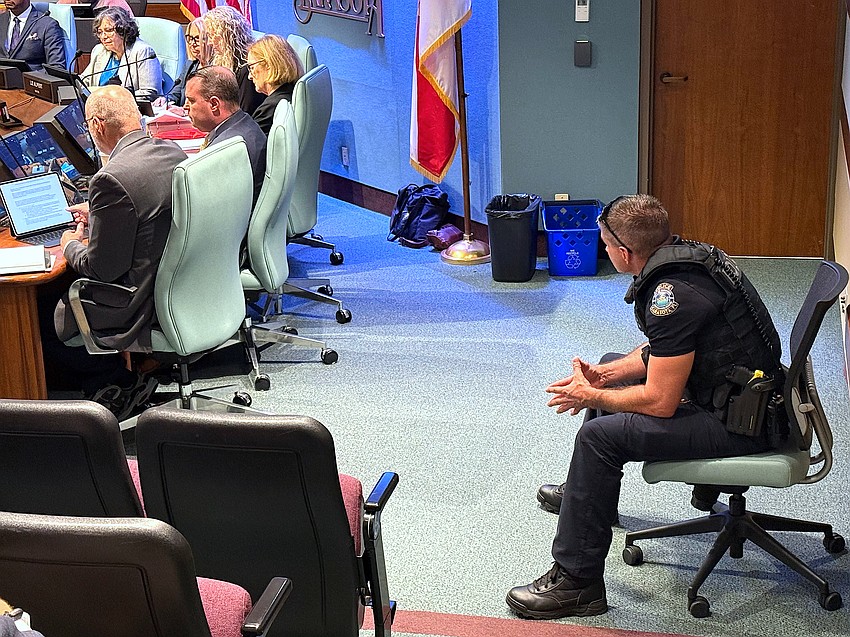
Among those places the general public may be unaccustomed to spotting weapons is inside the meeting chamber. Besides the officer regularly seated to the right end of the dais, there is now an officer with a long gun posted in the opposite corner of the chamber and another outside in the lobby. Also present is private security personnel who will search bags and scan attendees with a metal detector, a practice in place long prior to the McDaniels ruling.
McDaniels may well make its way before the Florida Supreme Court, and legislative adjustments may be made to remedy inconsistencies or fill any gaps resulting from the ruling. For now, though, it’s the law of the land and, out of an abundance of caution, long guns at City Commission meetings will remain for the foreseeable future.
“There will be some angst, I'm sure, but I think over time that angst will be reduced as long as there's not massive issues that occur with it,” Robinson said of open carry. “This is the status of the law and we don't have a choice and we’re going to abide by it.”