- March 15, 2026

-
-
Loading
Loading
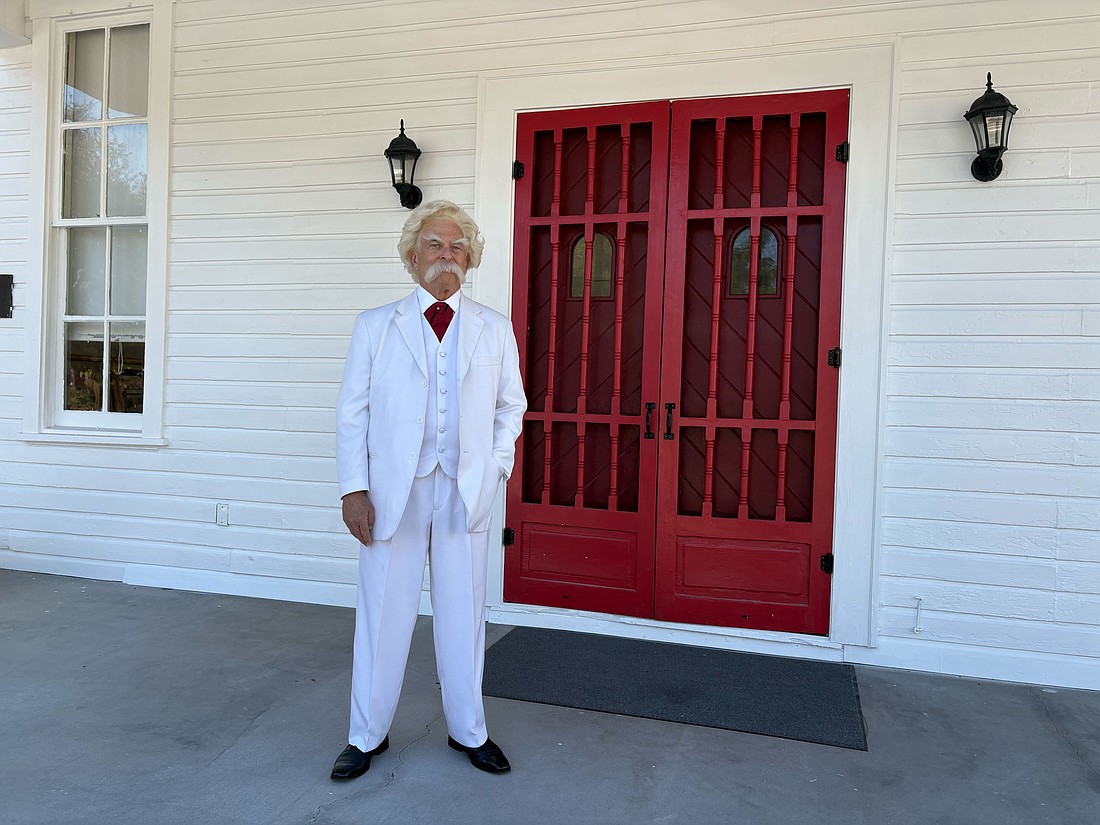
Alan Kitty has spent more than four decades stepping into the white suit, wild hair and razor-sharp wit of Mark Twain — not as an impersonator, but as a living conduit to America’s greatest humorist. His performances have taken him across the country, from classrooms to festivals. But it’s always the same mission — keep Twain’s voice speaking to the present.
Now, Kitty brings that voice home to Sarasota with the first annual Mark Twain Festival at the historic Crocker Church in Pioneer Park. Sponsored by the Mark Twain Society, it's part celebration, part revival meeting and part literary time warp — all anchored by a performer who’s made Twain his life’s work. And the first event on Dec. 6 is an appetizer for the Broadway touring show, "Mark Twain Tonight!" starring Richard Thomas coming to the Van Wezel Performing Arts Hall Dec. 19-20.
All of the above, eventually. But it really started when I was eight I read “Tom Sawyer,” tied my “valuables” in a kerchief, put it on a stick and ran away from home. I didn’t get far. Hunger has a way of changing your plans when you’re eight. Later in life, in 1979, I wanted to turn professional as an actor. I admired Hal Holbrook’s “Mark Twain Tonight” and decided I should have a show ready before I moved to New York City. If nothing else worked out, at least I’d have Twain. There were also coincidences. The year I read “Tom Sawyer,” my parents took me to New York. I fell in love with it! Twenty-two years later, I moved a half block from a building where Twain had lived. Those coincidences followed me my whole life. Eventually, I realized we shared a worldview — we’re kindred souls.
Yes, in 2007. A friend and I rowed the entire Erie Canal — 324 miles in 10 days. I was the oldest person to row it in a racing shell. Somewhere along that long row I realized, “It’s not enough to do what Twain has done. I need to become Mark Twain.”
Humor — our senses of humor are very similar. I love his irony, and a little sitcom timing sneaks into my work. I’m also love Twain’s approach to speech. As a writer and dramaturg, I gravitate toward dialogue. I’ll often modernize Twain’s rhythms when I adapt him, so contemporary audiences can catch the jokes.
Yes, a bit more. (laughs) I study Twain’s character and dialects. He was a man from Missouri trying to sound like a Yankee, and his travels influenced his accent and rhythms. Twain was also a 20-cigar-a-day man, so he had a gravelly voice — which I try to emulate. He loathed being thought a “country bumpkin,” which he was by birth, and he spent much of his life shedding that image. Twain wanted to mingle with the elite, dreamt of wealth and power, and even of finding treasure in caves. He was a self-made cosmopolitan with a rural origin. That tension shapes how I play him.
Right. I don’t memorize a fixed script. I internalize Twain’s stories — especially from his “Autobiography” — and follow an arc that makes sense each night. Every show is different. It depends on where my mind goes and what the audience responds to.
Finding his dialect — and finding the right balance between the younger, more rural Twain and the older, worldly Twain. His speech didn’t stay the same throughout his life. He definitely softened his dialect as he aged. And his public and private personas were also very different. When I mingle with audiences before a show, I’ll strike a middle ground between the public and private Twain.
That depends on the evening. If I get into politics, I might draw from Twain’s time as a young Washington correspondent. If I’m talking technology, I might lean into the period when he wrote “A Connecticut Yankee.” My show draws from Twain’s entire autobiography, so the “era” shifts with the stories I tell.
It’s not so much a misconception as an oversimplification.
The notion that you can fit Twain into any neat pigeonhole. You can’t! Twain was a Renaissance man — a universal man. That’s why everyone claims him: Republicans, Democrats, Calvinists, atheists, Italians, Chinese, French … Twain was an everyman. And he belongs to everyone.
“Captain Stormfield’s Visit to Heaven.” It’s incomplete, written late in life, and it contains one of my favorite Twain quotes — about Halley’s Comet. He was born the week the comet appeared and died the week it reappeared. He predicted the timing himself. It’s quintessential Twain — cosmic humor with a spiritual wink.
More and more, yes — especially as I prefer to travel less. Sarasota audiences tend to be older. They grew up reading Twain, who isn’t taught so much in Florida anymore.
Yes. I’m constantly discovering new things. I’ve read a lot of academic analysis, and I disagree with much of it because scholars try to pin him down — and Twain refuses to be pinned. His opinions wandered because he was always informing and revising them. He’s hard to categorize — like nailing a blob of mercury.
Our festival’s theme is determination, resilience and perseverance. Twain had all three — and needed them. Despite likely being bipolar, he worked constantly to become the best version of himself. I want audiences to ask themselves what it’ll take to become their best selves.
A young student once came up to me after a show and said, “I never knew Mark Twain was funny.” That made my day.
I once performed at a school in western Pennsylvania, near the Johnstown Flood site. Afterwards, we had a question session — and a girl raised her hand immediately. I expected enthusiasm. Instead, she asked, “Can we go now?” Later on, she returned to apologize to me. I asked, “Why?” She said, “Because my teacher told me to.” I told her she didn’t owe me an apology. It was one of the best questions I’d ever received because she’d followed her heart. She hugged me and handed me a card with “BFF — Best Friends Forever” written on it. That may be my favorite moment.