- March 19, 2026

-
-
Loading
Loading
Editor’s note: This is part two on the future of New College of Florida, University of South Florida Sarasota-Manatee and the John and Mable Ringling Museum of Art.
As is often the case, perception and reality are Mars and Venus.
Anna Lazzara, a Sarasota High Bright Futures scholar, will be a senior this coming fall at New College of Florida. She has lived on campus since 2022, the year before former Florida Speaker Richard Corcoran was appointed president.
Asked to rate on a scale of 1 to 10 the overall atmosphere of New College today versus her freshman year, Lazzara told us:
“Today, I’m going to go with a nine. A lot more things feel lighter on campus. It’s nice that the place where you’re studying and living every day you have camaraderie between the students.
“Everything is not so heavy all the time like before,” she told us. “How it was before I would say maybe between a four and five, probably leaning lower.
“It was not like ‘Oh my gosh, I can’t stand this place, but there was definitely a kind of funk in the air. There was just this expectation to be a certain kind of student and a certain kind of viewpoint. It could be kind of discouraging at times and give you the feeling that you couldn’t be your full self.”
Roy Quest, a soccer player in the inaugural class of New College athletes, will be a junior this fall. He has lived on campus two years. His 1-to-10 rating of the New College atmosphere?
“I’d give it an eight when I got there. Today, I give it a nine or 10. There has never been a huge divide between athletes and nonathletes. Personally, I see it as tight knit. I’ve made great connections, met great people and lifelong friends.”
Lazzara and Quest both said the most noticeable, tangible improvement at New College since Corcoran’s arrival is the campus’ physical appearance and amenities.
Admittedly, we know Lazzara and Quest’s comments are those of only two of 900 students. But you cannot discount them; their before-and-after assessments are 100% honesty.
Lazzara and Quest are passionate New College advocates. They help illustrate the turnaround underway at New College and how Corcoran is exorcising the demon that has nagged New College for the past decade: Its inability to grow enrollment.
Earlier this year, Corcoran told us that was one of the raps he heard repeatedly coming into and during his start at New College. He quickly concluded that had to be one of his first and top priorities as president.
“As a parent of six children, three who are in college, I did the parent tour,” he said, recalling his start. “OK, if I brought Kate or Jack or Caroline (his children) to this campus, what would I be saying afterward?”
He didn’t say it, but his implication was: “What a dump.”
Corcoran concluded that if New College was to have a chance at growing enrollment, the place had to improve dramatically its physical appearance and student amenities.
With a $15 million infusion from the governor in early 2023, that’s what he did. In fact, in his first two years Corcoran has worked at a breakneck pace making the campus a place where students want to be and go.
Some of the results: A new grass park on the bayfront for outdoor events; six new beach volleyball courts nearby. Students rave about the jumbotron at the pool and the improvements at the fitness center. The entire campus is adorned with fresh landscaping.

Dormitories inside and out were renovated: Restuccoed and repainted on the outside; mildewed popcorn ceilings removed; new counters in the dorm bathrooms; new refrigerators and cabinetry; new flooring.
“I wanted it so when parents walked in, they’d go: “Wow, this is a beautiful dorm.”
More improvements:
One of the most talked-about changes among the students has been the dining hall. It, too, was fully renovated, along with hiring a new food service vendor.
Says Lazzara: “The way I could tell New College was changing for the better was the difference that I saw from when I was a freshman and going in to eat my lunch or my dinner in the dining hall. Everyone had their little cliques that they went and sat with. It kind of felt like high school.”
Today, she says, “Coming into the dining hall, it’s always jam-packed … The good vibes and the good energy in that dining hall — that really speaks to how the campus life and student life are going.”
Beyond the physical environment, there is the academic side. Corcoran has brought in about 60 new faculty members for the most recently completed term and next year. What’s more, as noted in his 2024-25 job evaluation, “for the second year in a row, negotiated the largest cost of living adjustment in New College’s history.” Fifty of the new faculty members carry doctorates. The college is negotiating to have famed lawyer Allen Dershowitz on next year’s faculty.
When we asked a long-time faculty member for comments on the difference at New College from pre- and post-Corcoran, he declined. Understandably. It’s a touchy subject for sure.
Every corporate board knows when it brings in a new CEO, he or she has a way of operating that disrupts the status quo. Predictably, there are personnel who like the changes and those who don’t. There are personnel who choose to stay, and those who don’t. There are personnel who buy into the new mission and those who resist, complain and criticize, eventually leading to their departures or firings.
The faculty member contacted made those points, acknowledging Corcoran has made improvements, but he also has made changes the faculty member considers damaging and, to be sure, controversial. One example of the latter:
When Corcoran and his staff proposed a new regulation requiring that faculty members must attest they have reviewed all materials to be presented prior to the start of the semester and confirmed the material is appropriate, that generated a flood of opposition from faculty and others.
The board adopted the regulation to comply with the state board of governors.
To be sure, it’s too soon to tell whether Corcoran’s academic direction and the new faculty members can be considered successes. But on the faculty front, if you’re so inclined, you can read the names and biographies of the new faculty members for the fall semesters starting in 2024 and 2025 and judge their caliber. (See YourObserver.com/Opinion)
And in line with Corcoran’s strategy that to increase enrollment you must have attractive curricula, New College’s spending on faculty and staff has increased 41% since he arrived — from $22.4 million to $31.6 million in the 2024-25 school year, according to the State University System of Florida.
The school’s faculty ranks have increased 32%, from 95 to 125. Which means course offerings — a key recruiting feature — also have increased 25%, from 392 to 493.
All of Corcoran’s efforts are producing positive results — at least from the standpoints of enrollment, attracting donors and securing state funding.
Here were Corcoran’s opening remarks in his June report to the New College Board of Trustees:
“We’ll have our third class in a row of over 300 students, a number that had never been achieved in New College’s history for a single class, let alone three in a row.
“This class will put us at the highest enrollment ever in the history of New College, somewhere between 900 and 950, also a number never achieved before in New College history.”
When Corcoran arrived, enrollment was 609. His target is to reach 1,500. But one of the inhibitors to expanding enrollment even more now is a lack of housing.
Academically, Corcoran told trustees in June: “Our SAT score is up to 1,200, and our GPA is hovering right around 4.0. Right now, it’s about 3.97.” And for those who scoff at Corcoran’s efforts to have NAIA athletics, Corcoran told us next year’s incoming freshmen athletes produced higher SAT scores than the incoming nonathletes.
Much has been reported about Corcoran and the trustees’ handling of the New College Foundation endowment. But for the first time, its asset value topped $50 million, up from $42 million when Corcoran started. In two-and-a-half years, Corcoran has raised $10,440,652 from donors, an annual average of $4.4 million, 30% more per year than his predecessors.
Corcoran’s best fundraising has occurred in Tallahassee. In the past two legislative sessions, New College has received appropriations totaling $156,525,809. Never in New College history as part of the state university system has a New College president been able to woo that much funding.
For all of the changes that have occurred in two-and-a-half years, c’mon, you have to credit Corcoran.
When have you ever seen anyone move an embedded bureaucracy as quickly and effectively in such a short time and in a direction that is producing positive results?
Since New College’s becoming independent in the state university system in 2001, none of Corcoran’s predecessors was able to generate the support of the governor and Legislature the way Corcoran has.
To be sure, you can say Corcoran has leveraged and benefited from the old saw: It’s who you know. After all, Corcoran was DeSantis’ commissioner of education from 2018 to 2022, and one of the governor’s close advisers. He was Florida speaker from 2016-18 and still has deep connections with legislators present and past.
So when DeSantis decided he wanted to change New College’s deteriorating trajectory, he knew exactly the kind of passion and action that would come with Corcoran as the New College president.
You cannot deny Corcoran has delivered a lightning speed transformation in two-and-a-half years, more than any other New College president in the past 25 years.
Spend a half-day with Corcoran, and it’s a nonstop rat-a-tat of action and explanations of what has been accomplished and what’s about to happen.
He has big plans. The college just released its state-required master plan. It covers how the administration envisions the school’s physical environment will change to meet its academic vision over the next 10-20 years.
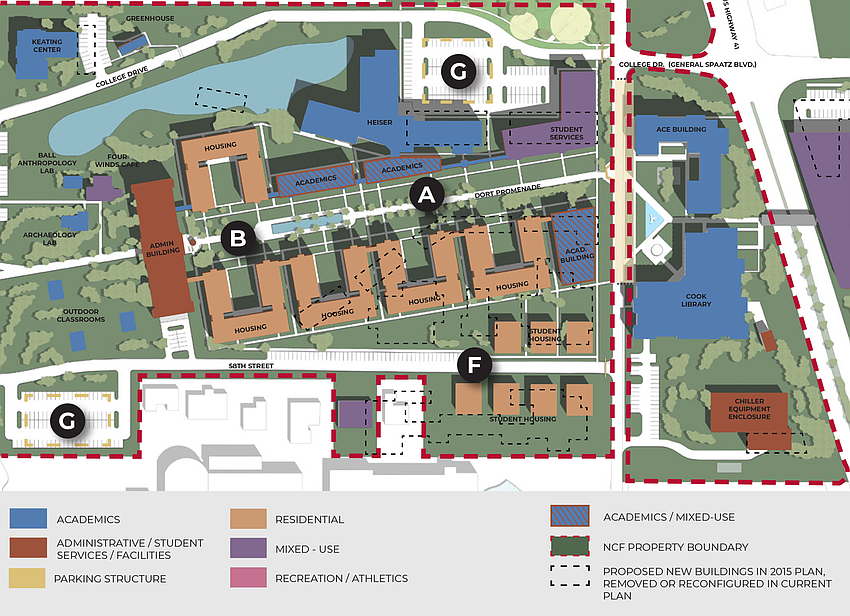
Just take a look at the rendering of the vision for New College’s west campus. It shows the college adding 19 buildings — 11 of them for student housing — and nearly tripling its total square footage to 750,664 square feet. That’s the equivalent of four Walmart supercenters.
The college’s five-year capital improvement plan shows the state committing $63,473,493 on top of the $150 million it already has invested.
Having seen (or read) all of what Corcoran has ignited and transformed, go back to our first installment: Once you finish the tour of New College, the Ringling Museum campus and the USF-Sarasota-Manatee campus, Cocoran’s vision — one unified campus under one, on-site leader and board — makes practical, and likely long-term economic, sense. Or does it?
We don’t really know. And that’s the point. We should find out.
What we do know is that many people’s efforts over the decades have produced successes. The trustees of the Ringling Museum can list the many additions to its campus, while the trustees of USF can point to its new student center and dormitory and that USF has grown to offer more than 40 different degrees.
But we’ll pose again: Are the three institutions that comprise 200 of the most historic and valuable acres in Sarasota-Manatee — all owned by the state — operating at the level they could or should?
They haven’t been.
Yes, there is some cooperation among the Ringling/FSU, New College and USF. But they all have separate boards of trustees, campus CEOs and leaders; fund-raising arms and foundations; business operations and visions.
What’s more, in their current leadership arrangements, the Ringling and USF are hampered with absentee landlords. Yes, the Ringling has Steven High as its on-site executive director. But what ultimately happens falls under FSU’s president and board. (Remember the dehumidifiers in the Rubens gallery?)
Likewise, USF has its chancellor, currently an interim chancellor. That person reports to the USF president in Tampa.
At the risk of offending, these arrangements make those institutions branches of bigger operations and relegated to less attention and resources.
In contrast, the buck stops at New College with the president. Corcoran is on-site every day, pushing initiatives; lobbying and cultivating trustees, the governor, legislators and the State University Board of Governors for the funding to build short- and long-term success; making sure mold and mildew are not damaging the campus.
That makes a big difference. All CEOs know that no matter how hard they try, they cannot duplicate the home-office culture in their satellites. When the CEO is on-site and pumping the troops every day, much more is accomplished and more quickly than if he or she is 300 miles away or even 60 miles away.
In fact, this should tell you something about the effects of the absentee landlord: After word surfaced that New College wanted to take over the physical assets of the USF-Sarasota-Manatee campus, USF’s Tampa lawyers wrote the proposed legislation — unbeknown to Sarasota and Manatee. If the home office was so opposed to such a transfer, that likely would not have occurred.
The fact is the ideas of New College taking over the physical campus of USF-Sarasota and becoming the steward, overseer and operator of the Ringling Museum campus are not going away. They will be on the agenda for the 2026 legislative session.
But rather than endure the inevitable angst, anger and fighting that will surface between now and then, this community and Florida taxpayers deserve better.
Gov. DeSantis and the Legislature should appoint a special, independent commission to analyze, explore and recommend the best long-term structure or structures to maximize the assets of the Ringling, New College and USF and bring a vision to life that makes sense and suits those 200 acres of historic and priceless bayfront.