
- March 19, 2026

-
-
Loading
Loading
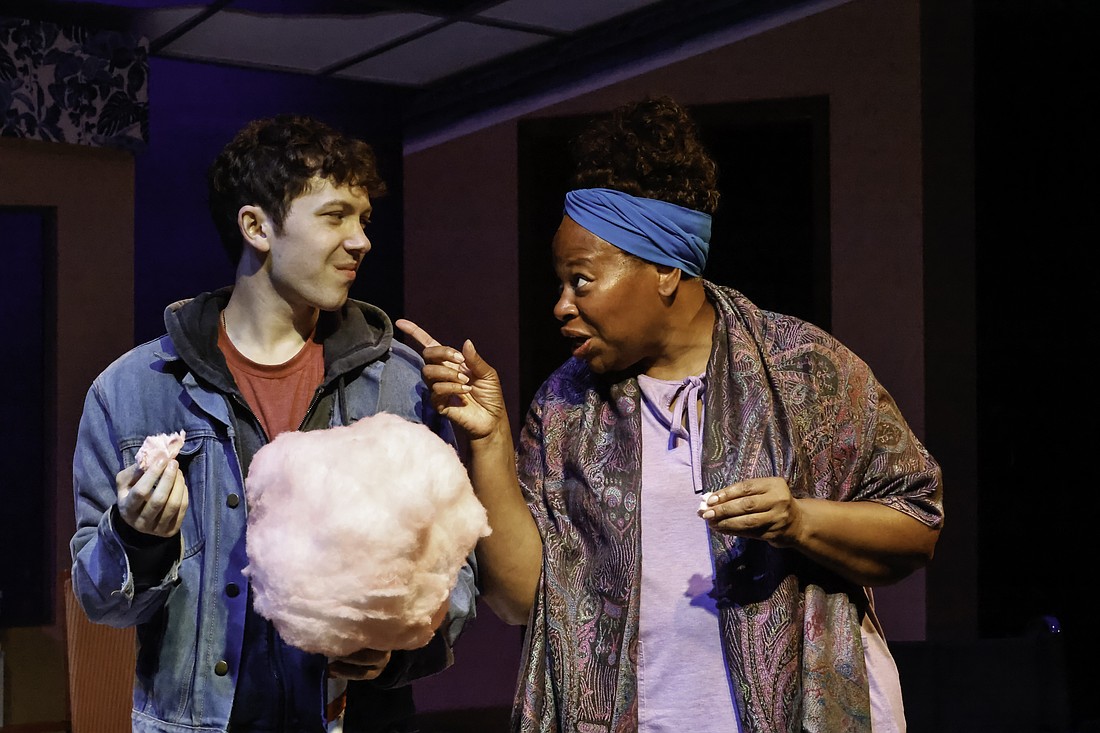
E.M. Lewis’ “Dorothy’s Dictionary” has turned the page at Florida Studio Theatre. It’s a story of reading, imagination, aspiration, healing and human connection. There are only two characters. But they stand for all of us.
Zan (Ethan Jack Haberfield) is an angry young man. Understandably. His father’s emotionally dead; his mother is literally dead. One day he snaps — and beats the living daylights out of another kid at high school.
The judge sentences Zan (short for Lyzander) to community service at a convalescent home. He serves his sentence by helping Dorothy (Alice M. Gatling), a reluctantly retired librarian. She’s only 45 years old — and sidelined by an unnamed degenerative illness that’s weakening her heart and eyes.
Dorothy can no longer read the books she loves, so she asks Zan to read them aloud to her. The sullen kid resents it, but he does as told. As the days go by, Zan’s reading gradually stops being a chore and becomes a joy. That’s been Dorothy’s plan all along.
Once a librarian, always a librarian. Dorothy is in love with books. Her nursing home room’s stuffed with them. When Zan begins reading to her, she shares her bibliophilia with evangelical zeal.
Zan reads snippets of “The Old Man and the Sea,” “Hamlet,” “Moby-Dick,” “Webster’s Ninth New Collegiate Dictionary” and Dorothy’s private dictionary of her own favorite words.
When Zan mentions he’s never been to the ocean (which is only a short bus ride away), Dorothy promptly provides a stack of nautical reading material. Zan’s universe of possibility expands. He’d never entered a library in his life. But now he’s hooked. The librarian’s plan works.
Director Kate Alexander guides this short, sweet production with a deft, delicate touch. It’s a quiet play. The hero is a librarian, after all. The scenes are intimate moments, not shouting matches. She honors that — and get you to lean in and listen.
Powerful performances bring this story to life. Gatling’s Dorothy is a quiet force of nature. Her characterization is nuanced, sharp, funny and never sentimental. She’s got a love affair with language — and a private war with digital devices and every form of mental passivity. “Look it up,” is her mantra.
Her indominable personality will share her literate loves (and hates) with Zan. (In the process, she becomes the mother he never had.)
Haberfield’s Zan is locked inside himself. Beneath his hoodie, his character’s a gumbo of hurt and anger. The kid’s not hostile — but his words can be cutting. His disgusted description of the care center? “The whole place smells like bleach and sick people.”
But when Zan reads Hamlet’s “To be or not to be” soliloquy, the words catch in his throat. As if he’s considering these alternatives for the first time.
The action unfolds in Isabel and Moriah Curley-Clay’s nursing home set. It resembles a massive diorama or a cut-away model in a Wes Anderson movie. They evoke the sterility with implied drop ceilings and an angular wall in forced perspective.
It’s a cold world after all. But not the whole world. The designers echo Zan’s oceanic aspirations on the floor. The tile pattern subtly segues to the shoreline of a beach. It’s a cunning motif that ultimately pays off.
Chelsea Allen’s costumes clue you into the characters. Dorothy’s decked out in decorative shawls of pink or purple. She may be formal and polite, but she has a flamboyant side. Zan’s decked out in a hoodie like a teenage version of the Unabomber. It’s body armor — his own wearable hiding place.
Lewis’ script is elegantly simple and highly original. A bare synopsis sounds formulaic. (Add one ailing adult, one troubled teen and three months of community service. Sprinkle a heaping helping of books, turn up the heat, stir gently and wait for friendship to simmer.) But the playwright reinvents the narrative recipe. Lewis avoids after-school special clichés and stock characters. And she’s happy to leave big questions hanging.
What’s Dorothy’s illness?
How did a classmate trigger Zan’s rage?
The playwright doesn’t say. She has bigger questions to answer.
Why do books matter?
Dorothy (and presumably the playwright) loves books and the power of words. Not only for the mental trips that reading provides. She also loves the human connections it sparks.
In George Lucas’ “Star Wars” mythos, a mystical Force surrounds us and binds us together. But language does exactly that in the real world. When used for good, words bring people together. Which they do, for Zan and Dorothy. And the FST audience all around me. Their wordless reactions spoke volumes …
They all were touched by this gentle, witty, smart, literate and moving play.