- March 19, 2026

-
-
Loading
Loading
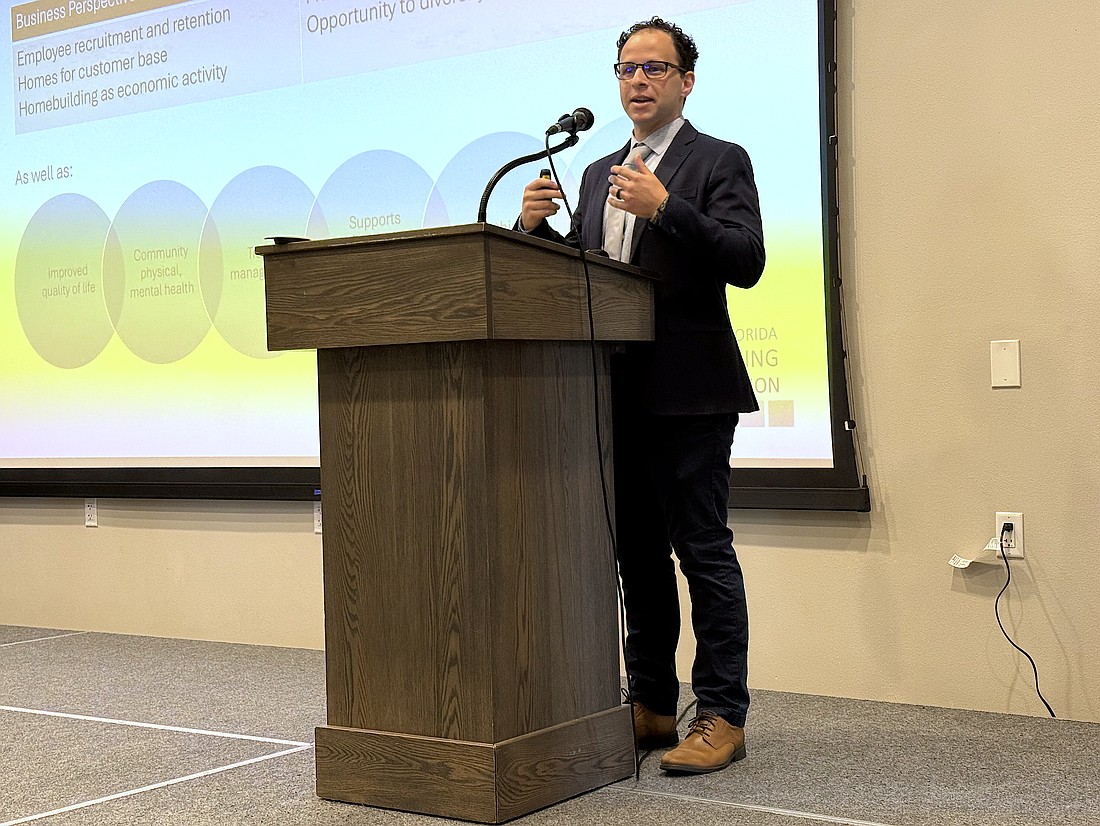
Local governments have accomplished much to address the shortage of affordable housing, but there is much more left to do, according to Kody Glazer, chief legal and policy officer of the Florida Housing Coalition.
Judging from the capacity crowd at the July 15 Greater Sarasota Area Chamber of Commerce State of the Community Luncheon, interest in finding solutions to the crisis remains intense as well.
Glazer was the guest speaker at the event, addressing one of the key issues facing the city and county of Sarasota for decades, further exacerbated by the mass migration to the area during and in the wake of the COVID-19 pandemic. If the audience took nothing else away from his presentation, Glazer implored members to memorize the chant “15,000 homes in 10 years.”
That’s much easier said, however, than done.
To help get it done, Glazer brought with him a blueprint developed by the FHC in partnership with local partners that requires active participation across the public, private and philanthropic sectors. The strategy requires bold and perhaps courageous policy considerations by governments to incentivize and accommodate innovative approaches to encourage development of truly affordable residences.
According to the FHC, approximately 59,738 (29.6%) of total households are considered cost-burdened, meaning paying more than 30% of their monthly household income for housing costs. Of this total, 47,305 (79.3%) are low-income households, defined as earning approximately $68,000 per year for a family of two.
Additionally, nearly 70% of local worker incomes are at 80% area median income or below, with the 10 most common jobs in the county not paying enough to afford typical home costs. That forces more than half the of county’s workforce to live outside of Sarasota County. Of the nearly 163,000 workers employed in Sarasota County in 2021, 51% (83,000) commuted from outside the county. It is reasonable to assume that number has only grown in the years since.
“The next time you hear someone be angry about not wanting affordable housing in my neighborhood, that is most of the workforce you're talking about,” Glazer said. “I would say a trend in NIMBY (not in my backyard) circles has been to focus less on the NIMBYs and more on the folks who do want housing. A lot of polling does show that the majority of communities want more housing, so more people can live close to where they work.”
To achieve that ambition, the FHC’s blueprint strategy to address what Glazer said is a deficit of 20,000 affordable rentals in the area includes:
From a policy perspective, Glazer said public subsidy is critical for development of new housing that's built for very low-income families in the community. This can come in the form of tax increment financing districts and other funding mechanisms with revenues dedicated to housing.
Also needed is a bolder approach to land use and zoning. “For the last 10 or 15 years there's been a reckoning for how zoning and land use policies can be reformed to unlock the private sector to build more homes in a community, particularly smaller homes that are maybe attached single-family homes, duplexes, triplexes and small-scale multifamily,” he said.
Those policies should be applied to not only to private land, but also land owned by the local governments. “In the state of Florida, once every three years at least (governments) have to look at the land that they own and identify the land that is ‘appropriate’ for use as affordable housing,” Glazer said. “Appropriate for use as affordable housing is not defined, so it is up to local governments decide for themselves.”
And finally, there is Senate Bill 1730. Passed in the 2025 legislative session, it allows, but does not require, local governments greater latitude and flexibility to approve housing on parcels owned by religious institutions providing 10% of the homes are affordable. Parcel eligibility includes land owned by a religious institution that contains a house of public worship or is contiguous to a parcel with a house of public worship.
The FHC estimates this tool can make available more than 30,000 parcels for affordable housing statewide.
These are just some of the strategies Glazer said may be deployed locally.
“It’s not just about building housing, it’s also about who people that are inside housing,” Glazer added. “A lot of effort can be made on things like financial literacy. We're trying to move people into home ownership, maybe building their credit. A lot of nonprofits already exist that do this work. They could be supported in this effort.”