- March 19, 2026

-
-
Loading
Loading
It’s lunchtime, and the restaurant is bustling.
New customers arrive, some head out. A lot more chat at tables while wait staff dash back and forth between the kitchen and dining room.
It’s chaotic and a bit loud, but in a jovial way.
Then a crash of a glass, plate and silverware. A gasp. In an instant, silence.
“I think it’s his heart,’’ someone yells.
It’s also Longboat Key, so an ambulance and a team of professionals are probably eight minutes away after 911 is called. Maybe less.
But in the interim . . .
It’s those few minutes that Longboat Key Fire-Rescue for the last decade or so has been trying to address through education and, perhaps more important, inspiration. To train everyday people not only how to help, but to overcome the anxiety of doing just that.
“You’d be surprised how much of the population has never witnessed an event like that,’’ Assistant Fire Chief Jentzen Barton said. “So when they actually see it, they just don’t know what to do.’’
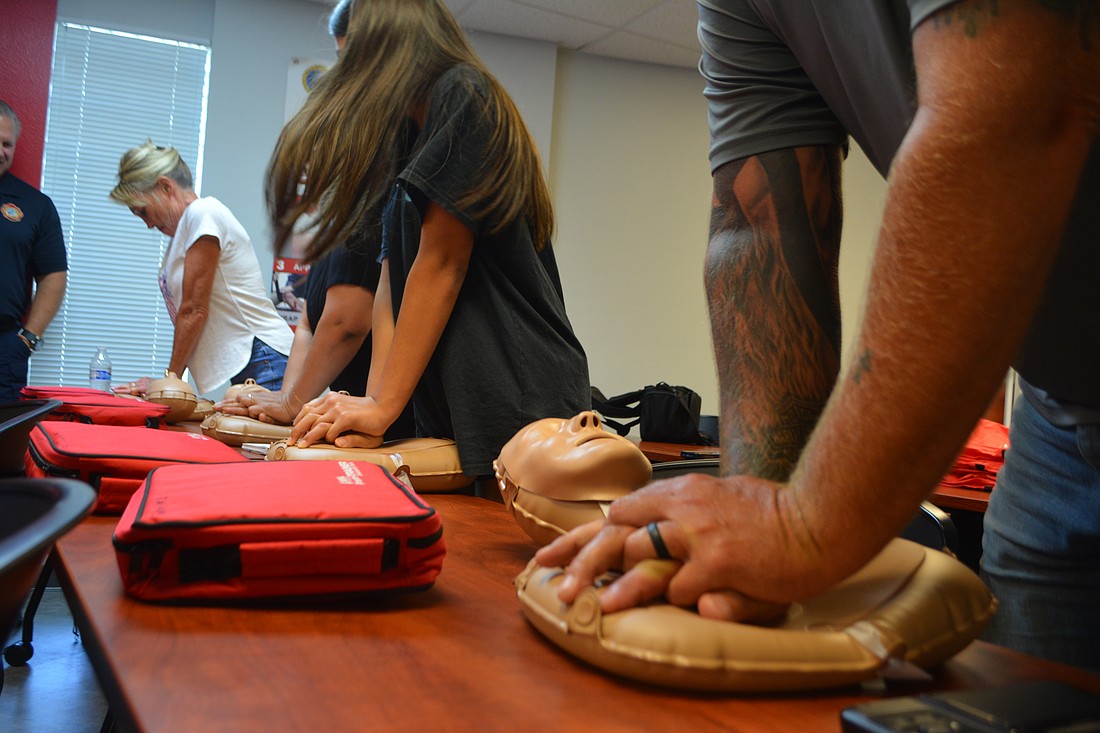
To that end, a group of about a dozen residents recently took the department’s class to learn the basics of a stripped-down version of CPR that involves chest compressions, aptly timed to follow the disco beat of the Bee Gees’ 1970s hit "Stayin’ Alive."
Can any of them make a difference?
They already have, said Lt. Ron Koper of Longboat Key Fire-Rescue, one of the instructors. He said recently two or three people on the island have been saved through Hands On CPR, which eliminates the TV drama staple of mouth-to-mouth resuscitation and focuses on heart compressions that keep blood moving. In 2024, the department responded to more than 2,200 calls, with about half medical while the rest ranged from fire alarms, fires, gas leaks and more.
“It just gives people a level of confidence that they can do something, no matter who they are or where they are,’’ Koper said.
The department conducted a series of classes this year, with another installment scheduled in mid-August. More are likely.
Beth Mclaughlin has been going to CPR courses since she was 14 and doesn’t plan to stop.
“It’s very easy to do. It’s something you may never use, but it’s like insurance,’’ she said in an interview at the July session last week. “You may never use it, but it’s a peace of mind to have it there and to be comfortable knowing that you have that knowledge.”
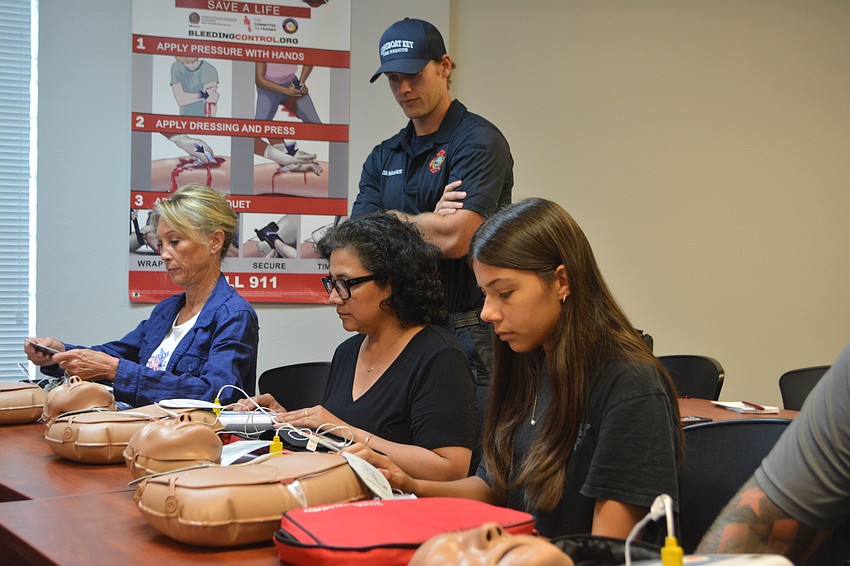
The class was full of ready-to-learn attendees, full of questions. Many wondered what to do if someone goes into cardiac arrest in a swimming pool or has a pacemaker. The instructors were attentive, patient, encouraging, and were sure to leave no stone unturned.
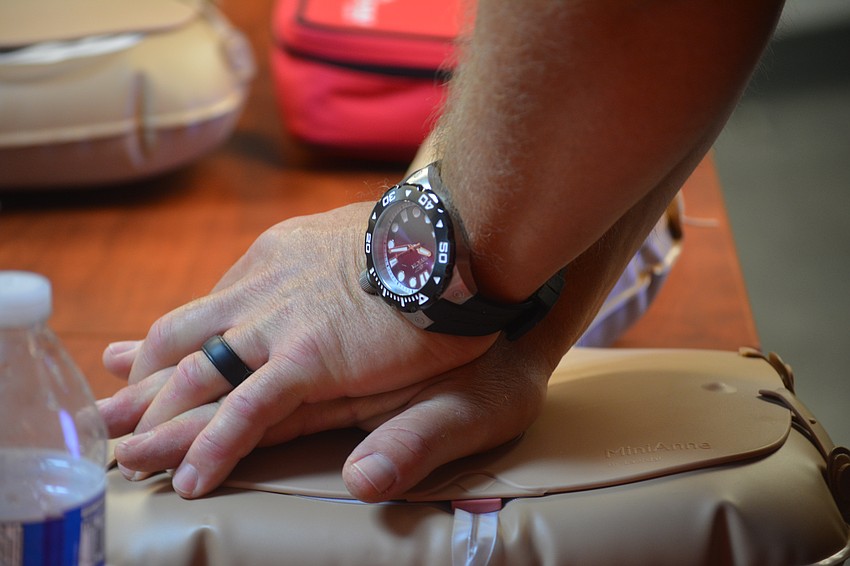
They practiced on simulators that delivered clicking-sound based on the depth and force of their CPR heart compressions, all the while listening to encouraging feedback from instructors.
Beyond questions and answers from class participants and firefighter trainers, the sounds of electronic voices from Automated External Defibrillators made clear there was more to learn than just chest compressions.
Placed around the island in public spaces such as Town Hall, Bayfront Park, the Public Tennis Center and more, AEDs are in plenty of private businesses and condo lobbies, too. A far cry from, again, the TV drama of someone yelling “Clear!” before an electric shock is delivered, AEDs largely talk users through their operation and are programmed to monitor a patient and make decisions.
All they need is a human to retrieve it and put it into action.
“Don’t be afraid,’’ Koper said. “We have a lot of individuals come through, either couples or singles. And the class, it’s open and friendly and that’s the purpose that we’re here to communicate with the public and give them a chance to ask questions. And it’s a very safe environment to do it.”
The course also provides an introduction to people who are either curious about or are unable to go through all the steps it may take to get Red Cross certified in CPR.
“It’s easy, it’s quick,’’ McLaughlin said. “It was what, maybe half an hour, 45 minutes? And you’ll leave more comfortably. If an emergency did happen that you would be comfortable stepping in and doing something that may help.’’
Blood circulation is the means by which oxygen is carried to vital organs. In the case of a heart stoppage, that delivery system’s pump fails.
Assistant Fire Chief Jentzen Barton said damage can begin in just a few minutes after a heart stops, even though blood may retain a level of oxygen for minutes without breathing taking place.
That, he said, is the basis for Hands-On CPR.
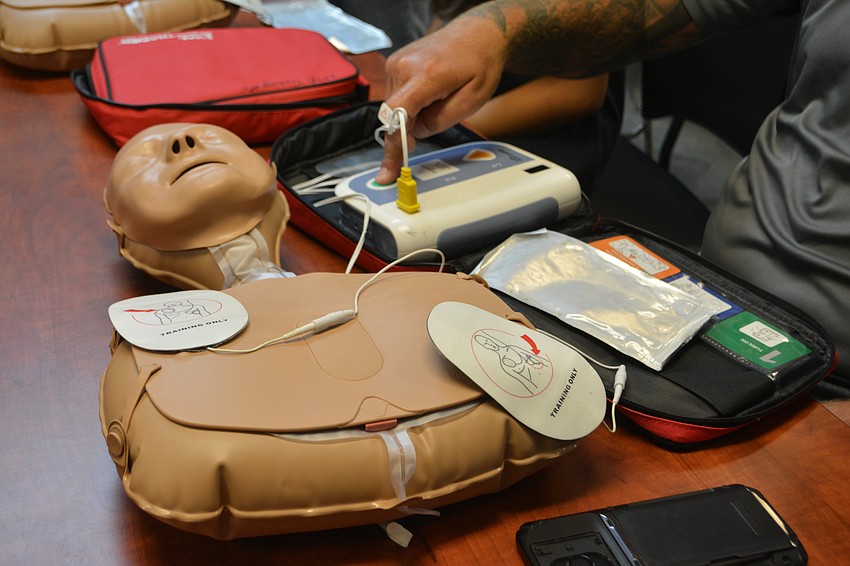
“Without the pump, it’s stagnant blood,’’ Barton said. “It doesn’t filtrate through the membranes and arteries and capillaries and things where the oxygen exchange takes place. Damage can begin to take place.’’
He said the department’s training is designed to deliver enough knowledge to keep bystanders or family members from freezing in the moment while still delivering a benefit over simply waiting anxiously for paramedics to arrive.
Research in the last few years has shown even the basic form of CPR taught by the department can make a difference.
“Let’s concentrate on what the most important thing is and that’s circulation of oxygenated blood,’’ Barton said. “They’ve realized there’s enough oxygen left in your blood to give you X amount of time if you’re circulating it, you’re still kind of getting that oxygen to tissues and cells.’’
When paramedics arrive, they will probably immediately administer oxygen.
The department also delivers information on the PulsePoint smartphone app. In addition to displaying for users the locations of nearby AED machines, it also has a sign-up feature that alerts CPR-trained registered users to reported heart-related cases nearby, based on 911 dispatches.
It’s just another way to broaden the field of those willing and able to help.
“Think of it like drops in a bucket,’’ Barton said. “Sooner or later, that bucket is full. It really would help. It’s really something everyone should know how to do, whether it’s saving your loved one or just someone on the street. Sometimes we get caught turning our heads when something happens that doesn’t involve us. This is something we shouldn’t do that to.’