- March 19, 2026

-
-
Loading
Loading
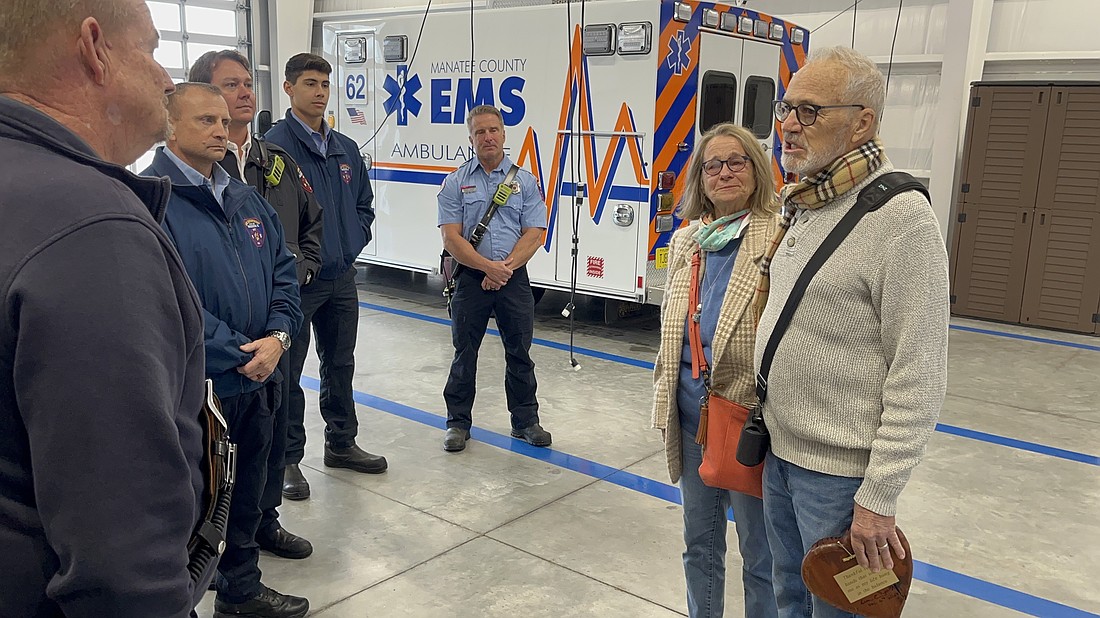
Seven months after having a heart attack, Bradenton’s William Booth still gets choked up when talking about how Manatee County’s Emergency Medical Services team saved his life.
Booth remembered the Dec. 6 incident, in detail, up until he entered the ambulance — the intense chest pain and yelling to his wife Stefanie Booth to call 911.
Booth remembered the breeze that blew over him as he laid on the gurney inside his front door that made him shiver, and the sound the gurney made as it clicked into place before sliding into the ambulance. Then, the memories stop.
“That’s the first time I died,” he said.
Booth's heart stopped four more times before the ambulance could pull out of his driveway.
“I was an Army medic (with the 82nd Airborne Division based out of Fort Bragg from 1973 to1976)," Booth said. "I was an EMT when I got out. What they do as a job is not foreign to me. How well they handled themselves that morning was fabulous.”
Booth is not the only professional to take notice of the level of care EMS offers in Manatee County.
Manatee County EMS received a gold achievement award from the American Heart Association's Mission: Lifeline EMS Recognition Program June 25 for the care given to patients experiencing heart attacks and strokes.
Booth noted that only three minutes elapsed between the time his wife called 911 and when the ambulance arrived. He said EMT William Thayer immediately took charge of the scene.
“There was no time to hesitate,” said Booth, who added that he only is alive because the EMT team knew exactly what do do and because the team members did not hestitate.”
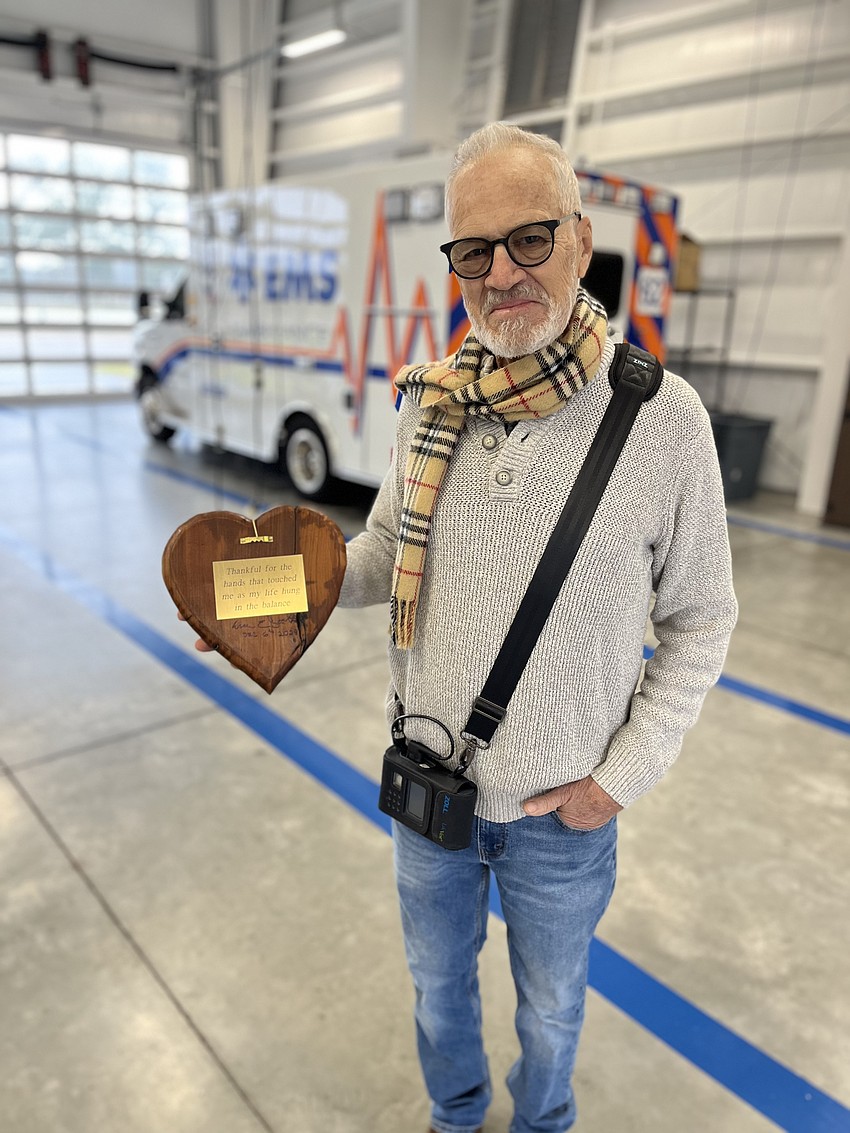
Sean Dwyer, EMS division chief, has been with Manatee County EMS for 19 years. He pointed out that EMS is a service separate from the fire department, which is not the norm for many counties.
Sarasota and Charlotte counties, for example, combine the two departments.
“Because of that, we get people driving up to three hours to work here because of the cool things we do,” Dwyer said. “Manatee County EMS, in general, is a trendsetter in the region with the care that we’re providing.”
The Lakewood Ranch EMS station was chosen to pilot a drone program in April 2024. The drone delivers medical supplies ahead of the ambulance, providing even faster response times for residents experiencing cardiac arrest, opioid overdose or mass hemorrhaging.
In October, EMS partnered with Tampa General Hospital’s Aeromed to be the first EMS department on Florida’s Gulf Coast to carry blood and have the ability to administer blood transfusions at the scene of an accident or on the way to the hospital.
Beyond what’s cool, Dwyer said EMS is extremely data-driven. Data determines what care is provided and if the community needs more ambulances in service.
Manatee County started participating in the American Heart Association’s recognition program two years ago. Participation didn’t change the level of care, it made EMS staff even more focused on data because so much of it has to be submitted to AHA.
Dwyer noted that AHA is the “gold standard” of best practices for heart attacks and stroke.
“Having (AHA) standards constantly in our face, and meeting those standards,” Dwyer said, “It ensures that the people visiting and living in Manatee County are getting that amazing care that our paramedics and EMTs are equipped to provide.”
The goal of the program is to provide patients with a “seamlessly integrated care system,” which includes communication between the EMTs and hospital staff prior to arrival.
While it might be tempting to drive a loved one to the hospital in an effort to save time, the AHA best practice is to call 911.
Paramedics and EMTs are trained to recognize and treat the symptoms of a heart attack, including high or low blood pressure and irregular rhythms. They can also recognize symptoms that mimic a stroke and determine what type of stroke a patient is having.
After identifying the type of stroke, the crew knows which hospital is best equipped to treat that patient. By the time the heart attack or stroke patient arrives, the hospital already has its electrocardiogram results.
Dwyer said it’s not atypical for someone who is experiencing chest pain or a heart attack to ultimately go into cardiac arrest or lose their heartbeat. Booth lost his heartbeat five times.
“(EMTs) couldn’t stabilize me,” he said. “I don’t know how many drugs they pumped into me, but I know they worked at it. I don’t think I’d be here if it wasn’t for them.”