- March 19, 2026

-
-
Loading
Loading
The family of Everglades champion Marjory Stoneman Douglas founded the newspaper that would become The Miami Herald, so it somehow seems fitting when environmental activist Clyde Butcher gets a call from the paper as a visitor arrives at his Venice gallery to interview him about his latest book.
The Herald wants to know what Butcher thinks about “Alligator Alcatraz.” That’s Florida Attorney General James Uthmeier’s nickname for an immigration detention center springing up in Big Cypress National Preserve.
The Miami folks will have to wait; Butcher is fierce about honoring his commitments.
With the new book of his life’s work, “Lifeworks in Photography, 1972-2023,” and a recent National Medal of Arts crowning his many honors, Butcher’s legacy is sealed. But at a time when many octogenarians might be content to play with their grandchildren, Butcher has been galvanized by the plan to build Alligator Alcatraz in Big Cypress, located about 45 miles west of Miami adjacent to Everglades National Park.
Suddenly, the 82-year-old has become the poster boy for the Stop Alligator Alcatraz Movement. Butcher, who looks like Santa Claus dressed for a safari, took the microphone at a June 28 rally in Ochopee, addressing the crowd from his wheelchair. Another speaker at the peaceful demonstration, which drew 1,000 people, was Native American activist Betty Osceola, a Miccosukee Tribe of Florida member. She was joined by other Miccosukees as well as members of the Seminole Tribe of Florida, whose ancestors once inhabited the land.
The immigrant detention center under construction is literally in Butcher’s backyard. He and his wife, Niki, have an art gallery in Big Cypress, so one could argue there is some self-interest in Butcher’s opposition to Alligator Alcatraz.
But isn’t that true for some of the world’s high-profile conservationists? Cable TV magnate Ted Turner has acquired 2.1 million acres of land near his various ranches over the years to prevent it from ever being developed. That’s one way to keep the neighbors at a distance.
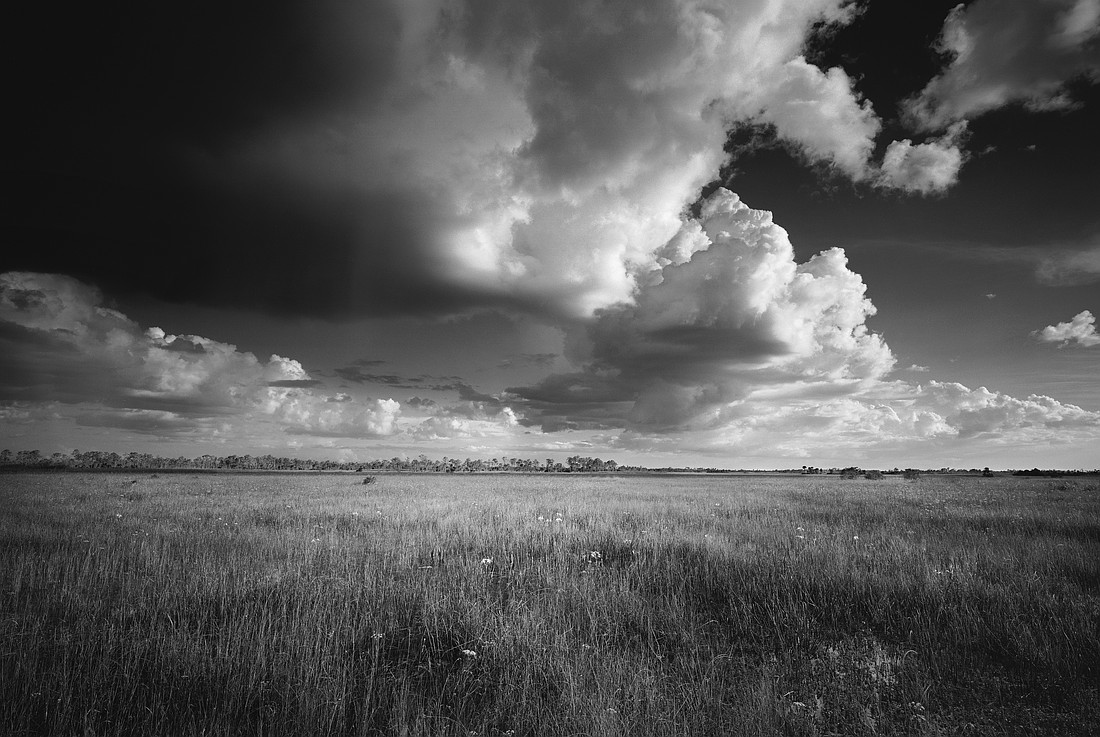
Butcher doesn’t have such grand ambitions, nor the wealth, to support such private conservation efforts. However, he is a big-picture guy —literally. His black-and-white photographs of the Everglades and other national parks, such as Yosemite and Grand Teton, can run as large 5 feet by 9 feet. He is often compared to legendary landscape photographer Ansel Adams.
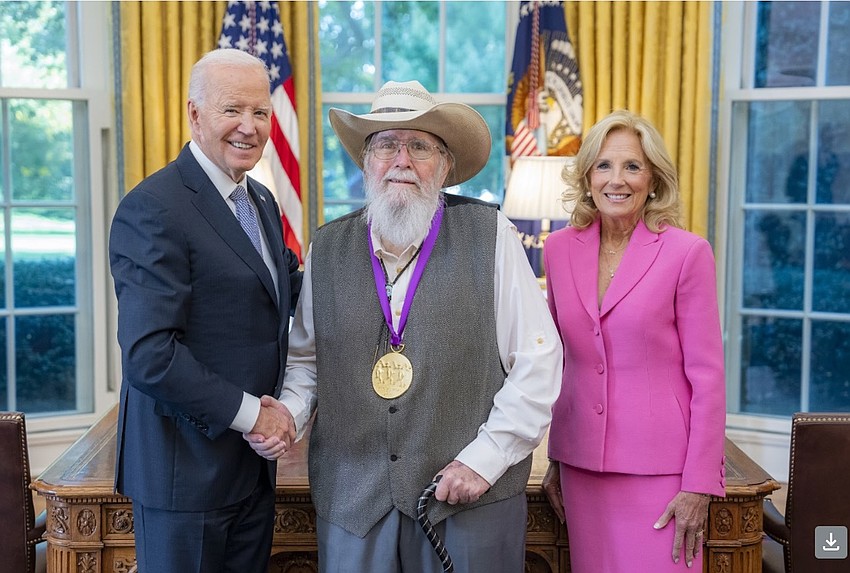
When Butcher received a National Medal of Arts this past October, the White House citation said: “From humble beginnings as a self-taught photographer, Clyde Butcher is considered America’s most acclaimed landscape photographer today. From the Rocky Mountains to the Everglades, and countless pristine places in between, his images inspire and challenge us to respect and defend our natural wonders.”
Ask Butcher why he’s stepping into the political fray with Alligator Alcatraz after suffering a debilitating stroke in 2017, not to mention a recent stay at Sarasota Memorial Hospital for health problems he’d prefer not to discuss, and you’ll get a long, winding story. Butcher describes how he and Niki, an artist in her own right, first discovered the beauty of the Everglades.
The native Californians were living in Fort Myers at the time. “We came here in 1980. I didn’t see or photograph much of Florida until 1984. That’s when I saw Tom Gaskins’ place up at Fisheating Creek. That gave me an introduction to the Everglades,” Butcher explains.
Gaskins, who died in 1998, owned the Cypress Knee Museum in Palmdale, where he sold cypress knees used for decorations and furniture.
“I brought my camera back the next day and photographed Gaskins’ place,” Butcher says. “The same week, I met Oscar Thompson, who had a studio down on Highway 80. I was looking at slides over his shoulder. I asked him, ‘Did you just get back from Africa?’
‘No.’
‘South America?’
‘No.’
‘Then where?’
‘Down the highway, about two hours.’
‘Can you take me there some time?’
‘How about now?’
Between those two events, I discovered the Everglades.”
Talk with Butcher some more, and it becomes clear that anecdote was not just a one-off conversational event. Butcher likes to answer questions with dialogue.
If he hadn’t been a photographer, maybe Butcher would have ended up in the movie business like Steven Spielberg, whom Butcher met at the National Endowment for the Arts awards ceremony at the White House, along with filmmaker Spike Lee and many other luminaries. (The two directors were the fellow honorees that Butcher mentions by name.)
It turns out that Butcher wasn’t the only one who thought the Everglades looked like Africa. That was also the impression of browsers at art shows across the country where Clyde and Niki sold their work.
Suddenly, Butcher’s safari attire starts to make sense. He was also wearing it at the December 2023 opening of his exhibition at Marie Selby Botanical Gardens’ Historic Spanish Point.

Given Butcher’s penchant for long-winded explanations, it’s no surprise his family, including his daughter, Jackie Butcher Obendorf, his son-in-law, Neal Obendorf, and grandchildren Kayla and Robert, have helped distill his messages supporting the Everglades on social media. But even their posts for Clyde Butcher Photography are not short. Here’s an example:
“As the population of Florida increased, and the beauty of the land became overrun by houses and strip malls, I began to worry about the rapid disappearance of natural Florida.
“Suddenly, my photographs of the Everglades were becoming history rather than images of how Florida presently appeared. That knowledge was disturbing and motivated me to begin my conservation activities.
“Saving the Everglades and working with state agencies and national environmental groups became part of my life, and the Everglades became the heart of my photography.”
In interviews and books, Clyde and Niki Butcher inevitably return to the loss of their son and how it affected their art. Ted Butcher was killed by a drunken driver in 1986 at the age of 17. Ted’s death prompted Niki to devote herself more seriously to her photography and move away from the cute arts and crafts she was selling to help support the family.
Clyde’s soul-searching sparked his decision to abandon color photography. Upon reflection, he came to the conclusion that black-and-white images better illustrate the strange, wild beauty of Florida’s dark interior.
“When Ted died, we were doing a show in Ann Arbor, Michigan, and I sat there looking at my color work. I thought, ‘People are really interested in Florida, but I don’t think they can see it in color. That’s why I decided to go black and white.”
The story continues ... “After my son was killed by a drunk driver, I was pretty pissed off. At the time, they were trying to build a so-called resource recovery plant in Fort Myers, where we living. It turns out it was a trash-burning plant and I decided to try and do something,” Butcher says.
Aha! It turns out the movement to stop Alligator Alcatraz isn’t the first time that Butcher has used his “brand” to publicly oppose a facility that he believes will be detrimental to the Everglades.
For Butcher, here’s the bottom line: “I’ve been taking photos in Big Cypress and the Everglades for 40 years, and I’ve never seen another person. Never. Alligator Alcatraz will destroy the pristine environment.”
With winding discussions about travel to far-flung art shows and long-gone souvenir outposts, one might be tempted to dismiss Butcher’s musings as those of an elder reminiscing in a rambling fashion about Old Florida.
But Butcher can surprise you with a firm grasp on numbers. This is a man who trained as an architect, after all, before turning to his hobby of photography to support his family when he was laid off during a real estate downturn in California.
When an interviewer points out that Butcher still has plenty of room to run in his crusade to protect Florida’s wilderness if he lives as long as Marjory Stoneman Douglas, who died at 105, he interjects, “She died at 108.”
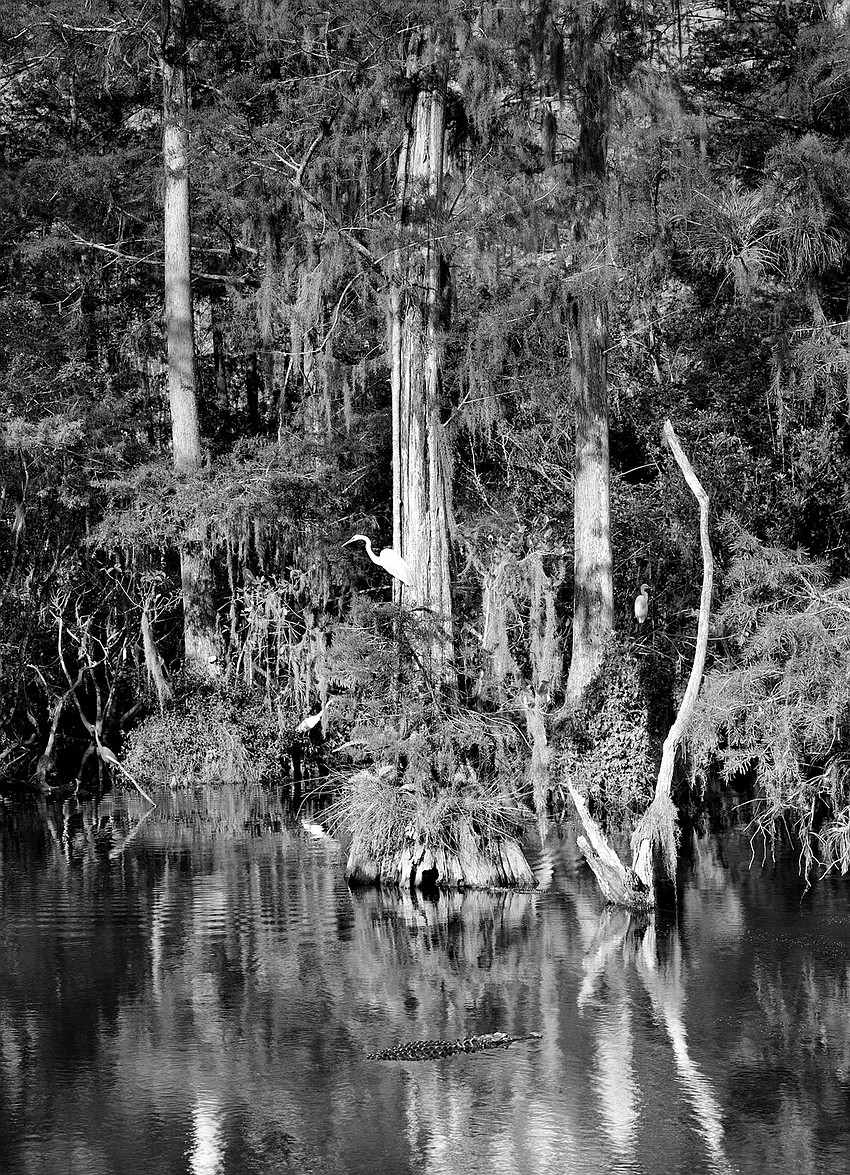
Butcher may indeed follow the centenarian in longevity. But collectors of his photography understand that life is fragile. They turn out in droves, and we mean droves, for the open houses the Butcher family periodically holds at their Big Cypress and Venice galleries.
Indeed, Butcher’s recent stint at Sarasota Memorial reminded him of his own mortality. So after moving to digital photography in 2017, he has returned to traditional photography. His team, including his photo editor, Paul Tilton, scoured the internet, and found Butcher the Alvandi Panoral 45 technical camera that met his specifications in Tehran, Iran.
After it arrived, the first picture Butcher took was of an oak in Myakka State Park. That photo has turned up in Clyde Butcher Photography’s social media feed juxtaposed with one of an oak carved with someone’s initials.
Some people have to be reminded not to deface trees. After all, younger generations didn’t see the America the Beautiful ads in the 1970s featuring a Native American shedding a tear at the sight of litter. (Since denounced for perpetuating Native stereotypes, they made a lasting impression on kids of the era, as did Woodsy Owl’s plea: “Give a hoot. Don’t pollute.”)
After learning about recent bombings of Iran by Israel and the U.S., Butcher became concerned about the welfare of the Tehran camera retailer. He asked his assistant to email the man. “I was so glad to hear he and his family are OK,” Butcher says. The environmentalist is also a humanitarian.