- March 12, 2026

-
-
Loading
Loading

When a hatchling sea turtle trudges through the sand and into the Gulf, it starts an epic journey trekking thousands of miles — but when the time is right, they return right back to their birthplace.
This year was a record for sea turtle nests on Longboat Key according to data collected from Mote Marine, with 1,473 turtle nests recorded, the most since Mote began tracking numbers in the 80s. It was a 17% increase from last year and more than double the amount of nests seen a decade ago. And many of the turtles that struggled onto that white-sand Longboat Key beach were born right there decades ago.
“If you’re hatched on Longboat you’re probably going to lay (a nest) on Longboat,” said Mote Marine Laboratory Staff Scientist Jake Lasala. “Sea turtles have something called natal homing, which means they can figure out where they were hatched and then they’ll come back to nest in that same area.”
It sounds straight out of a sci-fi novel when Florida Fish and Wildlife’s sea turtle research program lead Robbin Trindell describes it.
“It’s believed that when the eggs are incubating in the beach, that’s when they set what is called a magnetic map they use to tell where they are relative to that natal beach,” Trindell said. “It’s believed to be based on a magnetite crystal in their brain that is set according to the magnetic waves they sense on that beach.”
It’s a long way back for them to Longboat Key, even longer than a snowbirds’ route. Trindell said sea turtles can swim, but juveniles usually rely on ocean currents to take them north over and across the Atlantic Ocean.
They typically spend about 7 to 14 years on a chain of islands near Portugal, where they spend their adolescent years. They then make the trek back to the New World with a lot of help from the Canary and North Equatorial currents. They live in shoreline areas of the Gulf and the east coast of the United States before returning near their birthplace to breed, and often back to the very same beach to lay eggs. It’s about a 10,000-mile journey.
Trindell said the process of sea turtles returning to the beach where they were born to nest is a belief that's “very common.”
It has evolutionary advantages, she said, especially for sea turtles, which have a complicated and vulnerable birthing process.
“It makes sense from a natural selection point of view that if there was an area where an animal was able to successfully develop in a nest, make it to the water and then make it offshore to their developmental habitat, then that just gives some predictability of an area where that species can find the correct resources needed for that particular point in their life cycle,” Trindell said.
It takes 20 to 30 years for sea turtles to reach breeding age. Loggerheads can live to be older than 80, according to the National Oceanic Atmospheric Administration.
Longboat Key Turtle Watch, founded in 1969, is seeing the fruits of its early labors as nesting numbers continue to increase. In the summer of 69, the group saw just nine nests.
That number steadily grew over the years. Now in the quadruple digits, many of those baby turtles born decades ago are returning to the beach they were born to start the cycle over again.
Connie Schindewolf began volunteering with Turtle Watch in 1983. As one of the longest serving volunteers, she’s become a sort of historian of the group, and times have changed as more about sea turtles have been discovered through studies over the past decades.
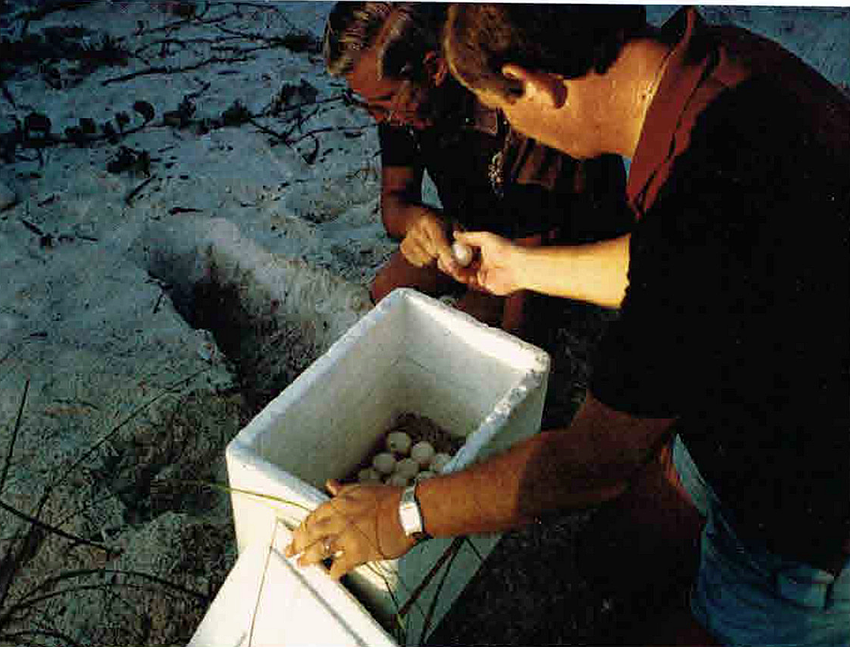
In the early days, they unearthed eggs. After posts marking nests began being removed and used as firewood, the volunteers began digging them up, placing them in foam coolers where they sat on volunteers’ lanais until they hatched.
“We were following guidance from the Florida Natural Resources who were who we reported to. We were digging every nest and we would put them into Styrofoam coolers and when they hatched we would come down to the water, stand back about 20 feet, turn the cooler over and release them and they’d go to the water,” Schindewolf said. “That’s what was going on from about 1983 to about 1990.”
After scientific studies proved that temperature during incubation directly affects the sex of sea turtles, a new method using a hatchery spanned from the late 80s to the early 90s where Wicker Inn is now located.
A hatchery kept the collected eggs in a fenced area to keep predators out.
“It looked like a cemetery. This little fenced off area with a date when we thought it was going to hatch,” Schindewold said.
Lasala with Mote thinks those hatcheries could be a reason for the large number of nests on Longboat Key today.
“I highly suspect that the reason why Longboat has such a high number of nests is because those turtles, and then those turtle’s hatchlings are coming back to the same spot that they hatched from,” Lasala said.
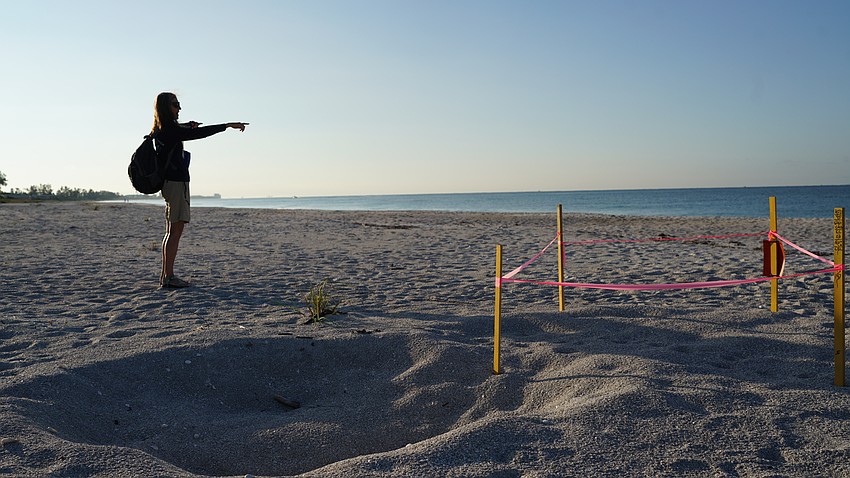
The methods on Longboat have changed, but volunteers still lead the way in sea turtle preservation.
Cyndi Seamon walks the beach each morning looking for tracks and nests just after sunrise during nesting season.
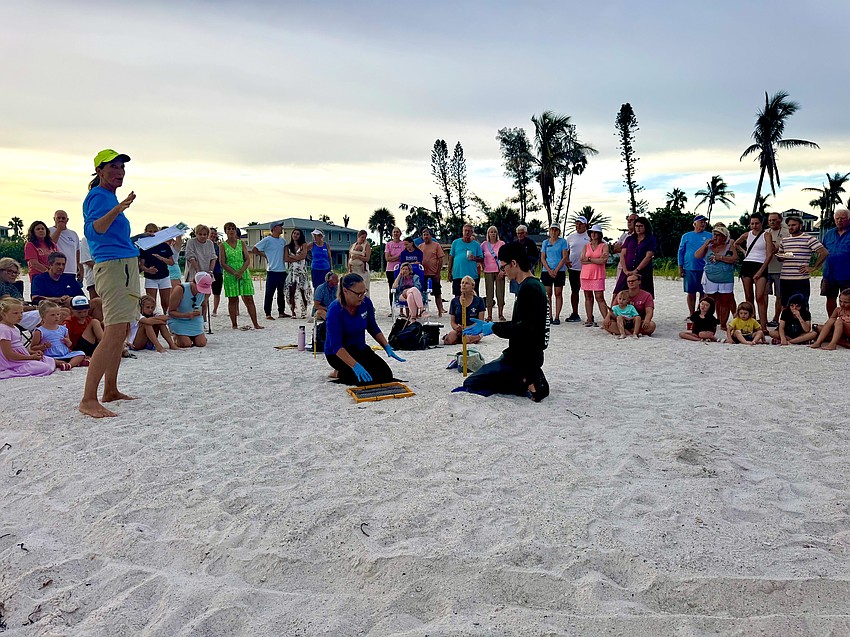
Seamon, vice president and board member of Longboat Key Turtle Watch, said the nonprofit organization splits the Manatee County portion of Longboat beaches into four zones, which volunteers patrol looking for tracks and signs of nests or hatches.
“In the mornings during turtle season, in the beginning of the season, we’re looking for those big crawls from the 200-pound turtles. Every single activity gets documented, every single thing gets put on a piece of paper, entered into (Mote’s) database,” Seamon said. “They are the data holders, we’re collecting it. As the season goes, then we’re checking every single nest to see if there’s any activity whether that be a hatch or a coyote or raccoon that dug into it.”