- March 14, 2026

-
-
Loading
Loading

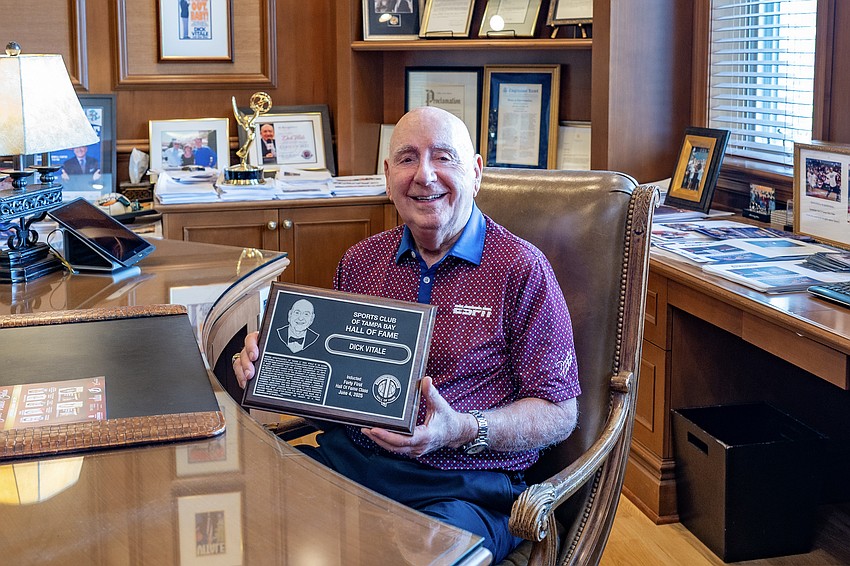
The most famous resident of Lakewood Ranch opens the door to the south wing of his mansion, issues a quick greeting, ushers me into his office and gestures that I should have a seat in a cushy chair across from an arc-shaped wooden desk.
On this Thursday afternoon in early June, it’s immediately apparent that I’m dealing with Dick Vitale — not “Dickie V,” the ebullient color commentator who has called basketball games on ESPN since 1979. There’s no booming voice, no radiant smiles or hearty handshakes, not one “it’s awesome, baby.”
This is Dick Vitale, just a few days short of his 86th birthday, who has overcome serious health issues in recent years and is, somewhat miraculously, back announcing games. A few days from now, he’ll sign a contract extension with ESPN through the 2027-2028 season.
“My one personal goal is to see all my five grandchildren graduate college, and to do that I have to be 90,” he says. “And my other goal is I want to be the first guy on ESPN [for] 50 years. I’m in my 46th now.”
It’s the offseason, and Dick Vitale’s days are still full to the brim. Most start with breakfast at the Market Street First Watch, where people approach him and he obliges with autographs and pics. “I’m not going to put myself in my house and hide from people,” Vitale says. “I’m not that way. If people don’t recognize me, I’ll put a sign on my back.”
He runs errands, makes phone calls, dines out most nights with his wife of 54 years, Lorraine, and pours relentless effort into raising money for his high-profile fight against pediatric cancer. It’s 2:30 in the afternoon and Vitale has already lived a full day, certainly for someone in his mid-80s. It’s fair to say that the man needs to conserve energy, so it comes as little surprise that I’m not getting Dickie V today.
But I wonder: What Dick Vitale will I get?
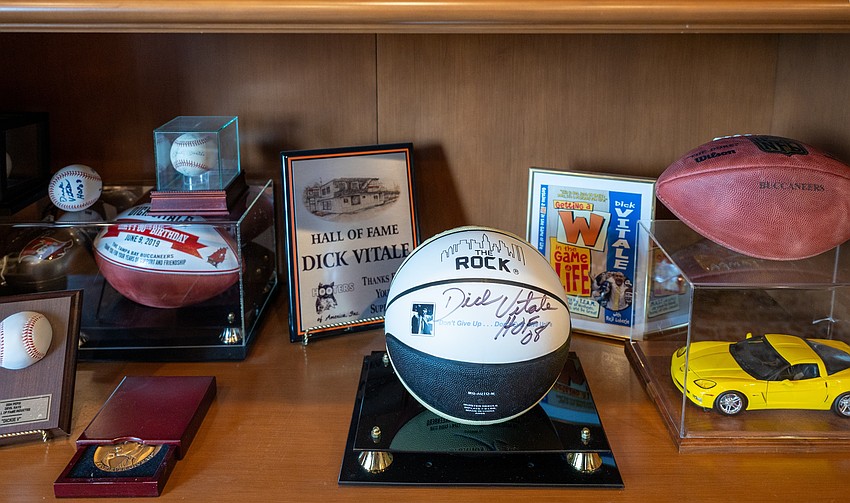
Amid the office’s deep-brown decor — desk, chairs, walls and shelves covered with framed photos and awards — stands a big grease board scrawled top to bottom with black magic marker: The Dick Vitale Pediatric Fund, it says, has raised $105 million, punctuated by “WOW!” Vitale’s charity is part of the V Foundation, which was founded by and is named after Jim Valvano, an accomplished college coach and Vitale’s dear friend who died from cancer in 1993.
Vitale, dressed in navy blue shorts and a pink-patterned golf shirt with the ESPN logo on the chest, starts pulling printouts of news clippings from piles and stuffing them into a padded envelope, all the while delivering a monologue about his charity and how important it is to ease the suffering of children with cancer. After a few minutes, he hands me the envelope, sits across from me behind his desk, and continues his pitch about the need for cancer research. This is Dick Vitale, the tireless promoter of his passion project. It’s a default mode.
But it’s not the Dick Vitale I’ve come to see.
After a few minutes, I politely interject, explaining to him that his philanthropic efforts are widely known, widely chronicled and highly revered by the community, including me. But what I hope to do is write a story about Dick Vitale the person. In effect, I’ve come to get as much of his life story as I can.
“Is that OK?” I ask him.
“Sure, whatever you want,” he replies.
And, man, do I get it — a two-hour-plus version of the Dick Vitale saga, the ups, the downs, the joy, the pain, the dark times that challenged his unremitting optimism. Above all, it’s been a life full of boundless love — given and received.
Vitale gets choked up and misty-eyed several times during the interview. “A lot of people say they’ve never seen their father cry,” says Vitale’s daughter Sherri, the youngest of two. “My dad cries. He’s an extremely sensitive man.”
He went by Richie. Richie Vitale, a likable kid.
The Vitales lived in a working-class neighborhood in East Paterson (now Elmwood Park), New Jersey, 20 miles from New York City. Neither of his parents got past the eighth grade. His father, John, pressed coats in a factory, paid by the coat, and at night had a job as a security guard at a nearby shopping mall. His mother, Mae, worked as a seamstress and held down the house. “I grew up in a home full of love,” Vitale says.
Before kindergarten, Richie lost the sight in his left eye after injuring himself with a pencil. That didn’t stop him from mixing it up on the playgrounds. He pitched in Little League and was “a pretty good little quarterback,” Vitale recalls, “a pretty good athlete.”
The Vitales attended Mass every Sunday, and afterward many of Richie’s 16 aunts and uncles on his father’s side would stop by the small, one-bathroom home to watch sports and to argue about it. Richie, a Yankees fan, eagerly joined in.
He had a wandering left eye, which made him the brunt of teasing from his classmates. The mockery stung, but he didn’t let on. With his disability, football was a no-go in high school. As far as basketball, “I was a pretty good shooter, but I had no quickness,” Vitale says.
Vitale earned a business administration degree from Seton Hall University — 15 miles south of home — and took a job in the accounting office of a plumbing company in Paterson. “I hated it from my first day,” he says. Soon after, he switched careers, taking a position as a teacher and coach at Mark Twain elementary school in Garfield. A year later, East Rutherford High, his alma mater, recruited him to coach varsity basketball. Colleagues started calling him Dick, and it stuck.
One night, while he was hanging out with some friends at the Blue Swan Inn in Rochelle Park, he approached a woman named Lorraine McGrath. “I guess you’d call it a singles place,” Lorraine Vitale says, sitting on a couch in their capacious living room. “I was there with my girlfriend.” He asked her to dance. She turned him down. He asked some more and finally got a yes. They went on a date the following week.
The couple married in 1971 and raised two daughters — Terri Vitale Sforzo and Sherri Vitale Krug — both of whom live with their families just a short drive from Mom and Dad.

East Rutherford High’s basketball facility consisted of a crackerbox gym so small that it couldn’t accommodate home games. Even so, one season Vitale led his team to a 35-0 record. “I guarantee you there haven’t been many undefeated teams that played all their games on the road,” he effuses.
Vitale reveled in his high school success, but itched to join the college coaching ranks. After a series of rejections, he landed a job as an assistant at Rutgers. Vitale’s income dropped from $12,000 to $11,000. He was never so happy to forfeit a thousand bucks. New head coach Dick Lloyd put him in charge of recruiting, and Vitale quickly upgraded the program’s talent. Word of his success at Rutgers got around, and in 1973, University of Detroit (now Detroit Mercy) hired him as head coach. Vitale steadily built the program’s success, culminating in 1977 with an odds-defying run to the Sweet 16 in the NCAA tournament, which ended with a loss to powerhouse Michigan. Scotty Connal, who produced the game for NBC, took note of Vitale’s energy and charisma.
Ultimately, the stress of coaching took its toll on Vitale’s health, causing him to suffer from bleeding ulcers and other maladies. The following year he stepped away from the job and became the school’s athletic director. One day, Vitale recalls, he was sitting in his “old dumpy office” when his secretary told him he had a visitor. It was Bill Davidson, owner of the NBA’s Detroit Pistons. He offered Vitale the team’s head coaching position, which came with a multiyear contract at a six-figure salary and new Cadillacs every 6,000 miles for both him and Lorraine. He accepted.
“It wasn’t right for me,” Vitale says, “and I’m gonna tell you why.”
Coaching an NBA team has always been a tough racket. Top players usually make more than the head coaches, which creates a touchy power dynamic. Players get injured and traded, fans are fickle. The list goes on. Suffice to say the job comes with ceaseless pressure. “You think you’re a genius and you’re gonna fix everything,” Vitale says. “You’re not.”
Of all the stresses that weighed on Vitale during his tenure with the Pistons, the one that stood above all was the most basic: losing. In his first year, he led an injury-riddled team to a record of 30-52. Davidson continued to support him, recognizing that the team was not yet set up to win, Vitale says. Even so, the hyper-emotional head coach poured his heart out to the owner, bemoaning the losses. “It was killing me inside because everything I ever touched in my life had been win, win, win,” Vitale says.
His baggage weighed on the family. “You could be planning Christmas dinner and he’d lose a game,” Lorraine says. “And then forget about Christmas dinner or presents or Santa Claus or anything.”
In the early part of Vitale’s second season with the Pistons, he continued to share with the owner how tortured he was over the losses. Twelve games in — with a record of 4-8 — Davidson fired him. “He said, ‘Dick, we loved your spirit, your energy,’” Vitale remembers, “‘but you can’t have that [can’t-win] mentality. That’s not who we thought we hired.’”
A devastated, jobless Vitale moped around the house. Lorraine scolded him. “You’re a guy who fights,’” he recalls her saying, “‘You lost your eye as a kid, you’ve overcome all the challenges. You’re letting this eat you up alive.’”
A few weeks after his dismissal from the Pistons, Vitale got a call from Connal, the TV exec he’d met during the Sweet 16, who had moved over to a startup cable network called ESPN. Connal invited the newly unemployed coach to be a color commentator for college basketball games. Vitale scoffed at the idea, but Lorraine pushed him to give it a try. On Dec. 5, 1979, ESPN aired its first college game — with Dick Vitale on the call. He made $350 and had fun doing it. But his game needed work — he was, unsurprisingly, too verbose — so ESPN got its color man some coaching.
Vitale reckons that it took a couple of years to lose the itch to coach hoops again and fully embrace his new gig. A key factor: “I had no more worries about winning and losing.”
After both of the Vitale girls attended the Nick Bollettieri Tennis Academy, in 1986 the family moved from Michigan to Bradenton, then to Sarasota and ultimately to Lakewood Ranch.
Vitale went on to be one of the preeminent TV sportscasters of his or any other generation and earned the fame and fortune that goes with it. His catch-phrases — headlined by “it’s awesome, baby!” — elbowed their way into the sports lexicon.
Play-by-play announcer Dan Schulman estimates that he called about 500 games with Vitale. “It was buckle up, because you never know where it’s gonna go,” he says. “And I was happy to wind him up and happy to let him go.”
Although Vitale may have come off to TV viewers as a loose cannon firing random shots across the bow, he was always meticulously prepared and delivered insightful commentary in his inimitable way. “I think he just understood better than anybody else and earlier than most that this is an entertainment business,” Schulman says. “He leaned into that, but not at the exclusion of preparation or information.”
It was not all love. A lot of hoops-watchers hated what they considered Vitale’s over-the-top shtick. And many of those haters were prominent sportswriters who wrote scathing pieces about him. Those slams stung badly. “People on the outside might see him and think he’s immune to criticism,” daughter Sherri says. “But, especially early in his career, it really got inside him.”
All told, it’s been a fairy-tale career, and a blessed life — except when it wasn’t. In the mid-2000s, Vitale had surgery to remove lesions from his vocal cords. They were non-cancerous, a relief, but six weeks of vocal rest were not. During that time, he had to scrawl out thoughts on a little grease board.
Vitale healed up, and soon he was Dickie V again. Matters took an ominous turn in 2021, when the tireless cancer warrior got hit with three diagnoses in succession — melanoma, lymphoma and, scariest of all, vocal cord cancer, which sentenced him to another extended period of silence. “I felt trapped,” Vitale says. In June 2024, more bad news: a diagnosis of lymph node cancer. Then in December of last year, Vitale announced he was cancer-free. On Jan. 25, he was in Winston-Salem, N.C., calling the Duke-Wake Forest game.
Dick Vitale has a few years to go to reach his personal and professional goals. Don’t bet against him. And if you see him at First Watch or in another restaurant, feel free to say hi.