- April 2, 2026

-
-
Loading
Loading
Hundreds of triathletes gathered at The Resort at Longboat Key Club last monthprepared to run, cycle and swim their way to victory.
But the morning of Oct. 14, and the Gulf of Mexico, had other plans.
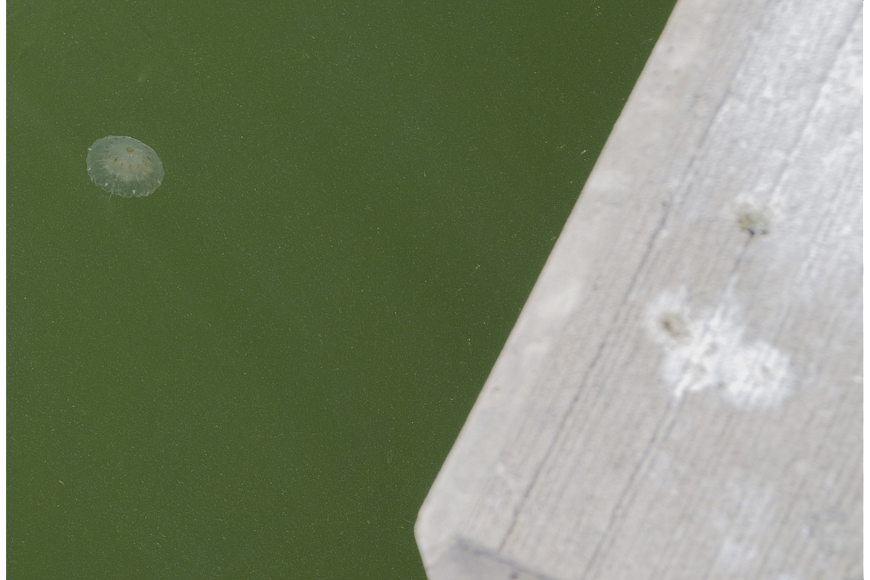
That’s because the lagoon at The Resort at Longboat Key Club was filled with jellyfish. Through November, They continued washing up along beaches as well.
Most of them are Atlantic sea nettles ranging from four and eight inches in diameter, said Andrew Angelo, a jellyfish specialist and biologist at Mote Marine Laboratory and Aquarium.
These animals can grow to longer than one-and-a-half feet and more than nine inches in diameter, have a brown striation around their bells and a brown spot in the center, “almost like a bull’s-eye,” Angelo said.
Although these squishy invertebrates are often prevalent in late summer and early fall, Angelo said this year’s smack — the technical term for a group of jellyfish — is unique.
“I’ve never seen them as prominent as they’ve been this season,” said Angelo, who’s spent seven years at Mote.
“I’ve never seen them as prominent as they’ve been this season"
But he said he’s not sure why there are so many this year.
It could be the storm surge from Hurricane Irma, which disturbed and suspended nutrient rich material in the water column along the coast: food that attracts zooplankton — Atlantic sea nettle’s main source of food, Angelo said.
Those storm surges could have also brought the jellyfish toward the shore — these gelatinous creatures do not move on their own but rather with the currents, Angelo said.
The Gulf of Mexico is also at a much lower salinity — or salt concentration — than normal, Angelo said. This is an ideal climate for Atlantic sea nettle jellies, allowing them to reproduce at a higher rate than if salinity numbers were higher, Angelo said.
It could also have something to do with global jellyfish numbers. Jellyfish populations swell and slough over a period of years.
Angelo said he hasn’t seen literature about growing Atlantic sea nettle smacks, but it could be a reason for the increase in population along Longboat Key.
It’s still a guessing game as far as when these jellies might leave, Angelo said. He said it all comes down to tides, winds and currents.
“Your guess is as good as mine,” Angelo said.