- March 10, 2026

-
-
Loading
Loading
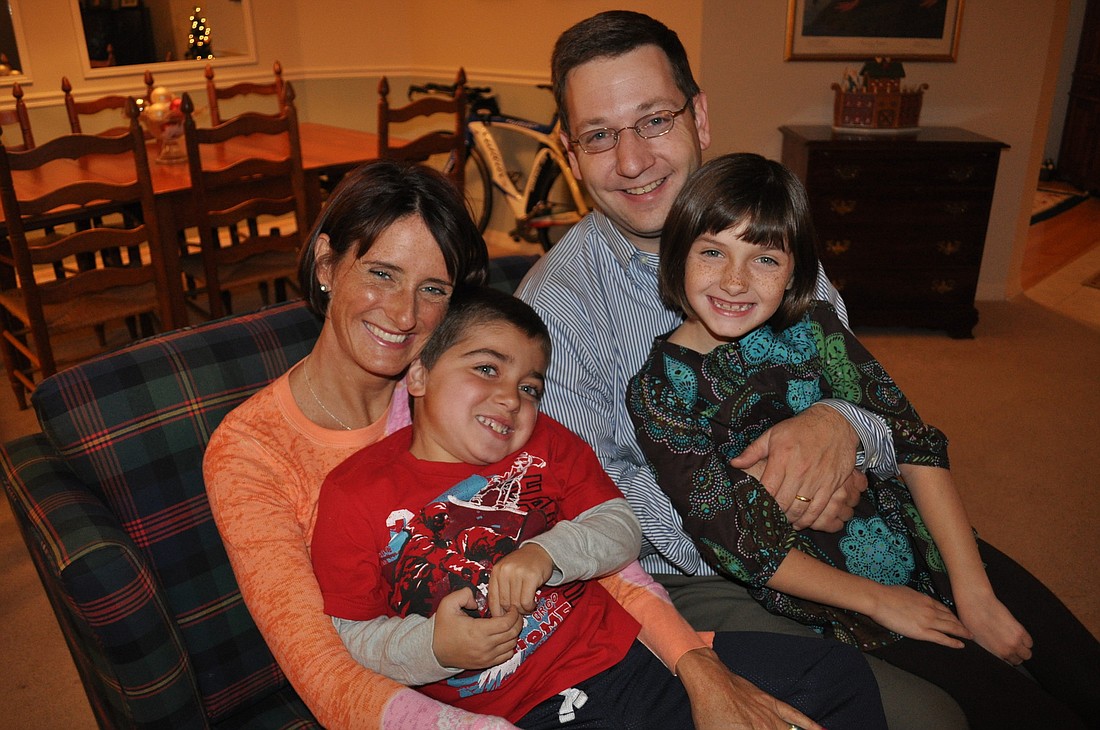
SABAL HARBOUR — As Sabal Harbour resident Nick Tullio raced into the last few miles of the 2011 Walt Disney World Half Marathon Jan. 8, he could feel his muscles burning.
But despite the challenge of running 13.1 miles, Tullio focused on his 7-year-old son, Grayson, who suffers from Duchenne muscular dystrophy, a fatal genetic disorder that results in progressive muscle weakness.
“The last couple of miles (of the run) were tougher from a fatigue standpoint,” Nick Tullio says. “When I (thought) of the challenges Grayson has when it comes to climbing the stairs or getting to bed, it puts it in perspective — and I pushed through.”
Tullio finished his first half-marathon in about two hours, 20 minutes. With the support of friends, family and others, he raised more than $2,000 for Parent Project Muscular Dystrophy, an organization that raises funds specifically for research and finding a cure for Duchenne. The organization had about 100 runners participating in last weekend’s race, which was part of its Run for Our Sons fundraising campaign.
“I had a lot of fun,” Nick Tullio says. “I’m still recovering but look forward to other fundraising, whether it be races or otherwise.”
PROGRESSION
When the Tullios gave birth to their twin children, Grayson and Emma, now 7, they had no idea there were any potential problems. But as the children developed, Grayson’s mother, Jennifer, couldn’t shrug the fear that something may be wrong with her son.
“He was slow to do things, specifically walking, crawling,” she says. “We had him in therapy from one year on. We just thought he had low muscle tone.”
When Grayson was about 18 months old, a trip to the emergency room because of breathing problems gave the couple new insights. Blood tests showed Grayson’s liver enzymes were abnormal, setting off a series of tests. Six months later, doctors took a biopsy of Grayson’s muscles, leading to a diagnosis of Duchenne.
“We never in a million years dreamed (it would be something like this),” Jennifer says.
She and Nick quickly found a neurologist and began Grayson’s treatment.
“You can ignore it a lot at first,” Jennifer says of the condition. “It’s the early stages — (Grayson) likes to be carried a lot.”
But now at about 50 pounds, Grayson is too large to carry long distances, and his condition is more noticeable.
The Tullios fitted him recently for his first wheelchair for use at theme parks, long walks or other more laborious excursions. Grayson also is on a waiting list for a helper dog, which will help him turn on lights and carry his books, for example.
“Your muscles break down easily,” Jennifer says of Duchenne and notes most children with Duchenne are confined to a wheelchair by their pre-teenage years. “Right now (Grayson) can walk, but he walks slow. You’re still on a clock against time.”
FIGHTING FOR HOPE
Upon arriving home, Grayson leaps toward the couch, laughing and chatting like any other active 7-year-old boy.
“He talks a lot and he talks loud,” Jennifer says with a grin. “He’s just a happy kid. We try to talk about (his condition) now. We’ve given it a name.”
Although there is no cure for Duchenne, Grayson is on three medications. The most important is a Cortisteriod, which helps prevent the muscles from breaking down. Unfortunately, side effects include weight gain and aggression, the first of which the Tullios are now beginning to see in Grayson.
Grayson, a student at Willis Elementary School, goes to occupational and physical therapy each once a week and also goes to InStride Equine Assisted Therapy in Nokomis for therapeutic horseback riding every Saturday.
“It’s our role as parents to provide the best life we can for Grayson,” Nick says.
Every day, the Tullios wage war against their grief, knowing they likely will outlive their child by many years. The pain comes in waves — sometimes as anger, sometimes as helplessness. But ultimately, they believe that through awareness and raising funding for research, a cure for Duchenne may soon develop.
“It’s all the same feelings you have (while grieving), but you try to focus on hope — that they’re going to find a cure,” Jennifer says. “That’s why we feel strongly about Parent Project.”
The Tullios say they also support the Muscular Dystrophy Association and other organizations that have helped them over the years.
BECOMING ADVOCATES
A longtime runner, Jennifer Tullio was the first in the family to tackle a marathon for the sake of her child. Choosing to raise funds for Parent Project Muscular Dystrophy. Jennifer Tullio tackled the New York Marathon for Parent Project in 2008 and again in 2010.
“I’ve always been a runner, but a half marathon is all I ever did,” Jennifer says, noting when she joined the Lakewood Ranch Runners Club, her fellow runners all did marathons. “If I decided to take that on, I (was) going to do it for Grayson.”
Nick, although not a runner, decided to take on the effort as well. He planned to run a half-marathon last year, but suffered a stress fracture days before the race. Jennifer ran in his place. Nick took a year off to recover before restarting his training in August.
“I had to start pretty much from the bottom again,” he says.
The couple takes turns running in the mornings so one parent is home with the children. The Tullios say running is a great way to become healthier, but it’s also a great way to fight for their child’s future.
“It’s tough,” Nick says of the battle. “You can crawl under a rock (and wait for change to happen) or you can (work) for another outcome. Ultimately the goal is to find a cure for Duchenne and the boys affected by it. At the end of the day, a cure is what we are after.”
Nick Tullio this week launched a new website, which has information about Grayson, Duchenne and a way to donate to the cause.
Contact Pam Eubanks at [email protected].
WHAT IS DUCHENNE?
Duchenne muscular dystrophy is a fatal genetic disorder affecting one in 3,500 live male births. The condition, which results from a mutation in the gene that encodes for dystrophin, results in the progressive muscle weakness, which also leads to medical problems with both the heart and lungs. Most men with Duchenne live into their late 20s but require the use of a wheelchair by their teenage years.
Because the mutation occurs on the X chromosome, it most commonly affects boys. Duchenne is passed from parent to child, but more than one-third of cases occur because of spontaneous mutations.
Source: www.parentprojectmd.org
HOW TO HELP
For information on Grayson, Duchenne and ways you can help, visit the Tullio’s website. For information about Parent Project Muscular Dystrophy, visit www.parentprojectmd.org.