- March 19, 2026

-
-
Loading
Loading
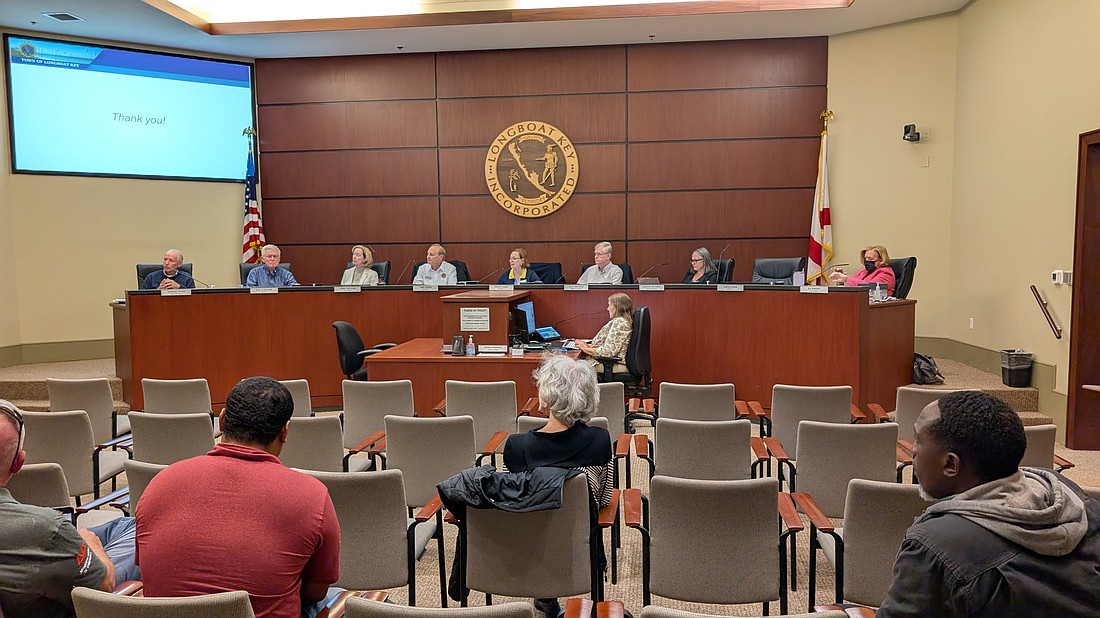
Temporary is a subjective word, but Longboat Key town commissioners got some clarification on what exactly it means when discussing certificates of occupancy on Longboat Key.
Town Attorney Maggie Mooney provided commissioners a memo detailing the town’s rules and regulations for temporary certificates of occupancy, or TCOs, at a workshop meeting. The topic led to discussion among commissioners about if there are ways to improve how TCOs are issued in the town.
Mayor Ken Schneier said the Commission was hoping to get clarity on the regulations because there have been examples of repeated TCO renewals.
“The issue as it has come up, without mentioning any cases, has been a function of living under what seems to be a perpetual TCO,” Schneier said.
Temporary certificates must be re-applied for every 30 days and are issued by and under the discretion of the building official.
“It’s important to understand that TCOs and their requests are not guaranteed,” Mooney said, later elaborating that “if the building official is going to not extend (a TCO), while it is discretionary, I would encourage our building official to have a really good reason why they are not going to do that.”
Town code specifies that buildings can remain with a temporary certificate for a maximum of three years.
“If that property does not obtain it within the three-year timeframe, then that site plan approval is null and void and technically they would be out of compliance with their development,” Mooney said.
TCOs may sound familiar to those who have paid attention to the most consequential Longboat Key development in recent years: the St. Regis Longboat Key Resort. The resort built on the former site of the Colony Beach & Tennis Resort opened in August 2024. Seventeen months later, the resort is still operating under a temporary certificate. In October, Town Manager Howard Tipton said “we have let them know that they need to be winding this down and wrapping this up,” when it comes to how much longer the resort can operate under a temporary certificate.
Commissioner BJ Bishop expressed frustration that those trying to move into single-family homes may not be given TCOs like large commercial projects may receive.
“Those issues on residential are never going to come in front of (the Commission). So the frustration level of our community is I can’t move into my house until every shrub and plant is built, but a commercial project can be missing their hurricane protection and whatever else they haven’t done and they’re able to move in with no consequences,” she said.
Planning and Zoning Director Allen Parsons told town commissioners that there is often a financial incentive for shifting from a TCO to a CO, saying that financing for large projects is often tied to the milestone of being issued a CO, not a TCO.
“The one project that we’re all not mentioning here is atypical (for Longboat Key),” Parsons said, alluding to the elephant in the room.
Commissioner Penny Gold pointed to the elephant, mentioning St. Regis in defense of the resort, saying that dealing with contractors, utilities, vendors, etc., is not easy for single-family home construction, let alone a large multimillion-dollar hotel.
“A huge project like the St. Regis, I can’t even imagine how many issues they might have been working on through last year,” Gold said. “In reading through this ordinance, I don’t see that there’s anything major in here that needs to be changed. It seems like a reasonable standard with a cut-off in three years.”
When St. Regis was mentioned specifically, Mooney said it would be better to talk about the issue in a more general sense.
“I am getting very uncomfortable about the discussion of a property owner and a property that is not in here. This was a high level discussion, and that was what it was intended to be,” Mooney said. “If you are discussing particular properties, and I know you’re giving a hypothetical in what may or may not happen to a particular property, it is simply not appropriate to do that without them in the room.”
Whether three years is an appropriate amount of time to allow buildings to stay under a TCO may be a moot point, at least for now. State of Florida Senate Bill 180 prevents local governments impacted by 2024 hurricanes from enacting more “restrictive or burdensome” land development regulations or comprehensive plan changes until 2027.
No action was taken at the workshop meeting.