- April 10, 2026

-
-
Loading
Loading
Just leave us alone!
That’s what we want.
Laissez-faire.
That is our Word for 2026.
Longtime readers know this tradition. In the first or second edition each year, we publish a Word — one word to live by, to guide our direction and actions in the new year, to inspire us year-round, to serve as a guidepost for what we do and want to accomplish in the new year.
Laissez-faire is a bit different.
It’s a reminder — on multiple levels. It’s a reminder and direct admonition to every elected and wanna-be officeholder of how most Americans want to live; a reminder of what is required for liberty and economic prosperity; and a reminder of what we should be teaching our children and grandchildren.
Indeed, my guess is if you cut through all the noise, divisiveness and vitriol that erupts as a result of the actions of our politicians and governments — federal, state and local, Republicans and Democrats alike — at the core of Americans’ most fundamental desires is to be left alone.
We want to live our lives the way we want to live them; to live in the ways that make us happy; to live as neighbors who respect one another’s personal interests (so long as they do no harm). To live in peace.
Yes, we also want to live by the rule of law. But we want to live by the rules our Founders established — with our governments constrained and limited, and reversing the never-ending, growing, freedom-sucking leviathan that nags, nips and intrudes into every facet of our lives.
Laissez-faire.
Then there is the economic side. It’s quite obvious today the term laissez-faire capitalism is reviled. There are only a few of us who embrace the idea of an unfettered, free-market economy based on peaceful, voluntary trade with one another; with government serving only as a forum for determining the rules of the game; as an umpire to resolve disputes; and, most important, serving to protect our individual rights.
In the words of laissez-faire capitalism’s most ardent advocate in history, the late Ayn Rand, “If one wishes to uphold individual rights, one must realize capitalism is the only system that can uphold and protect them.”
Sadly, however, it’s no exaggeration to venture that most Americans reject this truth: That we would all be so much better off and prosperous if the chains of government were taken off U.S. businesses and individuals. Abolish crony capitalism and subsidies; dismember the federal regulatory leviathan.
The idea of laissez-faire has been around since long before Christ. Jeffrey Tucker, founder and president of the Brownstone Institute, wrote an engaging essay in 2017 on the meaning and origins of laissez-faire for the Foundation for Economic Education.
The French term came about in 1680 during the reign of King Louis XIV. Like all despots, he created an economic disaster with ever-increasing taxation (Some things have never changed.) To reverse this, Jean-Baptiste Colbert, the king’s finance minister, believed that imposing more government regulations and controls would boost economic activity and prosperity.
But as the story goes, when Colbert asked a group of manufacturers what he could do for industry, a merchant named M. Le Gendre responded: “Laissez-nous faire!” … “Let it be!”
Seventy years later, according to Tucker, the incident was reported in a French economic journal, and the full phrase became “Laissez-faire et laissez-passer, le monde va de lui même!” Translated: “Let it be, and let goods pass; the world goes by itself.”
But the roots of laissez-faire go back even before the French disaster. Tucker found that wise Chinese philosophers spoke of laissez-faire as early as 300 B.C. In his 2017 essay, Tucker recounted Chinese references. A sampling:
“The Sage says: ‘I take no action, yet the people transform themselves, I favor quiescence and the people right themselves, I take no action and the people enrich themselves … ’”
And yet, the politicians cannot help themselves.
So many of them, of course, are smarter than we are and know far more than we how we should live our lives. Clearly, the majority of them must believe that.
Judging from their actions, they obviously think it is their voter-given mandate and right to go to Washington or Tallahassee or Town Hall to pass laws that regulate how you live; to prescribe a benefit or favor to one group at your expense; to create a government benefit that can be seen now — but to heck with thinking about the inevitably negative unintended consequences.
They can’t help but meddle.
In the Florida Legislature, for instance, the 120 House members are limited to filing six bills each a year. Typically, they do — 720 bills.
There is no limit for the 40 Senate members. In the 2025 legislative session, Sen. Joe Gruters, R-Sarasota, sponsored or co-sponsored 45 bills; Sen. Lori Burton, D-Palm Beach, sponsored or co-sponsored 48 bills. Altogether, 1,959 bills were filed in the 2025 session.
Really? There is that much that requires new laws?
Thankfully, only 269 were passed. Still, imagine that every year.
Mind you, some bills are necessary to keep Florida’s government operating. Many come to life from constituents who want the government to tilt the playing table one way or another.
Still others are the result of what Milton Friedman referred to as “the law of laws.” A legislature adopts one law to fix a perceived wrong. Then it comes back the next year to modify the unintended consequences of the original law. And then the next year it modifies the consequences of the previous year. Ad infinitum this goes.
Washington is far worse. It’s always a pendulum swing — from the exasperation and disappointment brought on by one side to the exasperation and disappointment from the other — e.g. Biden to Trump; Democrat majority to Republican majority. We merely trade one version of egregious intervention and picking winners and losers for another.
Neither is successful. They both bring ever-more government, with a never-ending litany of failures from both sides — $38 trillion national debt; $1.7 billion annual deficit; $100 billion a year taken from taxpayers to subsidize 42 million Americans on SNAP; disastrous health-care regulations; and on and on.
Or consider this marker of the extent of government in our lives: The Federal Register. The register is the daily journal of all agency regulations; proposed rules and notices; executive orders, proclamations and presidential documents. See the accompanying box showing how government always grows.
When you put all of the federal Leviathan together, you can still apply Milton Friedman’s conclusion in his 1962 classic, “Capitalism and Freedom”: “The greater part of the ventures undertaken by government in the past few decades have failed … The central defect of these measures is that they seek through government to force people to act against their own immediate interests to promote a supposedly general interest.”
How and why does this happen? Friedman: “Men of good intentions and goodwill who … use the power of the state to achieve their ends and confident of their own ability to do so.”
As noted earlier, they are certain they know better than we how we should live. Talk about hubris.
When you vote in the mid-term elections in 2026, choose the candidates who reject the Zohran Mamdani dogma that “there is no problem too large for government to solve, and no concern too small for it to care about.”
Choose the candidates who will leave us alone. As the late Austrian economist F.A. Hayek noted: “Though democracy is probably the best form of limited government, it becomes an absurdity if it turns into unlimited government.”
Laissez-faire. Leave us alone!
The word “capitalism” has been a dirty word in the U.S. for a century. The full phrase, laissez-faire capitalism, has been even dirtier.
Progressives and conservatives alike harrumph that we can’t have an unfettered, unregulated, free-market economy. They fret there would be anarchy and unbridled greed.
Indeed, as Jeffrey Tucker wrote: The Left thinks “if we let the economic sphere be free, the world will collapse.” Oh, imagine what a horrible calamity life would be without government control. Ha!
Likewise, the Right disdains a free market because it “is similarly convinced that state control is necessary, lest the world collapse into violent, warring, culture-destroying gangs.”
Neither would happen.
History is always a good reference point. If you go back to the beginning of the second century of the U.S. — for 35 years from the mid-1860s to 1900 — laissez-faire capitalism and limited government worked.
In “The Fall and Rise of Laissez-Faire in the United States, 1789-1900,” economic historian Burton Folsom Jr. chronicles how the “Gilded Age” was the most laissez-faire and limited government era in American history. The U.S. prospered.
“More Americans than ever before,” Folsom wrote, “came to believe that if the United States were ever to become a serious economic force in the world, it would have to be done in free markets with very limited federal aid.” Leading Democrats and Republicans alike actually embraced that.
Folsom: “To help ensure that Congress would not be tempted to seriously intervene in future economic development, President Ulysses Grant worked to eliminate the federal income tax” — a goal he achieved in 1872.
During this period, the U.S. and Congress achieved 28 consecutive years of budget surpluses. The national debt shrank from $3 billion in 1866 to less than $1 billion in 1893.
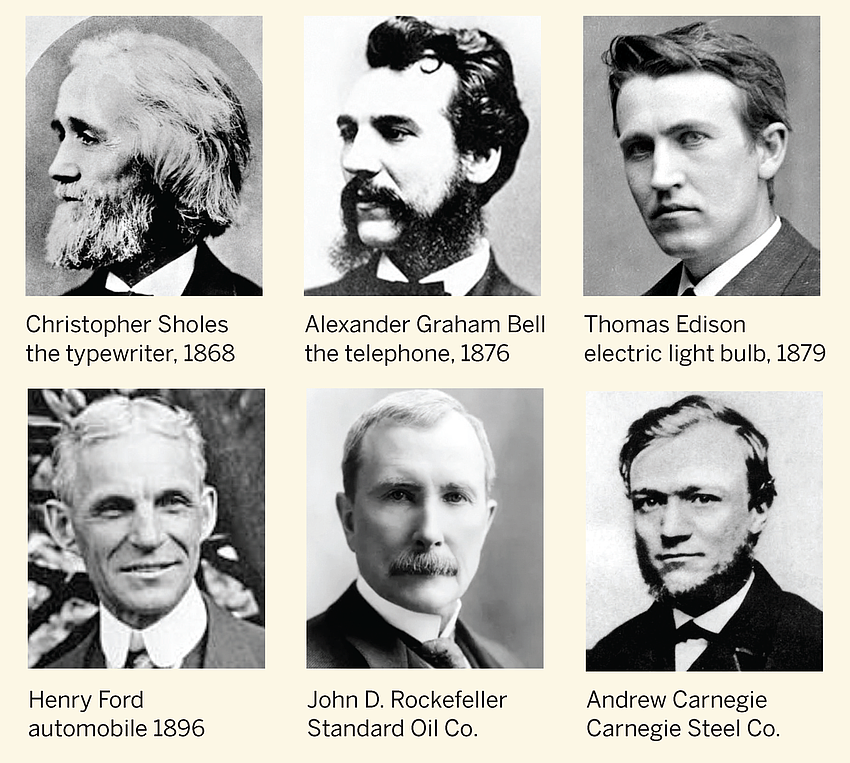
More important, Folsom said, the achievements of entrepreneurs, inventors and developers during this period were “in a word, spectacular.” A few:
Christopher Sholes secured a patent for the typewriter in 1868. Alexander Graham Bell invented the telephone in 1876. Thomas Edison changed the world with electricity and invented the phonograph and movie film in the late 1880s. Henry Ford operated his first car in 1896.
And, of course, there were John D. Rockefeller and Andrew Carnegie, the kings of oil and steel. Their businesses made kerosene and railroad travel widely affordable and created thousands of jobs.
By 1900, the U.S. surpassed Great Britain as the greatest economic power in the world.
It can be done — limited government and free-market capitalism. And with great success.
But sadly, Folsom wrote: “The triumph of laissez-faire lasted only one generation.”
The Gilded Age gave way to the Progressive Era (1900-1920), when the cries began for government intervention … taxing high earners; regulating railroads; breaking up big businesses. Cries that have carried on for a century and have spread into every corner of the economy and our lives.
From agriculture to health care to home building to employee pay to savings accounts to light-bulb wattage to toilet bowl flushing, our so-called free-market, capitalistic, economic system is anything but free.
It’s a system of crony capitalism, subsidies, regulations and lawsuits — tentacles of an incurable cancer that persistently pervades federal and state governments. Quoting Friedman again: When it comes to asking for favors from government, businesses are always first in line.
There are no signs the evils of interventionism and crony subsidizations will end. It’s quite the opposite. Not only is our current Republican president an interventionist extraordinaire, constantly picking winners and losers, we have a socialist radical as the mayor of New York City.
This is why we’re heralding laissez-faire as the Word for 2026. Even 60 years ago, F.A. Hayek, said of the slide toward serfdom and socialism, “What is most urgently needed in most parts of the world is a thorough sweeping away of the obstacles to free growth.”
Let the world take care of itself. Laissez-faire. Leave us alone!
Electing pro-liberty, pro-capitalist candidates to public office is one way. Another is education — of the American populace and next generations.
This is crazy: Typically, the most important issues to Americans in every election are their pocketbook and the state of the economy. And yet, so few Americans appear to have an understanding of or care how economics and capitalism work, or how their freedom and capitalism are so intertwined and so adversely affected by government intervention.
Indeed, the amount of disdain Gen Zers have for capitalism is alarming. When pollster Frank Luntz conducted focus groups of Gen Zers in 2024, Luntz summarized the results:
“(They) think the inequality that exists in America justifies economic redistribution and government directly engaging in the economy in a more aggressive fashion. The intensity is anti-capitalism rather than pro-socialism. Young people resent and reject the current system much more than they embrace and support socialism.”
Much of that can be attributed to ignorance.
To that end, when we asked Florida State University economics professors about their experiences with first- and second-year undergrads who come into their classes, here are the comments of Professor Michal Hammock, Ph.D., who teaches principles of micro and macroecomics to 2,000 students a year:
“Most of my students … had a high school economics class of poor quality. The class is usually taught by a coach with no knowledge or interest in the subject, and students come away from this experience with an impression that economics is boring, and no clear understanding of what economics is. A small group of students has taken AP economics courses in high school, and those are much higher quality.”
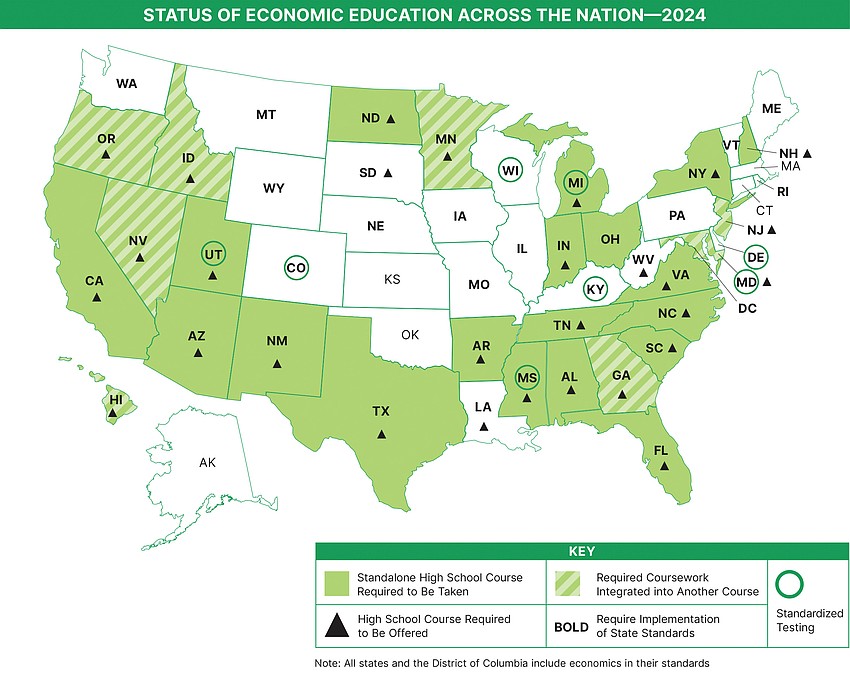
For 75, years, the Council of Economic Education has tried to spread the knowledge of economics and personal finance. This not-for-profit coalition of economics and personal finance educators, private-sector corporations, business leaders and economists has been dedicated to training teachers and integrating economics and personal finance into K-12 schools. It has been slow going, but it’s making progress. (See: CouncilForEconEd.org/Cee-History-Timeline/.)
In 2024, the CEE said it reached 5 million students. Sadly, that is not quite 10% of the estimated 55 million children in U.S. schools. To the good, the numbers continue to grow, albeit slowly. (See map.)
But the economic educators’ plight is also a clear indicator that if the understanding of capitalism versus socialism versus entitlementitis is to spread, it must happen in our homes.
Ultimately, we are responsible for teaching our children the virtues of capitalism and limited government. No other economic system in the world has lifted more people out of poverty than capitalism. And it is also true than whenever government intervenes into the market, it inevitably makes matters worse, more expensive and less efficient.
As written here in 2024, it’s worth quoting Ronald Reagan again from a 1989 speech: “Let me offer lesson No. 1 about America: All great change in America begins at the dinner table. So tomorrow night in the kitchen I hope the talking begins … ”
Laissez-faire means more than “Leave us alone.” It’s a symbolic phrase for liberty and prosperity. Advocate that word in 2026.