- April 7, 2026

-
-
Loading
Loading

Commissioner George Kruse described what the Manatee County government will look like if the state and voters opt to eliminate property taxes for homeowners.
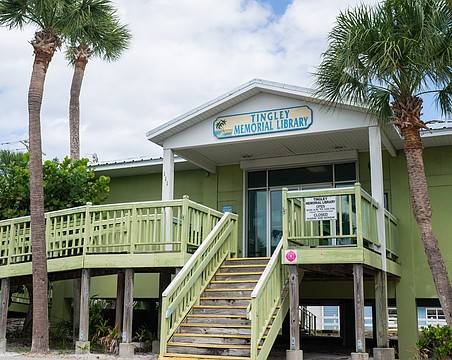
He said the county would stop buying conservation land through the Environmental Lands Management and Acquisition Program. Funding for children and veteran services would be cut. There would be no free pools over the summer or free bus fares. Libraries might close, and any “niceties” for Animal Welfare would be eliminated.
“That’s just facts. That’s not threats,” Kruse said. “There’s only so much blood we can squeeze from a stone.”
In his opinion, the general public doesn’t want what the state government thinks it wants, so Manatee County is trying to take a more thoughtful approach.
The first of several budget workshops was held at the downtown administration building Feb. 11. Budget 101 sessions will be held within each district to involve residents in the process throughout March and April.
The session in District 5 is scheduled 6-7 p.m. March 11 at the Lakewood Ranch Library.
While the Feb. 11 workshop focused on possible millage cuts at the county level, Deputy County Administrator Corey Stutte offered an overview of what could happen at the state level if property taxes are cut.
There are five House Joint Resolutions that could have an impact of up to $177.2 million on Manatee County’s general fund revenues in 2027. To be adopted, 60% of voters would also have to approve the measures.
HJR 201: This is the dominant bill. If it passes, it would override the following four bills and go into effect Jan. 1, 2027. The bill would eliminate all non-school property taxes on homesteads. The school district would still levy taxes on homesteads, and the county cuts cannot impact law enforcement funding.
HJR 203: If passed, this bill would have the same result as HJR 201, but it would happen over the course of 10 years. Instead of eliminating all non-school property taxes in one year, homestead exemptions would increase by $100,000 each year until 2037 when all non-school property taxes on homesteads would be eliminated.
HJR 205: If passed, this bill would eliminate non-school property taxes for residents over the age of 65.
HJR 207: If passed, this bill would add an exemption equal to 25% of the remaining assessed value of the homestead after applying existing exemptions.
HJR 209: If passed, this bill would add an additional $200,000 to the current homestead exemption of $50,000. It would also require that the property is insured, and any cuts to services could not impact first responders.
“The 800-pound gorilla still in the room is Tallahassee,” Commissioner Mike Rahn said. “If they don’t do anything at session, I can pretty much guarantee you the governor is going to call a special session, so that’s still the dark cloud hanging over whatever we do and whatever decision we make as far as a millage cut coming into 2027.”
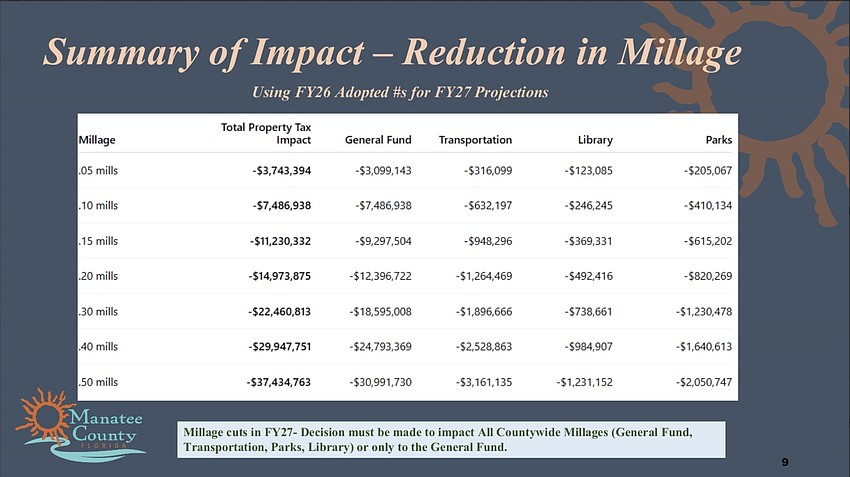
Regardless, commissioners came into the new year with a goal to make a meaningful millage cut, and they decided to put the tough decisions into the hands of the people after what Commissioner Jason Bearden referred to as the “trash situation.”
“If we ran an intensive survey to find out what the constituents wanted in the county, we wouldn’t be in this thing where we’re trying to backtrack and fix things,” he said of recent efforts to bring back bulk trash pickup.
In addition to community meetings, the county will be using surveys to understand what services residents are willing to live without.
Staff members submitted generalized cuts for review by commissioners, but there were no dollar amounts associated with the cuts.
Using the Sports and Leisure department as an example, staff said a reduction of millage would cause a reduction of operating hours at three county parks: G.T. Bray, John Marble and Premier. In addition, it would cause a reduction of fitness and athletic programs across all county parks and a reduction of information, education and community resources from all county libraries.
However, commissioners asked staff members to be more specific. How much would eliminating fitness classes save residents per month? What if libraries were open five days a week instead of six days a week?
Kruse pointed to a criticism from some members of the public about the county wrapping electrical boxes for $100 each.
“If people realized that (the wrapping) actually cost them point four cents each, they probably wouldn’t have cared very much, especially when you consider that it extends the life of the box more than point four cents,” he said.
The goal of the surveys and budgeting workshops is to educate the public on how much county services cost and let them decide if the services are worth the cost.
One mill equals $1 for every $1,000 of taxable property value, but Manatee County commissioners don’t have control over how every cent of that dollar is spent.
Deputy County Administrator Courtney De Pol reiterated the importance of educating the public on how much they're spending, where those tax dollars are going and how much is discretionary.
“Two mills is truly what’s left over — what could be reduced and is not required,” she said. “Those are service-type things. So for an average homeowner with a $300,000 home and a $50,000 homestead exemption, that two mill portion only equates to about $500 a year, which ends up being $42 a month.”
The end goal of the community workshops is for a resident to understand what services their $42 pays for each year, which they’ll either deem important or not.
But that hypothetical $42 is not the entirety of that individual's tax bill. It is only what's left over after all the mandatory taxes are paid.
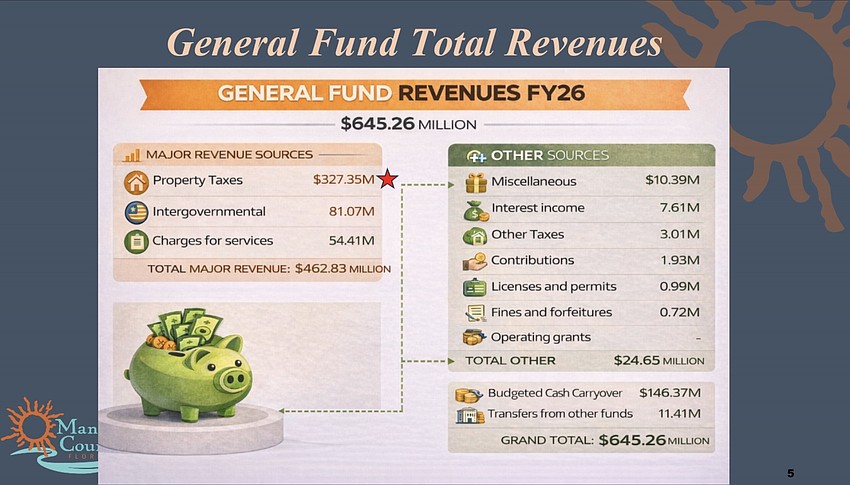
According to a press release dated Nov. 3 from Ken Burton, Jr., the Manatee County tax collector, the total taxes to be collected for 2025 is $1,346,551,937.85.
Only a small portion of those funds are discretionary.
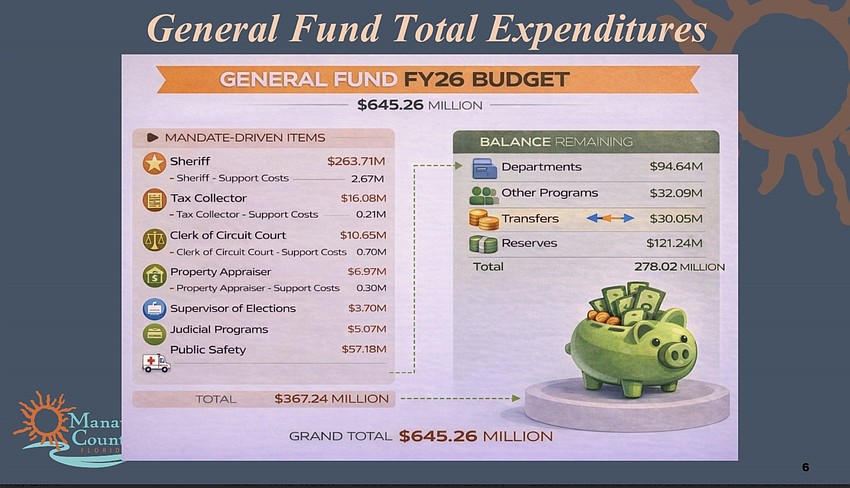
To start, 50 cents of every dollar goes straight to the Manatee County School Board. Another 29 cents goes to the Sheriff’s Office. Under the proposed legislation, neither one would be affected if property taxes are eliminated.
That's 79 cents immediately off the table. Once the dollar is fully whittled down by constitutional officers, such as the Clerk's Office, and taxing authorities, such as the Mosquito District, commissioners have just 11 cents out of every dollar to spend.
"People are being told property taxes are like rent (by Gov. Ron DeSantis)," Kruse said. "Property taxes are user fees for things that are being provided."
Kruse asked staff to put together a list of about 50 such items that include costs, so residents can select five that they're willing to give up for a millage cut.
That survey will be informal and online to get an immediate pulse on where residents stand for the 2027 budget season that begins in June. For 2028, a more in-depth survey will be conducted, but the results aren't expected to come back until October.
The 2027 budget will be finalized in September.