- April 4, 2026

-
-
Loading
Loading
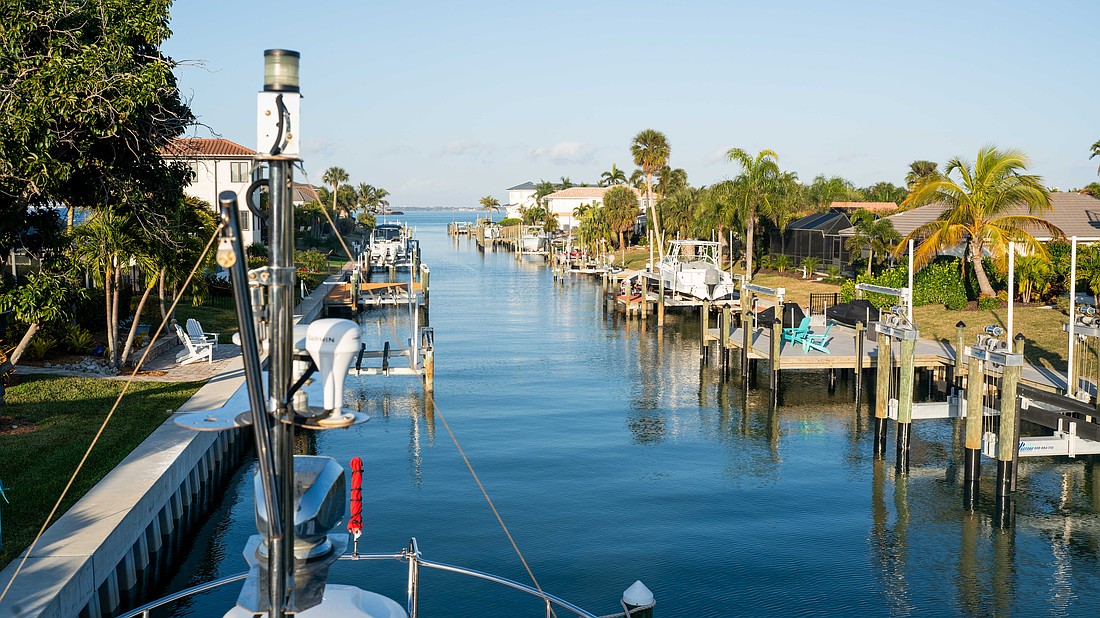
When Jay and Lynne Plager were shopping for a new home, having canal access was a huge selling point.
“I’ve been a boater all my life and always owned boats from the time I was 13, so having a canal with a boat on it was something of a fantasy of mine when I was a hard worker up in Washington,” said Jay Plager, a Country Club Shores resident. “I would look at the magazines on weekends that showed people in Florida living on canals with their boats. Something I always wanted to do, so we decided to do it.”
But after two-and-a-half decades of letting nature be nature, the canals that border so many homes and serve as navigational channels for boaters have slowly changed, impacting navigation.
“We maintain our streets, we maintain all these different aspects of our island, but we haven’t maintained our waterways since 2003,” Public Works Director Charlie Mopps said. “So, that’s 23 years where we’ve had siltation, we’ve had storm events, we’ve had erosion.”
First Line Coastal, the engineering and consultant firm tasked with evaluating the health of the town’s 88 canals, graded the town’s canals on an A-F scale. More than half have a grade C or below, and 18 were given Ds and 4 Fs. The canal the Plagers live on got a passing grade, a C+, but the two still experience issues when embarking on Scarlet Lady, their beloved 29-foot trawler. Jay Plager said navigating the canal itself usually isn’t an issue, but exiting from the canal into the bay is.
“There’s a hump there behind the breakwater. If you need more than three or four feet of depth under your keel and the water right at the mouth is down to two-and-a-half feet, you’re going to drag,” Jay Plager said. “It almost never happens, but it happened to us last month because we had one of those really low tides.”
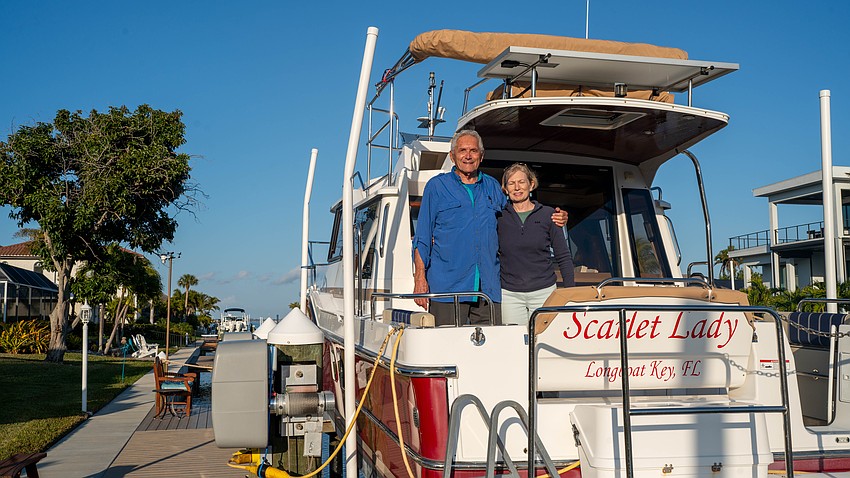
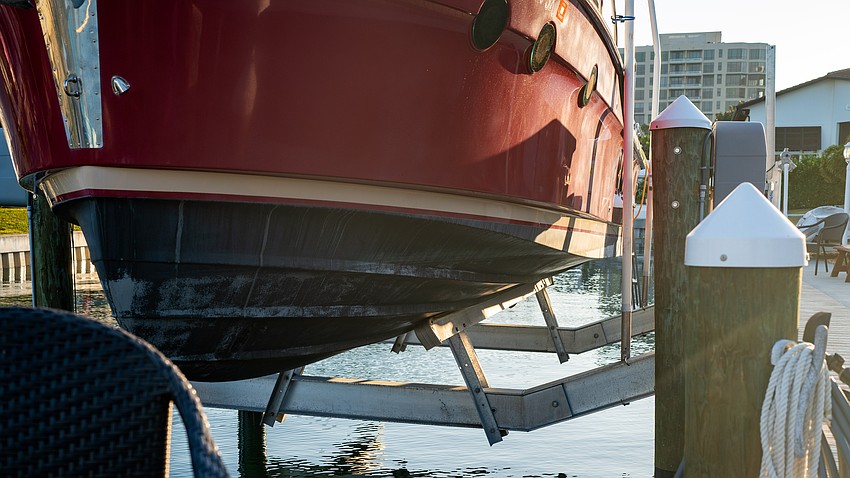
The other hiccup comes when lowering the boat from its lift. The beams that support the boat are nearly two-and-a-half feet below the bottom tip of the hull, meaning more space is needed to drop the boat into the water. The Plagers upgraded their lift to one with bow-shaped beams, which help to avoid the sediment that builds up around the pilings. While they were at it, they replaced their bulkhead and built a bigger dock around their lift.
“With the old lift, I had a problem getting off at low tide,” Plager said. “It was fairly expensive (to upgrade), but that’s what we want. And it’s worth the investment.”
The cost of initial canal dredging will be about $9 million.
Money for the program will be raised from Longboat Key residents — $2 million a year for the first five years of the program and $1 million a year after.
Those with canal-facing properties will be charged a flat fee of $620 per “equivalent benefit unit” on their property tax bill. That means properties that have the potential for a boat ramp or an existing boat ramp.
After five years, that fee will drop to $318. Properties without canal access will not have a flat fee charged.
The EBU fee will raise about 70% of the funds for dredging.
The rest will come from ad-valorem assessments that will be charged to canal-facing properties (raising 10% of total cost) and non-canal-facing properties (the remaining 20%). That 0.0623 millage will be assessed on all Longboat Key properties for the first five years and will drop to 0.032 in the following years.
Trish McDonald, who lives at a condo without canal access, said she doesn’t think property owners like her should have to bear such a cost for canal dredging.
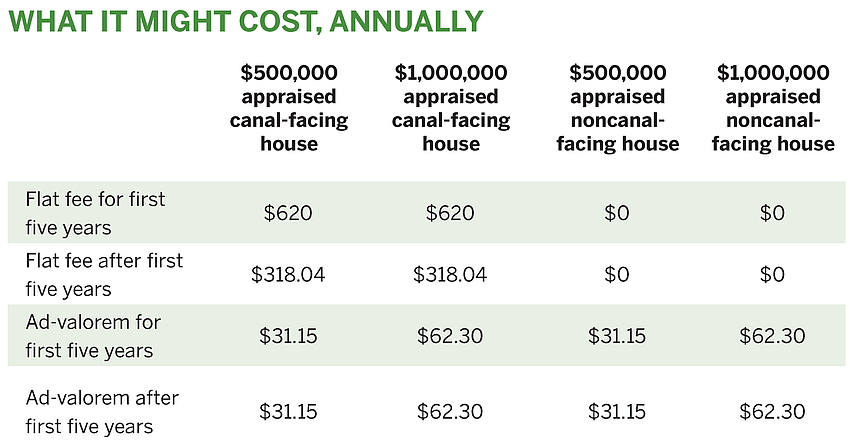
What it might cost, annually | ||||
| $500,000 appraised canal facing house | $1,000,000 appraised canal facing house | $500,000 appraised non-canal-facing house | $1,000,000 appraised non-canal-facing house | |
| Flat fee for first five years | $620 | $620 | $0 | $0 |
| Flat fee after first five years | $318.04 | $318.04 | $0 | $0 |
| Ad-valorem for first five years | $31.15 | $62.30 | $31.15 | $62.30 |
| Ad-valorem after first five years | $31.15 | $62.30 | $31.15 | $62.30 |
The 80/20 cost split between canal-facing and non-canal-facing property owners mirrors how beach renourishment is split between residents.
“As a practical matter, I, as a non-canal-homeowner, can only access those canals by boat. I don’t have a boat, but if I did, my access to those canals is very limited,” McDonald said. “Is it fair for me to have to assume 20% of the cost? I understand some of the arguments about runoff water and whatnot, and that’s fine. I don’t say we shouldn’t pay anything, it’s just how is that percentage allocated. My home up north, if I’m repaving my driveway, I shouldn’t expect my neighbor to pay for 20% of it even if repaving my driveway gives my neighborhood and my neighbor some ancillary benefits.”
Jay Plager, when asked whether he thinks the cost-sharing is fair, brought up the beach renourishment fund as a comparison, noting that many areas of the beach in front of condos are closed to residents and don’t have public parking lots.
“My view is these canals are much more egalitarian than the beach,” Plager said.
The Longboat Key Town Commission will vote on how the funds are raised at the May 4 Commission meeting. Commissioner Steve Branham said how the cost is going to be split is not set and will be debated at the meeting.
“Whether or not 80/20 is the correct number is still subject to discussion,” Branham said. “But it’s certainly a great place to start.”
The word dredging may bring to mind images of large machinery similar to what can now be seen removing sediment from the floor of New Pass.
Residents may be relieved to hear, though, that any dredging that would happen in the canals of Longboat Key would look much different.
Public Works Director Charlie Mopps said there are two types of dredging: hydraulic and mechanical. The former uses large spinning cutter heads to break up sediment before it is suctioned into a pipe. Mechanical dredging is much more straightforward and less impactful. It’s essentially a small barge with an excavator sitting on it. Longboat canals are narrow, and with homes lining most of the waterways, the town hopes to reduce impacts by utilizing only mechanical dredging.
Canals will be dredged to a depth of five feet.
It will take about two weeks to a month to dredge each canal, Mopps said, and dredging would begin three years after tax and fee collection begins. After the initial round of dredging, the maintenance phase starts, with canals monitored annually and follow-up dredging completed when necessary.
“That’s why it’s a program, not a project,” Mopps said. “We will monitor the situation, and when it dictates that we need to come back, we will. Typically, your higher dynamic areas where you have a canal going through a sandbar or something like that would be those areas where the frequency of dredge might be three to five years.”
Longboaters know the value and unique ecology of Sarasota Bay, where seagrass sways in the shallow waters, feeding manatee that share a habitat with dolphins, wading birds and various other species.
The slow-moving and protected manatees make their way into canals often, and dredging crews will be on the lookout.
“You know we have manatees in our canals, especially this time of the year,” Mopps said. “So there has to be an observer on the dredge. If an observer sees a manatee, they have to shut down operations.”
Seagrass will be impacted during the dredging. It’s so common in Sarasota Bay that tearing some up can’t be avoided, but Mopps and First Line Coastal Founding Partner Mark Stroik explained that mitigation will be done to counteract the negative impacts to seagrass beds.
“By the time this project is done, there is going to be more seagrass in Sarasota Bay and the bay will be healthier as a result,” Stroik said.
One of those mitigation areas will be adjacent to Sister Keys, where a dredge in the 1800s increased the depth of the bay drastically, removing seagrass habitat area that still has not been restored. Seagrasses need shallow water to grow as they heavily rely on sunlight.
Mopps also explained that dredging will increase the water quality of the canals, many of which have stormwater pipes exiting into them.
“If you think about 23 years of grass clippings or any kind of light detritus that fell into the canal that sinks to the bottom and is creating a bioload that helps feed those bad algae that we don’t want, like red tide,” Mopps said.
The material dredged from the canals will be reused when possible. Stroik said doing so will save the town money because of the costs associated with transporting and disposing of material. Any material that is not able to be used, whether for seagrass mitigation or as cover for the subaqueous pipeline project, will be sent to the landfill and used as daily cover.