- April 2, 2026

-
-
Loading
Loading
Some conversations are bound to generate passionate opinions from participants. The things our president does, says and posts on social media is one. Little middle ground there, on either side, in those discussions.
Other chats might not be as serious. But the topics nonetheless lack consensus. Take pineapple on pizza: crime or cuisine? Another example: What’s the acceptable outside temperature in Florida to turn on the heat inside?
In recent years, another topic, especially in Lakewood Ranch and the surrounding area, has bubbled up into a hotly contested dialogue: roundabouts.
Yes, those circles of concrete, with grass in the middle, or sometimes art installations. To the untrained eye, mere intersection replacements.
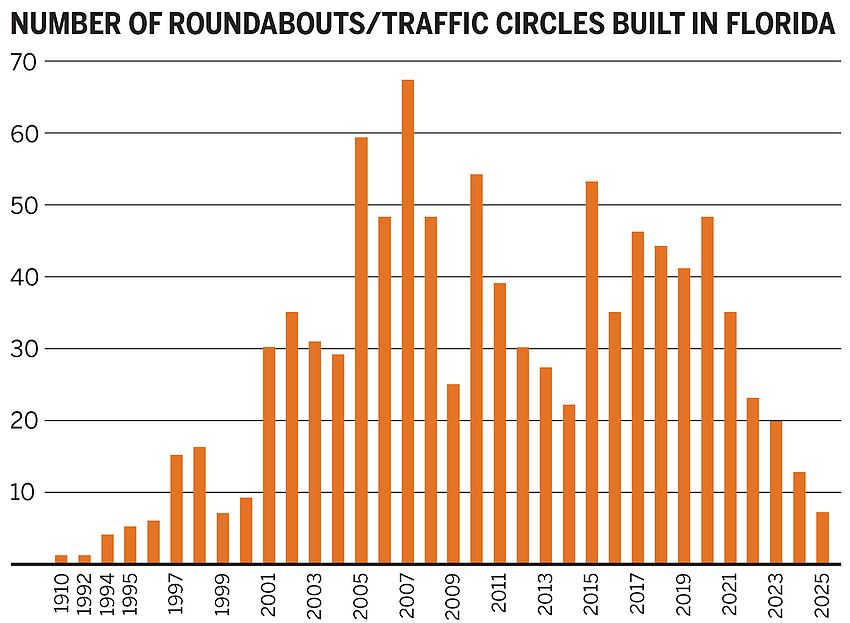
By now, we have all probably heard the stats from traffic experts of why more and more they’re becoming a compelling choice.
But some people — not just traffic engineers — love roundabouts. Or at least like them a lot. Yet while hate is a strong word, others strongly dislike them. One person in that camp, clearly, would be famous vacation dad Clark Griswold, played by Chevy Chase in the “Vacation” movies. Clark, of course, in 1985’s “European Vacation,” loses his cool while struggling to “get left” on the Lambeth Bridge Roundabout in London. “Hey look kids, there’s Big Ben, and there’s Parliament... again,” he mutters as he motors around the circle, unable to get left while day turns to night.
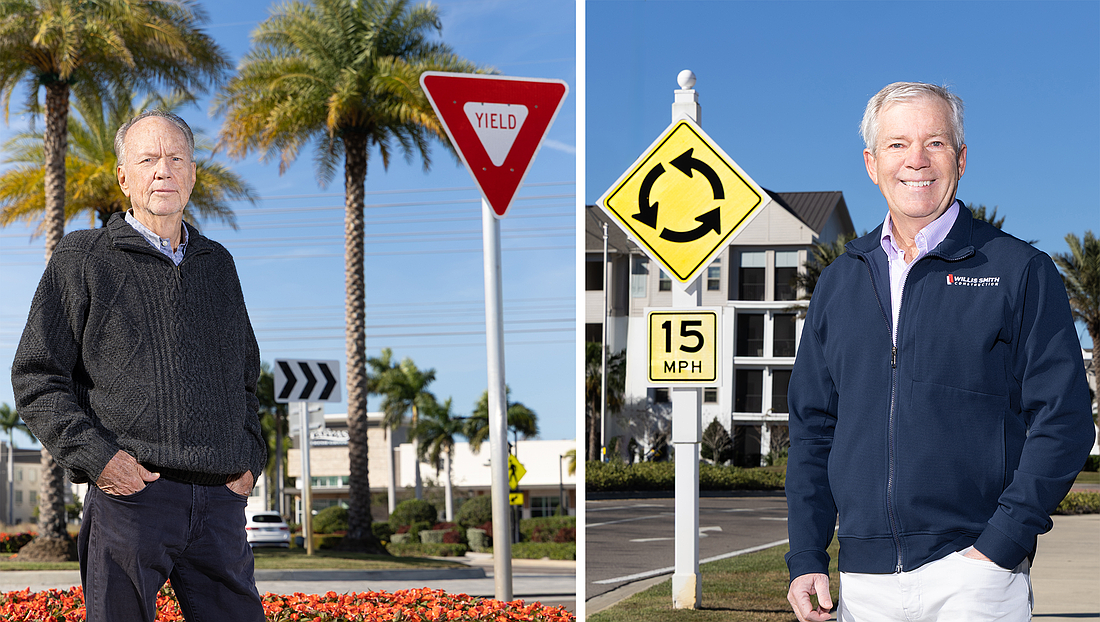
Into this breach steps a pair of Lakewood Ranch residents, strangers in life, with a common denominator: they have opinions on roundabouts. One, David Sessions, is all in. Another, Darrel Drury, stresses he’s not for or against roundabouts — but he certainly has perspectives that lean in the “no way” category.
A breakdown of each’s perspectives:
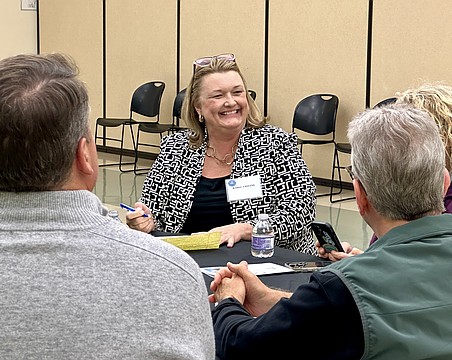
Darrel Drury is a retired Yale University professor who has lived in Country Club East since 2022. He moved to Lakewood Ranch from Alexandria, Virginia, in 2018, renting an apartment first while finding a home. At Yale, he taught advanced statistics and experimental and quasi-experimental design to both graduate and undergraduate students. There, according to a letter he wrote to the Manatee County Government Liaison Efficiency Committee Aug. 25, 2025 on a non-roundabout issue, his job “was to figure out the best ways of ferreting out the truth by applying the scientific method to complex data sets.”
Drury says more than just a general take on roundabouts, his concern is the county or state doesn’t plan properly before building one.
“I’m not anti-roundabout, and I’m not pro-roundabout,” he says. “What I am for is studying the complexity of each roundabout.”
Drury says that can be done with microsimulation modeling. That’s a computational technique that simulates outcomes of large data sets by modeling individual units, like people or, notably, automobiles. “These are tools that are not being used,” he says.
Consider the oft-heard pro-roundabout line that they are safer. “Saying they are safer is accurate in the whole and true,” Drury says, “but those studies are based on a single-lane, independent roundabout. They are safe in general, but that’s the key. Every roundabout has to be analyzed individually.”
Drury, in general, has other issues with roundabouts.
One is cyclist safety. He cites a study from the University of Copenhagen about roundabouts in Denmark. The study found that integrated cycle lanes in roundabouts, common in Denmark, are riskier for cyclists, while segregated cycle tracks, more common in the Netherlands, are safer. Counterintuitively, the study also found lower speed limits on roundabouts were more dangerous for cyclists. Roundabouts, Drury says, “absolutely did not make it safer for cyclists. In fact, they made it worse.”
And, given Lakewood Ranch’s demographics skew older, Drury worries about the cognitive decision making of drivers in navigating roundabouts and their initial fear as they learn to use them.
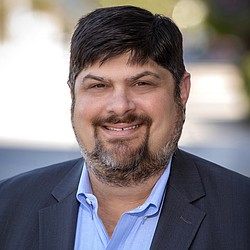
David Sessions has been a Lakewood Ranch business leader and resident for decades, now living in The Lake Club. He’s chairman of Willis A. Smith Construction, a Lakewood Ranch-based builder behind a host of projects in the region, from schools and fire stations to the recently opened Mote SEA Aquarium. Sessions joined the company as a project manager in 1988, and worked his way up to eventually being CEO. Willis A. Smith had $231.39 million in revenue in 2024.
As a panelist last year at a Lakewood Ranch Business Alliance event on the history of long-term businesses in the community, Sessions revealed he was, to the surprise of most attendees who hissed, a fan of roundabouts. So much so that as a young construction executive in 1991 he joined the board of the Sarasota/Manatee Metropolitan Planning Organization (MPO), which is tasked to “guide regional decision-making on transportation issues.”
Sessions remained on the MPO board for 19 years, trading off as chair and vice chair for a decade. Willis Smith has never built roads, so for Sessions it was more of a passion play. “My business has nothing to do with the roads,” he says, “but I’ve always been fascinated by road networks.”
And he was especially fascinated when a British traffic engineer spoke to the group in the mid-1990s. The fellow talked about the difference between traffic circles and roundabouts and how, he told the MPO board, in Europe 70% of all traffic accidents are eliminated in roundabouts. There are no T-Bone accidents at a roundabout, like there can be at intersections. And there are no red lights to run.
Sessions learned about one of the first roundabouts in the region, in Clearwater, and he drove there to check it out. Ditto for the first one closer to home, near Bradenton Beach. “I made a point to go there and drive around and around that one,” he says. “I was fascinated by it.”
There’s a practicality to roundabouts, too, that Sessions likes. One, he says, is the safety component. “You no longer have to watch people see a yellow light and think that means speed up and go faster,” he says. “A roundabout prevents that.”
It also improves traffic flow — a point most traffic engineers stress when considering a new roundabout.
A third reason Sessions is pro-roundabout? Community beautification. “A roundabout,” he says, “looks so much better than a signalized intersection.”
Sessions thinks some of the animosity toward roundabouts stems from new residents who are used to traffic circles up north and not used to the flow of a roundabout. And not every corner needs one, he admits.
“There are a lot of places where roundabouts make sense,” he says. “although there are some places where they don’t make sense.”