- April 1, 2026

-
-
Loading
Loading
“Flying cars, they said."
That’s a common online punchline about the lack of technological advancement since shows like The Jetsons predicted a space utopia where flying cars were commonplace vehicles for commuters. Instead, all we get is AI videos of cats whitewater rafting.
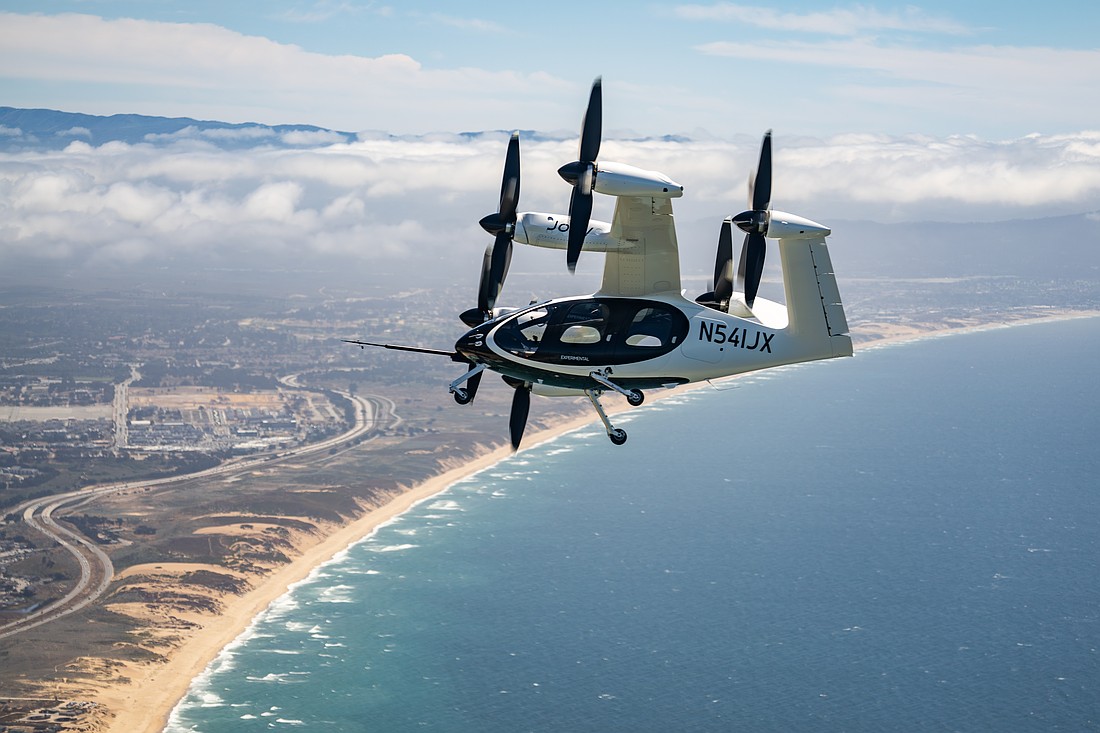
But now, sci-fi is becoming reality. Technology continues to advance, with electric, propellor-powered “air taxis” completing successful test flights and starting operations in China and Dubai. The FAA has launched the “Innovate28” initiative with the stated goal of Advanced Air Mobility, or AAM, flights beginning in 2028.
“While operators, manufacturers, and state and local partners are responsible for planning and developing vertiport infrastructure, the FAA issued vertiport design guidance and an implementation plan that brings these efforts together and provides a clear pathway for the industry to scale operations safely,” the FAA wrote in a statement to the Observer.
Florida wants a piece of the action, and FDOT has a blueprint. Its Advanced Air Mobility Business Plan explains the state’s vision to become a pioneer in Advanced Air Mobility, or AAM by building an “aerial highway network.”
“By creating seamless aerial links between economic and population centers, this network will offer both business and leisure travelers faster and more flexible alternatives to traditional ground transportation,” the business plan states.
The first phase of FDOT’s plan is creating a Central Florida I-4 corridor, which encompasses Sarasota, Tampa, Lakeland, Orlando, Melbourne and Daytona Beach.
eVTOLs (an acronym for electronic vertical takeoff or landing vehicles) are much quieter than helicopters and fly at a lower altitude than commercial aircraft. They fall in the category of AAM. Atlantic Aviation, through its subsidiary company VertiPorts by Atlantic, is a company that is working to construct “VertiPorts” where eVTOLs would take off and land.
“It’s a little like a helipad and a lot not,” VertiPorts by Atlantic CEO Kevin Cox said. “At the end of the day, for these aircraft to scale and perform, we’re looking to turn these aircraft every 10 to 15 minutes. What’s fundamentally different about the aircraft, obviously, is how quiet it is, it’s electrified, there are no emissions and it fundamentally allows you to get to non-traditional places in urban and suburban environments that heretofore, because of noise or because of a variety of pushback from communities with louder piston-driven engines, you couldn’t get to. Tomorrow you will be able to.”
Cox said his company hopes to expand its Florida presence, with vertiports in West Palm Beach and Boca Raton already confirmed.
With the state signifying its intent to back the new transportation method, towns like Longboat Key have been approached by companies like Atlantic to gauge their interest in allowing the aircraft to take off and land in town limits.
Assistant Town Manager Isaac Brownman said the town was approached by Atlantic, which operates out of Sarasota-Bradenton International Airport, among others.
“They’re just getting into the business of the vertical takeoff and landing of aircraft,” Brownman said. “They would not be an aircraft operator. What they’re looking at with their business plan in the future is becoming an infrastructure operator. In order to operate this type of aircraft, you have to have a landing facility and a charging station because they’re electric.”
Town Engineer Jennifer Fehrs sat in on the town’s meeting with Atlantic and said it was a broad discussion between the company and town staff about the emerging technology and its benefits. Cox said his company is reaching out to municipalities to gauge their interest in allowing the new technology.
“In Florida, we are excited about the state for many reasons. For one, there are many cities that have congestion in them and/or barrier islands that have a tough time getting from point A to point B. We do believe that the Florida network will be an early first state adopter. That will allow us to begin building those dots on the map,” Cox said. “It involves not only understanding the demand and assessing the ability how many people we can convert and benefit, but it also involves willing communities and willing governmental and regulatory bodies.”
To do so in Longboat Key, town code would need to be changed. Aircraft, including helicopters, are currently not allowed to land in town limits except at established airports, of which there are none.
Fehrs and Brownman both mentioned the potential of allowing eVTOLs as a means of avoiding traffic during peak season. If adopted on Longboat Key, that would likely look like a hotel or resort building a eVTOL vertiport as a way to connect visitors from the airport to the island without driving.
With any new technology comes limitations. If alive in 2028, George Jetson, a mid-level employee at Spacely Sprockets, likely couldn’t afford his own eVTOL to commute to work. Maybe in a few decades, though (The Jetsons was set in 2062).
“It sounds a little unusual, but we fundamentally believe it’s kind of like cell phones. Cell phones started very expensive, and they started with just a few people, traditionally those in the business community. And now you have cell phones that are ubiquitous around the globe,” Cox said. “Ultimately, we do believe this industry will become ubiquitous in terms of people using it because it takes a limited amount of infrastructure and it allows you to get very quickly and efficiently from point A to point B.”
Correction: This article has been updated to correct the spelling of Joby.