- March 20, 2026

-
-
Loading
Loading

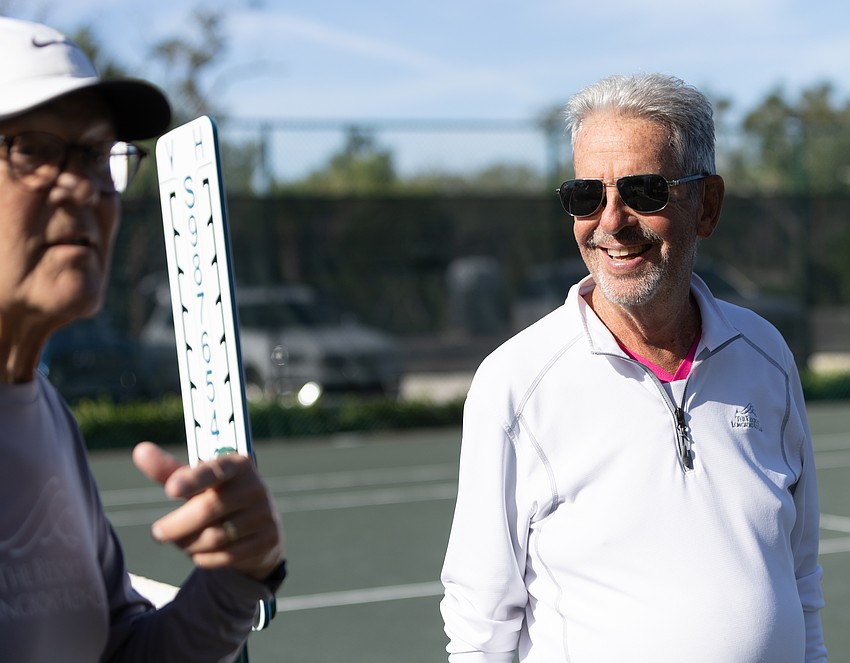
If this is the end of an era, you wouldn’t know it by the fun these old-timers are having on the tennis courts at the Resort at Longboat Key Club. It’s a Monday morning in December and a dense fog has lifted, allowing the sun to crack the clouds. Eight players, ranging in age from late 60s to mid-80s, occupy two courts, playing doubles. Their shots are mostly soft, their knees don’t bend much, they rarely chase down balls. The fellas banter as they play, talk lighthearted trash, gently berate themselves for lousy shots. Occasionally, a cry of frustration rings out — but no profanity, never that.
These senior gentlemen are part of the Ruff Group, an informal club of tennis players at the Longboat Key Club that has lasted so long none of its current members can say specifically when it began. The best guess is the mid-1980s. Over four decades, age has taken its inexorable toll, attrition has accelerated and there is some concern that the sun may be about to set on a proud tradition.
The club is named after its founder, the late Bob Ruff, who organized a network of games that, at its peak, would see some 40 players on eight or more courts. Bob, who died in 2021 at age 93, pronounced his name “Roof,” but for the sake of catchiness, the contingent is commonly known as the “Rough Group.”
These days, the name has a tinge of irony. The club’s numbers have been steadily dwindling. Eight players is a rare turnout. Larry Coleman, who at 85 is blessed with a resplendent head of silvery hair, has for several years carried the mantle of organizing the games and reserving the courts. He sometimes has trouble coming up with just four players. On rare occasions, that has forced him to resort to drastic measures — recruiting women at the club to fill in.
The attrition in the ranks is no surprise. Members move away, bodies break down, guys get sick, they just get worn out and retire. Then, of course, there’s death. These fellows attend their share of funerals.
And then there are the near-funerals. One of the younger members, in his mid-60s — who will remain anonymous because he was not interviewed for this story — took a summer trip to New Zealand, where he had a major cardiac arrest and remained in Kiwi Land for open-heart surgery. “He was a really good player,” fellow player Elliot Salenger says, then adds half-jokingly, “except that he almost died.”
The man made his comeback in December.
Diehards. That’s an apt word to describe the Ruff Group guys still hanging in there. Aldo Massara is the oldest at age 90, and the longest standing — 27 years. (The oldest ever, according to those on hand, was the late Lou Meltzer, who was 99.)
Massara, who’s been out of action with a bad back, has graciously come out to the courts to be part of a group interview. He grew up in Italy and still has the accent to show for it. A genial sort, quick with a smile and a story, he worries his playing days may be over but holds out hope for a comeback. “The nice thing about tennis, and this group, it’s not just the tennis. It’s the camaraderie,” he says. “We joke around, tease each other. I mean, we play competitively but don’t take it that seriously.”
Some aren’t so sure about the competitiveness. Salenger, 82, cites a recent occasion when, after a game, someone asked, “Does anyone remember the score?” then adds, “These guys are more interested in remembering where their cars are.”

On a more serious note, he says, “At this age, the social interaction is much more important than the quality of the tennis. It’s more important that guys get together, get out of the house to do things.”
Salenger is a retired trauma surgeon who grew up in Queens, New York. He attended Columbia University, where as a member of the basketball team, he guarded Bill Bradley, who went on to become the AP College Player of the Year in 1965 (and a U.S. Senator). “I said to my coach at halftime, ‘Coach, I think he scored 30 points on me.’” Salenger quips. He started playing tennis in his 30s, after med school.
On this Monday morning, the players briefly gather under a shelter between games, just as they do during their regular Wednesday and Friday sessions. Bonhomie permeates the group. It’s readily evident that they’re glad to be here and able to play, to have people in their age and skill range to play with. And to be part of the tradition that is the Ruff Group.
Bob Ruff’s high school in Springfield, Illinois, didn’t have a tennis team, so he started one. Thus began a lifelong devotion to the game. While in the U.S. Army just after the Korean War, he captained the First Army tennis squad. Ruff practiced law in Indiana for decades, then retired to Longboat Key in the early 1980s.
No one seems to recall the precise origins of the club, other than that Ruff wanted to put together a regular schedule of tennis games. “Bob was a lovely, cantankerous old man who loved to play and played all the time,” Salenger says. The club has always been open to all ages, but over time it tilted toward seniors. That became self-perpetuating because younger players understandably prefer to play among themselves instead of napping their way through games with the old dudes.
The Ruff Group members did some math and figured out that their founder had arranged at least 30,000 contests. “He was a very smart guy,” says John Woods, director of tennis at Longboat Key Club when the Ruff Group started. “He put together different levels and would match players up.”
And legend has it that Bob Ruff organized these thousands upon thousands of games in his head.
Ruff auditioned prospective members on the court, mostly to gauge their skills and slot them into the proper level. Massara, who’s known for his killer dropshot, remembers his entree: “After about 10 minutes, Bob said, ‘Fine, you’re doing fine.’ And at the end, out of nowhere he told me, ‘By the way, we don’t use foul language around here.’ I said to myself, ‘Do I have tattoos? Do I look like a Hell’s Angel?’ I didn’t say anything. We had a memorial brunch for him and I spoke a little bit. I said that from then on, I always insulted in Italian.”
At one point the club was so robust it held parties in the Longboat Key Club ballroom to bid farewell to the snowbirds in the spring and welcome them back in the fall. With wives joining in, these bashes would gather more than a hundred attendees. In addition, the men regularly held post-game lunches at Spike ’n Tees, an on-site restaurant.
That stuff doesn’t happen anymore.
The Ruff Group continues to play on the clay courts of the Longboat Key Club as pickleball sweeps the nation. The members are not so much antagonistic as agnostic about that game with the paddles instead of rackets, the small court, the perforated plastic balls and something called “the kitchen.” Interestingly, none of the members at this Monday session can think of someone in their ranks who defected to pickleball. And no one in this gathering has plans to do so.
Still, the outflux of Ruff-ians has far outpaced the influx. Coleman, a 25-year member, is getting weary of wrangling players, not to mention calling in at 7:30 a.m. to reserve courts — three days in advance. Just mentioning that brings out the grump in him. With the games concluded and our little confab beginning to break up, Coleman says, “This could be my last year running it. It’s too much aggravation.”
“So who’s gonna step up?” a reporter asks the group.
After a moment of silence, “We all appreciate what Larry does for us, very much so,” someone says. “It’s a thankless job.”
Salenger, for one, thinks the rumor of the Ruff Group’s impending demise has been greatly exaggerated. “We have a few guys age 65 or 70 who are in a perfect position to take over,” he says. “They just don’t realize it yet. One of them will be anointed director.”