- March 19, 2026

-
-
Loading
Loading
As European settlers arrived in North America from the 15th to 19th centuries, they confronted an indigenous world where women often served as political leaders, healers and negotiators. But women were mainly assigned the duties of child-rearing, farming, cooking and sewing.
Men’s work was primarily hunting, trading, leading religious ceremonies, educating the next generation of warriors and fighting enemies.
The beaded wampum belts that Native Americans gave as gifts and to encourage other tribes to join their military campaigns were made by women, as was apparel fashioned from animal hides and decorated with beads and feathers. Creating these goods was referred to as “women’s work.”
As colonists introduced woven cloth and blankets to the New World (along with firearms, metal tools and alcohol), tribes began incorporating them into their cultural traditions. Women began fashioning distinctive patchwork skirts and creating designs still used on modern-day Pendleton blankets.
Once the U.S. government confined nomadic Indian tribes to reservations and the wars between settlers and indigenous peoples ended around 1900 after four centuries, Native culture didn't cease to exist. Making and selling jewelry, pottery, paintings and other art became a way for tribal members to celebrate their culture and earn money.
Thanks to the efforts of the Smithsonian Institution, which opened the National Museum of the American Indian in Washington, D.C., in 2004, and museums such as the Eiteljorg Museum of American Indians and Western Art in Indianapolis, Indiana, and the Museum of Indian Arts and Culture in Santa Fe, New Mexico, the evolution of Native American "women's work" is widely recognized as art.
Some tribes, enriched by gambling revenues from casinos on their reservations, have built their own museums. The largest of these is the Mashantucket Pequot Museum in Connecticut, with more than 300,000 square feet dedicated to Native histories and cultures.
Modern-day collectors have followed in the footsteps of George Gustav Heye, who used his collection of 800,000 Native American artifacts to found the Museum of the American Indian in New York in 1916. Today, prominent collectors of Native American art include John and Susan Horseman, Judith Lowry and Brad Croul and J.W. "Bill" Wiggins.
In the 21st century, one could argue there is greater appreciation than ever for contemporary art created by tribal members, especially women. It is against this backdrop that The Ringling presents "Ancestral Edge: Abstraction and Symbolism in the Works of Nine Native American Women Artists."
The exhibition, which opened Sept. 13 and runs through April 2026, is the brainchild of Ola Wlusek, curator of contemporary art at The John and Mable Ringling Art Museum. Wlusek spearheaded the groundbreaking 2023 exhibit, "Reclaiming Home: Contemporary Seminole Art," which marked the first time that The Ringling presented the work of Indigenous Florida artists in its massive galleries.
Five years in the making because of interruptions due to COVID-19, “Reclaiming Home” featured art by members of the federally recognized Seminole and Miccosukee tribes and artists with mixed heritage.
Some of it was loaned by the Ah-Tah-Thi-Ki Museum on the Big Cypress Seminole Indian Reservation, which also lent advice on the dazzling, multimedia exhibition. Other works were loaned by the Eiteljorg, the Museum of American Indian Arts and Culture, and Santa Fe’s IAIA Museum of Contemporary Indian Arts.
“Reclaiming Home” featured more than 100 pieces, including several large installations, by 12 artists whose works were spread throughout the cavernous Ulla R. and Arthur F. Searing Wing. There are some large-scale pieces in “Ancestral Edge,” but the all-female exhibition in The Ringling’s Keith D. Monda Gallery for Contemporary Art is not nearly as ambitious as “Reclaiming Home.”
Wlusek was still working with installers during a recent interview, but she estimated the number of works in “Ancestral Edge” to be somewhere between 30 and 40. The nine artists represented come across the country.
There is one artist featured in “Ancestral Edge” who was also showcased in “Reclaiming Home.” She is Elisa Harkins, a multimedia artist, musician and curator of Cherokee/Muscogee/Creek descent who lives and works on the Muscogee Reservation in Oklahoma.
Harkins uses electronic music, dance and visual art to preserve and disseminate tribal traditions. At The Ringling, you can hear Native songs that Seminoles sang to console themselves as they traveled the “Trail of Tears” along with other tribes who were relocated from their homelands in the southeast U.S. to Oklahoma.
Harkins makes videos of Native singers and recorded in sheet music the songs that were handed down through generations. She also taught herself to sew so she could create patchwork fabric used for Seminole skirts. “I like the fact that while the patchwork is quite accomplished, it’s not perfect. You can see that it’s not machine-made,” Wlusek says.
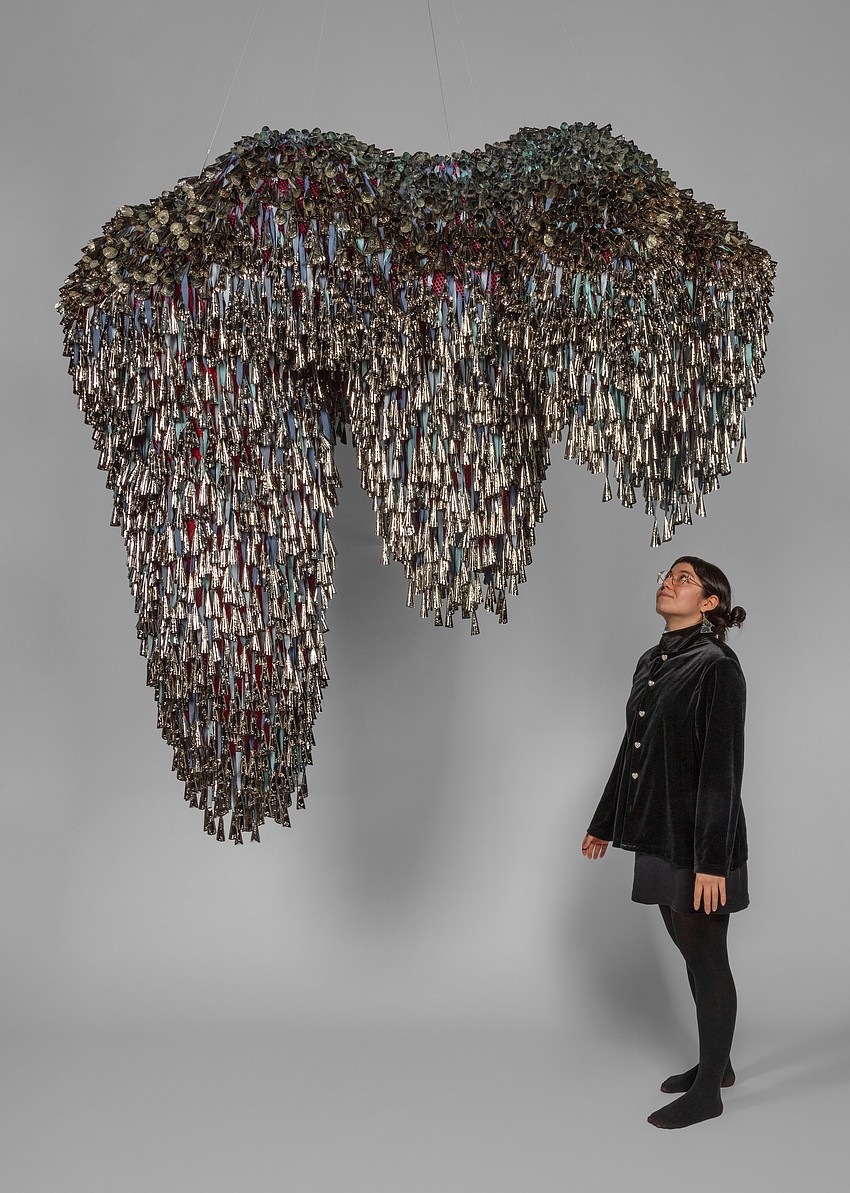
When you first walk into The Ringling’s Monda Gallery, you are greeted by Marie Watt’s shimmering installation, “Sky Dances Light: Revolution VII.” The thousands of tin jingles in the piece resemble the small metal cones sewn into Native American costumes worn for ceremonial dances and powwows. The artwork was loaned to The Ringling from the Gochman Family Collection.
“Many of the artists in this show are skilled in community-based arts and crafts and have incorporated these into their work,” Wlusek says.
One of the artists that Wlusek is most excited about is Dyani White Hawk. Her silkscreen prints, “They Gifted (Day)” and “They Gifted (Night),” were recently acquired by The Ringling for its collection.
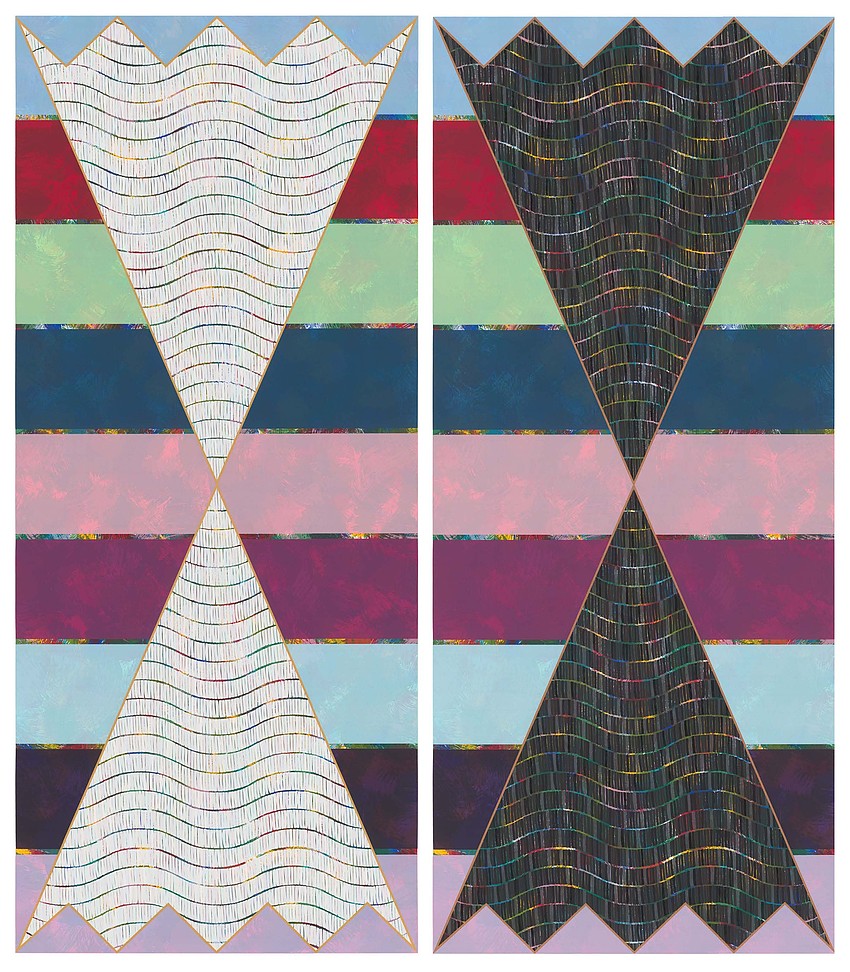
The companion works, created in 2024, are based on Lakota symbology and motifs found in the tribe’s beadwork and quillwork. According to the artist’s statement, they “explore the potential to communicate the powerful concepts of balance and interconnectivity, including to one another, the land, and all forms of life.”
But even recent works by Indigenous artists are based on longstanding traditions such as weaving. Among them are Kiana Bell’s ornamented sweetgrass baskets, on loan from the Ah-Tah-Thi-Ki Museum. Born in Oklahoma, Bell now lives in Hollywood, Florida, where she has been inspired by her cultural roots and Florida’s lush landscapes to create her baskets.
Chitimacha/Choctaw artist Sara Sense also builds on weaving with “Brooklyn Alligator,” a three-dimensional artwork fashioned from photographs, not something you see everyday, even in a museum. The diamond print seen throughout is inspired by crushed sea grapes, a fruit that is native to coastal Florida. The title of the photo-weaving references both Florida’s gators and the Brooklyn Museum’s collection of Chitimacha baskets.
Blankets are another recurring motif in “Ancestral Edge.” These seemingly mundane items are fraught with pain for some Native Americans because they symbolize the loss of lands unwittingly traded away and gifts accepted to seal treaties that were later broken.
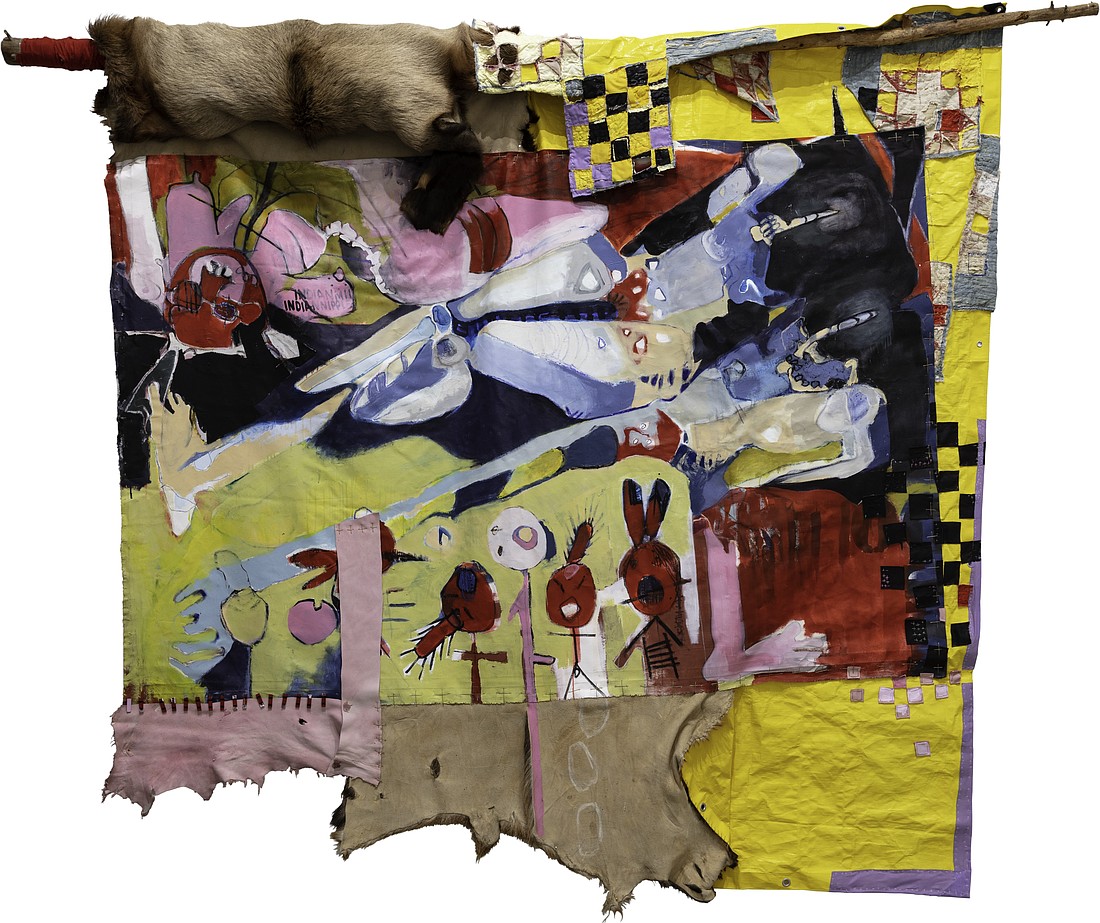
Nevertheless, Native Americans took the colonists’ blankets and incorporated them into their culture. Blankets and hides, symbolizing Native hunting practices that produced not only food, but clothing, can be seen in several artworks on display in “Ancestral Edge.”
One is Natalie Ball’s mixed media tapestry, “Playing Dolls,” on loan from the Rubell Museum in Miami.
Born and raised in Portland, Oregon, but traveled far from home to earn numerous academic degrees, including a bachelor’s degree with a double major in Indigenous, Race, & Ethnic Studies and Art from the University of Oregon, a master’s from Massey University of New Zealand focused on Indigenous contemporary art and an MFA from Yale.
Ball returned to her ancestors’ homeland of Oregon/Northern California to raise her three children. She serves as an elected official on the Klamath Tribal Council in addition to creating her massive mixed-media wall hangings.
What Wlusek found particularly rewarding about curating “Ancestral Edge” was learning how much new indigenous art is being created right now. “Most people, when they think about contemporary art, they think about works going back to the 1970s, but some of the art here was created last year,” she says.
Correction: This story was updated to correct the admission price.