- March 19, 2026

-
-
Loading
Loading

In the history of musical theater, the Broadway show usually gives birth to a not always successful attempt to transfer a winning story to the silver screen, often with bankable Hollywood stars who can’t sing (their voices are dubbed) and can barely dance.
The traditional creative evolution took place the other way around with “The Wedding Singer.” The story hit the big screen first, with a 1998 rom-com starring Adam Sandler as a band leader who falls for a catering hall server (Drew Barrymore) who’s otherwise engaged.
It wasn’t until 2006 that “The Wedding Singer” was adapted for the stage and opened on Broadway. Set in the 1980s, the musical has become a favorite with nostalgia-crazed high schools and community theaters who love the big hair, shoulder pads and heavy metal that reigned supreme during the decade.
It’s not only in movies and Broadway musicals where dreams come true. It’s happening right now at The Sarasota Players, the 96-year-old community theater where Jalex Scott is making his directorial debut at the helm of “The Wedding Singer.”
About 20 years ago, Scott was a high schooler with theatrical ambitions who listened to the soundtrack of “The Wedding Singer,” with music by Matthew Sklar and lyrics by Chad Beguelin, on a nonstop loop.
Even before he got his first directing assignment for the Players, Scott knew everything there is to know about a wedding singer looking for love in all the wrong places.
“It really is my favorite musical,” Scott confessed in a recent interview in the former retail space in The Crossings at Siesta Key mall where the community theater makes its home until it moves to Payne Park in 2026.
Patrons of The Players (now known formally as The Sarasota Players) may recognize Scott’s name because he won the theater’s new play contest back in 2020, with “The Mantle.” COVID-19 and other delays prevented the play from being produced until 2023. Scott has also been seen on stage around town in recent years.
On a recent afternoon, there was no place for a reporter to interview Scott and Katie Priest, the music director of “The Wedding Singer,” in the Players’ lobby. Wasting no time, Scott stepped behind a curtain and reappeared with a round table, as if out of thin air. Chairs soon followed.
It was an apt introduction to a production where sets appear out of nowhere and then just as quickly vanish.
As Scott and Priest patiently explained the optimistic romance-driven plot of “Wedding Singer” and outlined the conflicts faced by its protagonists, the 1985 song, “The Power of Love,” by Huey Lewis and the News came to mind.
You don’t need money, don’t take fame
Don’t need no credit card to ride
this train
It’s strong and it’s sudden,
and it’s cruel sometimes
But it might just save your life
That’s the power of love
In addition to its original songs, ’80s hits like this one fill the air as patrons take their seats and during intermission. Let’s hear it for Pat Benatar!
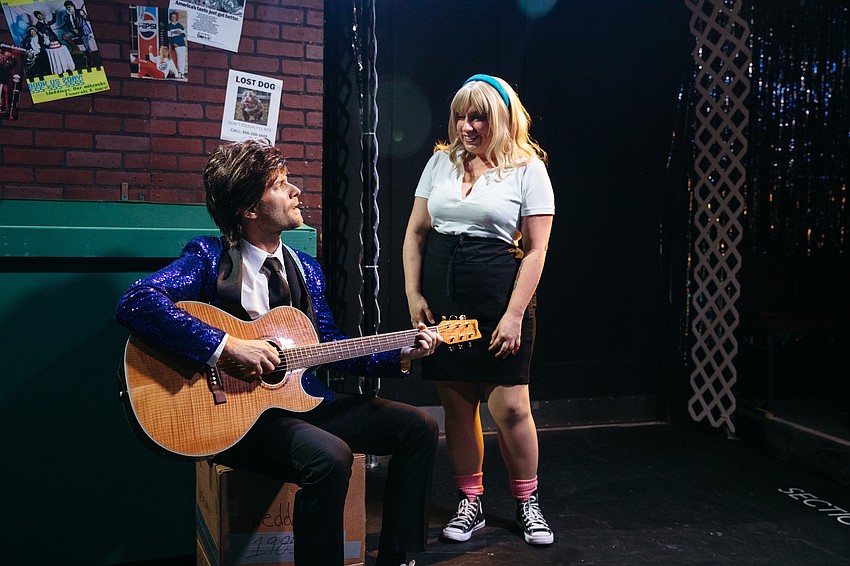
With an ensemble cast led by Christos Nicholoudis as wedding singer Robbie and Lacey Knispel as the waitress Julia torn between the search for love and stability, Scott leans into the decade where it was morning in America, greed was good and people woke up from the laid-back 1970s to learn they were living in a Material World.
In addition to a faux three-piece band led by Nicholoudis that also includes Kevin Moroney and Kelly Leissler, Priest fronts a real band that can be seen in an alcove.
Audiences may remember Priest’s star turn in Manatee Players’ 2021 production of Rodgers and Hammerstein’s “Cinderella,” but her “day job” is teaching voice and music at the State College of Florida and privately.
There will be no plot spoilers here, but let it be known that Scott’s raucous, joyful production brings back familiar faces from the ’80s, including Imelda Marcos, Mr. T and Billy Idol, best known for his ’80s hit, “Nice Day for a White Wedding.”
Choreographers Brian Finnerty and Tahlia Chinault demand a lot from the ensemble cast of “The Wedding Singer.” The players deliver in big ’80s fashion with dance numbers that move in a circular motion to accommodate the Players’ theater-in-the-round space. The floor’s bright geometric pattern reminds us of fashion’s fascination with triangles, circles and other shapes in ’80s, but also echoes the stained glass of a church.
With the average production cost of a Broadway musical now more than $20 million, it’s fun to see what a scrappy community theater can do with nearly 100 years of props and a lot of energy and ingenuity.
Props, wigs and costumes get starring roles in “Wedding Singer,” as members of the ensemble assume different roles throughout the show. Even music director Priest does a cameo as Nancy Reagan when the action moves to Las Vegas, whose wedding chapels are known for celebrity impersonators who officiate at on-the-fly nuptials.
Finnerty, who is the Players’ production manager, handles props while costume designer Jill Castle pulls together looks inspired by “Material Girl” Madonna as well as rockers Boy George and Cyndi Lauper, whose edgy, color-infused locks later went mainstream.
As for those frumpy, flowery Laura Ashley and Belle France frocks that women of all ages wore in the 1980s, they have thankfully been relegated to community theater costume shops and thrift stores.
Despite the embrace of wealth and glitz, the decade portrayed in “The Wedding Singer” seems quite innocent by today’s standards. The musical has great fun reminding us of life back when cellphones were clunky brick-like devices for just the rich and famous and when video and music were moving into the Digital Age. “What’s a CD player?” is a typical line that draws appreciative laughter from the audience.
Class consciousness comes into view in a playful way as "The Wedding Singer" pokes fun at the bridge-and-tunnel crowd who drive into Manhattan from the suburbs to party with “Saturday Night in the City.” One of the musical’s most infectious songs, “All About the Green,” reminds us how hedge funds and junk bonds first became household words back in the ’80s.
The rainbow-colored dance floor is where most of the action takes place, whether it’s at a wedding reception, a bar mitzvah or a stand-in for New York nightclubs of the 1980s like Danceteria and the Palladium.
For more intimate moments, as when Robbie’s grandma (Nancy Denton) offers him words of wisdom in his bedroom, beds and chairs on wheels rapidly appear and then disappear. This is community theater on the move, thanks to a team led by Finnerty and stage manager Cass Smith that demonstrates great creativity in the quick-change sets.
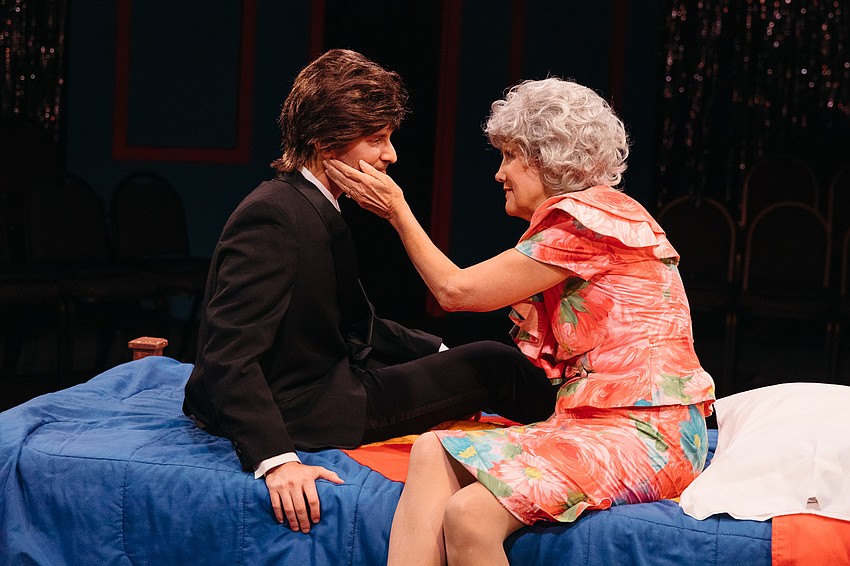
Denton, a favorite with Players audiences, wins adoring applause for grandma’s sexy duet with Jacob Brown in “Move That Thang.”
The rousing optimism of “The Wedding Singer” is the polar opposite of the Players’ recent production of “Cabaret,” set in a 1930s Berlin nightclub as the decadence of the Weimar Republic is giving way to authoritarian impulses.
The blind faith in the power of money displayed by some characters in “The Wedding Singer” seems naive at times, but the darkest place the show takes us is a garbage bin, where Robbie is encouraged to “Come Out of the Dumpster.”
Some audience members may recall there was a stock market crash and a savings and loan crisis in the 1980s, but the musical’s characters don’t know that belief in unbridled free markets and Yankee exceptionalism will be momentarily shaken.
The anguish of a woman torn between love and security is well-known to readers of Jane Austen’s novels, where the size of one’s annual income is publicly discussed by neighbors and potential suitors. The theme was also recently mined to great effect in the film “Materialists” starring Dakota Johnson.
But while the two steps forward, one step back march down the aisle in “The Wedding Singer” follows a well-worn path, it’s not cliché except when it wants to be. The musical, with book by Beguelin and Tim Herlihy, never takes life too seriously. It doesn’t want you to, either. Think “Happy Days” meets the ’80s.
“The Wedding Singer” invites the audience to fall head over heels. With any luck, those padded shoulders will cushion the fall if things don’t work out the way they’re supposed to.