- March 19, 2026

-
-
Loading
Loading
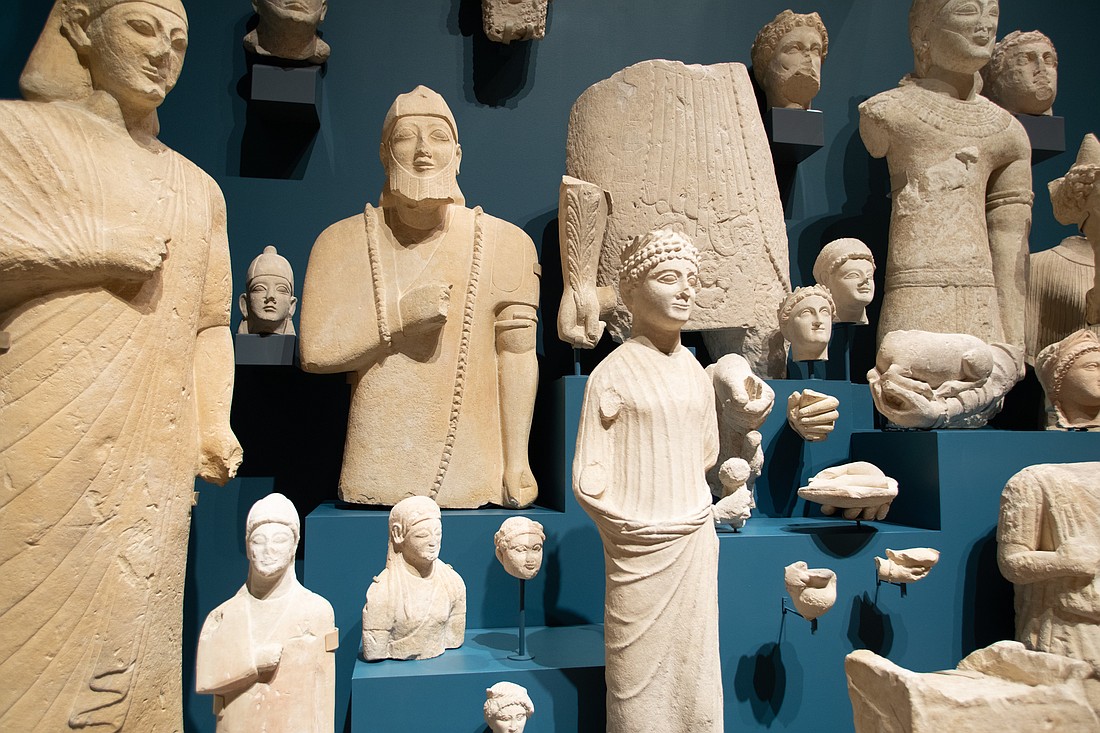
After nearly a decade of planning, research and restoration, “Ancient Art from Cyprus and the Mediterranean” has finally taken shape in Gallery 12 at The Ringling. This permanent exhibition brings nearly 3,000 years of history to life with 201 selections from the museum’s vast Cypriot collection.
Most of these sculptures, ceramics, jewelry, and precious objects come from the island of Cyprus — one of the world’s oldest cultural crossroads. Curated by archaeologist and consulting curator Joanna Smith, this installation flows from John Ringling’s original vision for an encyclopedic museum. Smith shares why that vision still matters.
It’s part of the overall reinstallation of the museum. In 2014 I was finishing a position at Princeton, where I’d just done the “City of Gold” exhibition. With perfect timing, The Ringling’s designer then reached out to me — my colleague Joan Mertens at the Met (Metropolitan Museum of Art) had recommended me as a consultant. I visited that year, wrote a proposal and we were off. Budget bumps and COVID caused long delays, but we took our time. These objects have never had a permanent gallery and we wanted to get it right.
The Ringling’s antiquities collection numbers about 3,500 pieces, and roughly 2,300 come from Cyprus. John Ringling bought nearly all of them in 1928 at the Anderson Galleries in New York, when the Met was selling parts of its ancient holdings. That purchase was a turning point; it established Ringling as a serious collector.
Most trace their origins to explorations by Luigi Palma di Cesnola, a 19th-century Italian-American U.S. consul on Cyprus who later became the Metropolitan Museum’s first director. Cesnola’s finds formed the Met’s early collection of ancient art. The Ringling’s holdings preserve that same lineage. They’re significant for what they are and what they tell us about the history of collecting.
They’ve been extraordinary. We knew preparing these objects for display would be a monumental effort, but everyone rose to it. Emily Brown and her team in object conservation looked closely at how pieces had been treated in the 19th century — making sure the heads went with the right bodies, and noting which ones didn’t. And they made a few surprising discoveries. One conservator, Tara Johnston, was cleaning what she thought was a silver ornament. But the surface didn’t look right — and she realized that the piece was covered in gold foil. So, what looked like silver jewelry turned out to be gold.
It was thrilling. When I first visited, I saw so many familiar faces — from Cesnola’s old publications or The Ringling’s 1983 temporary show — but also works I’d never seen before. Having them cleaned and properly displayed reveals an incredible level of craftsmanship. Many have truly never been on view until now.
I wanted to tell a story that’s both chronological and thematic. One side of the gallery focuses on ancient history; the other looks at collection history. A central case presents what we call “the Crowd” — about 50 limestone sculptures, grouped together as they would’ve been in an ancient Cypriot sanctuary. People made dedications to the gods, so you’d encounter a field of figures, not just one. Two colossal heads crown that grouping. Each once belonged to a 10-foot statue. Traditionally, you’d see one displayed alone, but we’re showing both. They’re similar yet distinct — different facial expressions, different energy. Together they create a real dialogue.
We have engraved glass fragments that needed to catch the light just so. Our lighting specialist, Keith Crowley, invented a way to illuminate the pieces from behind, and the mount-maker, Casey Schelhorn, engineered supports that make the glass seem to float. They look like little jewels, brilliantly lit.
Yes. You see it everywhere—in dress styles, materials and iconography. Our objects show Cyprus’ links from Italy and France to Persia and Egypt. The island sat at the hub of the eastern Mediterranean trade routes. It was rich in copper, agriculture and timber — everything from shipbuilding to textile weaving flourished there. Cultural connections radiated far beyond the island of Cyprus. Our gallery’s diversity of materials mirrors that cultural mix. And we couldn’t resist including a map!
They were incredible observers. They could be precise and naturalistic, but also playful and abstract. The sculpture of the Greek goddess Artemis is one favorite. She has her fawn, or possibly a hunting dog, and arrows, but her head is slightly too large for her body. That was intentional; Artemis was a protector of children, and the proportions seem childlike.
I hope people will enjoy individual objects but also imagine how they were experienced in their time. From one entrance you move through funerary art — including, in one case, objects from a single tomb excavated in 1961, giving a sense of how families honored the dead. From the other, you approach a sanctuary dedicated to Apollo — spaces filled with votive figures standing in for their worshippers. As you move through the gallery you join that ancient crowd. It’s about community and continuity.
John Ringling wanted an encyclopedic museum. In a 1928 “Christian Science Monitor” interview, he talked about creating a sense of universality in art. This gallery fulfills that dream. It’s not a separate building, but it’s a distinct world within the museum.
And there’s a circus connection. The Ringling Brothers circus shows often had ancient themes like “Solomon and Sheba” and chariot races. The costumes in our Cypriot sculpture aren’t that far removed. I think these pieces resonated with John Ringling’s imagination as a showman.
Proud, relieved and thankful for everyone who played a part. I feel so grateful to executive director, Steven High, who had the vision for the reinstallation, and Sarah Cartwright, chief curator, Amanda Robinson and her team from registration, along with all of my other colleagues who made it a reality. Joni Bradley, our designer, realized exactly what I had envisioned. The “crowd” in the center is exactly how I always saw it. The funerary sculptures along the side feel just right. Even the architecture plays a part — the stairs from the Monda Gallery bring you down from the height of those 10-foot-high heads. You join the group — and feel part of something greater. That’s how I feel. And that’s what I wanted visitors to experience.