- March 19, 2026

-
-
Loading
Loading
Editor’s note: This is the first of two parts on the future of New College of Florida, University of South Florida-Sarasota-Manatee and the John and Mable Ringling Museum of Art. This week’s installment focuses on the neglect of the campuses and the attacks on New College President Richard Corcoran’s vision.
Sometimes you don’t see it until you see it.
So go see it. It just may change your mind.
It changed mine.
Take the drive …
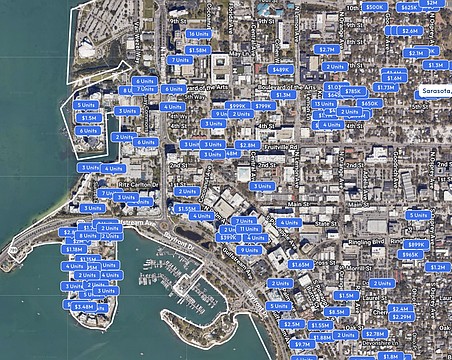
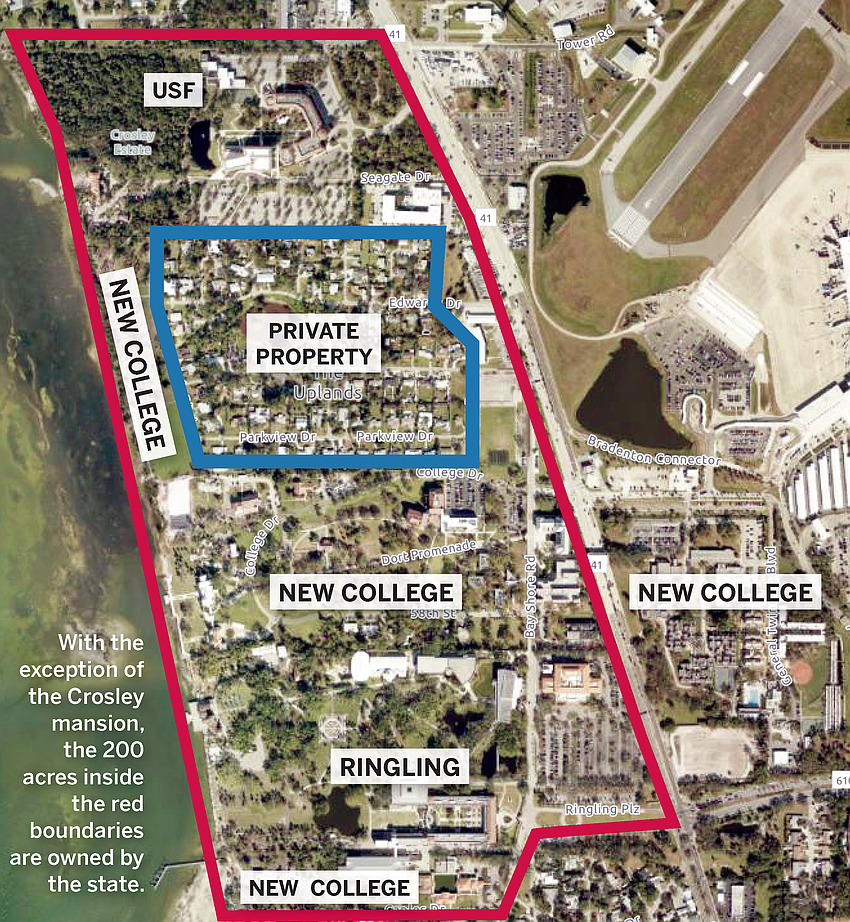
Drive to the University of South Florida-Sarasota-Manatee campus on Tamiami Trail and tour the property — all the way to the bayfront and around the Manatee County-owned Powell Crosley mansion.
Then go south on Tamiami to Edwards Drive, go west. Take that to Uplands Boulevard to the bayfront and go south. All that gorgeous land along the bayfront is state-owned land.
At the southern end of Uplands, you will come upon New College of Florida — its approximately 100 total acres stretching from the bay on the west and across Tamiami Trail to the east to the airport and including the late Charles Ringling’s beautiful bayfront mansion.
The New College property stops at the northern border of the John and Mable Ringling Museum of Art’s 66 acres. And that, of course, encompasses the priceless Ca’ d’Zan on the bay; the Mable Ringling Rose Garden; the internationally famous Ringling Museum of Art; the historic and current Asolo Theaters; Circus Museum; Center for Asian Art; Kotler-Coville Glass Pavilion, Ulla and Arthur Searing wing and Keith D. Monda Contemporary Art Gallery.
Just to the south of the museum property is the historic Ralph and Ellen Caples mansion and bayfront estate — also part of the New College campus since 1962.
Altogether, from USF to the southern border of New College, Florida and Manatee taxpayers own 200 priceless and historic waterfront acres. Add in all of the education and museum structures and infrastructure, and you’re looking at close to $1 billion in total value.
This is unmatched Sarasota and Manatee history. And priceless indeed.
Yet, you can also say much of this property — in particular, the Ringling and New College campuses — over the past five to 10 years has been mismanaged and neglected. In the case of New College: grossly mismanaged and neglected.
Walk all of the campuses. USF looks the best, thanks in large part to the construction over the past two years of the $43 million student center and 200-room Atala Residence Hall.
Down the way, thanks to the irrepressible drive of New College President Richard Corcoran, New College now looks dramatically different than it did before his arrival in October, 2023. Corcoran has poured more than $15 million state appropriations into renovating what was a mold-infested, dilapidating campus.
When Corcoran made his first visit to New College, here was the welcoming committee:
The New College of Florida sign attached to the walkway over Tamiami Trail had vegetation growing around the letters. Letters were chipped. Paint peeling. “It looked apocalyptic,” he said.
When he drove west on College Drive, two yellow, plastic corrugated greenhouses looked to be remnants of a hurricane damage — collapsed eye sores. When Corcoran asked how long they were like that, staff told him: two years.
Black mold was growing in the I.M. Pei dormitories around the air-conditioning vents. Refrigerators were rusty, bathroom counters worn and decades outdated. If you saw this as a college-bound student, you would have said: “No way.”
Inside the Charles Ringling mansion, chunks of ceilings were falling to the floor throughout the upstairs, a result of long-term lack of HVAC maintenance. All the chandeliers were broken. Stacks of paintings were stuffed into closets.
The entire campus was so tattered and neglected a donor who visited the campus for the first time said it looked like a place in the throes of bankruptcy.
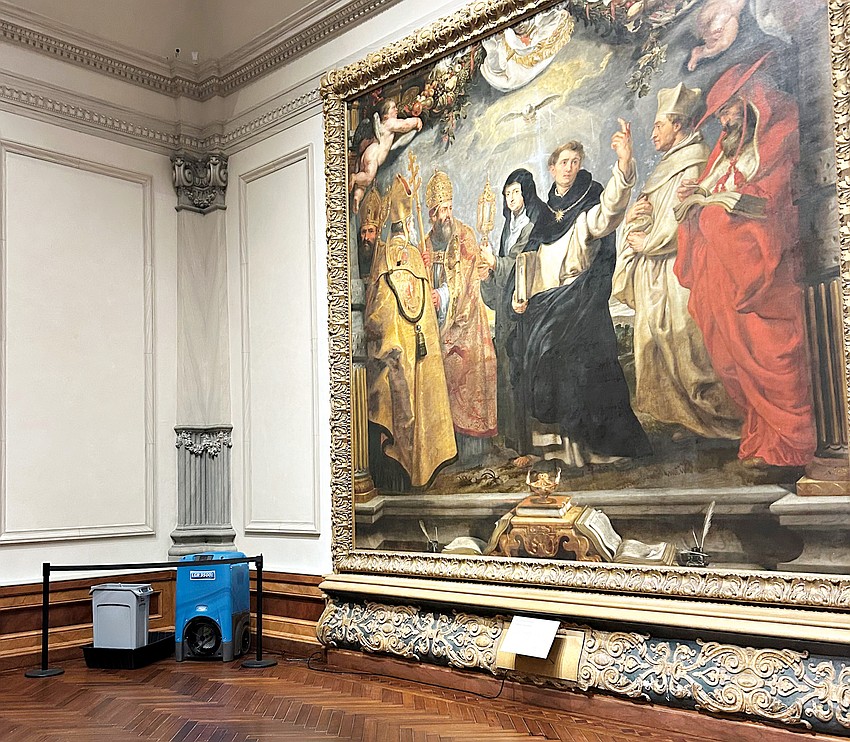
Next door, the Ringling Museum had and has similar signs of neglect. Look at the accompanying photo of the famous Rubens gallery — trash receptacles to catch leaking water, while dehumidifiers hum in corners of the room to keep the priceless paintings from deteriorating. A volunteer said there are longstanding HVAC issues for which the museum has been trying for years to get the funding. Finally, he said last month, improvements should come this December.
Beyond that, walk the Ringling Museum campus. It doesn’t project the lush, manicured, cared-for feel or look of what you find at Walt Disney World. Weeds are in the sidewalks. Mildew dresses the rooftop sculptures. This is the state museum of Florida? The showcase of Florida museums?
Last week, nine months after Hurricane Milton, the museum finally replanted the Mable Ringling Rose Garden. In the list of large capital expenditures for fiscal 2025-26 for Florida State University, the steward of the Ringling Museum, there is no major appropriation listed for the Ringling Museum.
Once you finish this tour, Cocoran’s vision — one unified campus under one, on-site leader and board — makes practical, and likely economic, sense.
Open your mind. There’s a compelling, if not convincing, case.
To begin, let’s first note we opposed Gov. Ron DeSantis’ plans to reconstitute New College of Florida and the Legislature agreeing to invest what appears to be on track for $200 million of taxpayer money over five years to turn around what has always been a financially lost-cause money pit.
Turnarounds so often require twice as much time, twice as much money and twice as much pain, disruption and perseverance as initially projected.
We made the case then that no sane business investor would invest in a New College turnaround. Certainly given the state’s many needs, we argued the amount of capital and time could be much better utilized. It made little sense for the governor and Legislature to use taxpayers’ money on this high-risk, expensive proposition whose return on investment would be a total guess.
Add to that, all of the angst and turmoil surrounding the nation’s public universities; the declining value of their degrees; and how they have been turned into woke, leftist, DEI sanitariums. New College had become ground zero for that among Florida’s public colleges and universities.
Surely, we said, state government has far higher priorities and issues on which that time and taxpayer money would be better spent (or saved).
In fact, we argued, DeSantis should sell New College and let it become someone else’s turnaround venture, not the taxpayers’.
The skepticism was not unfounded about the pain and disruption that would stand in the way of a complete transformation of New College.
Ever since Corcoran became president of New College in 2023, he has been excoriated and under relentless, hostile attack. No matter what he does, he is cast as the evil Darth Vader wielding an extreme right-wing light sword — in spite of facts to the contrary. A sampling:
Not true. Roof leaks in the dilapidating library (thanks to previous administrations) destroyed hundreds of books.
Research determined the property should generate $90,000 a month. The school was losing $900,000 a year. Corcoran told the museum owner he wanted to terminate the month-to-month lease and worked out a mutual year-and-a-half departure.
Then, of course, there is the gasping and screeching that exploded into a mushroom cloud when the news broke that Gov. DeSantis had included wording in his 2025-2026 budget to transfer the stewardship and operations of the John and Mable Ringling Museum and its assets from FSU to New College. After that, USF and New College agreed on wording to transfer USF assets to New College.
Like Florida panthers protecting their lairs from predators, USF and museum trustees and partisans erupted. They rallied to lobby local legislators and anyone else who could stop what everyone dubbed Corcoran’s “land grabs.”
USF and museum trustees and supporters celebrated later when the Legislature ran out of time, leaving the proposals in the bin of dead bills. But the hostility toward Corcoran continues to fester.
Last month at a USF board meeting in Sarasota, much of the meeting was devoted to continuing to fight Corcoran’s one-campus idea. USF history professor Scott Perry told the USF Board of Trustees: “It is obviously far more advisable to create a synergy with FSU than with an institution as incompetently run and as scandal-ridden as New College.”
Professor Perry’s vicious, visceral comments reflect a lack of facts and closed-mindedness that pervades much of the community. They should tour New College as a start.
Indeed, the question that deserves serious examination is this: Instead of knee-jerk rejection, what is the best structure long-term for the three state institutions that sit on those 200 acres of historic, priceless land?
In two-and-a-half years, Corcoran has birthed and begun executing a fresh, compelling vision.
Next week: How the New College transformation is working. Imagine an alternative.