- March 19, 2026

-
-
Loading
Loading
It’s hard to believe, but not so long ago, marketing didn’t consist of corporate sponsorships for nearly everything, annoying pop-ads on websites and a barrage of computer-generated emails filling up your inbox. Advertising was elegant, sophisticated and often devilishly simple. Yes, once upon a time advertising was art.
The art poster movement got its start in Paris during the Belle Epoque, a period from 1871 to 1914 literally known as the “Beautiful Era.” During this era, artists such as Alphonse Mucha, Henri de Toulouse Latrec, Théophile-Alexandre Steinlen and others created colorful, often whimsical ads for tobacco, liquor, nightclubs and theatrical performers such as Sarah Bernhardt.
The Belle Epoque officially ended with the start of World War I, a barbarous conflict that led to the downfall of royalty in some European nations and ushered in a period of democratization and less formality in social relations.
The House of Windsor was a survivor, and London held on to its commanding position in finance and culture, if not in fashion. Across the Channel in France, a seamstress with humble origins was set to revolutionize fashion with casual women’s apparel inspired by nautical and athletic styles. A century later, her name — Chanel — is still synonymous with luxury.
Paris was cheap between the wars and its “Moveable Feast” attracted a literary set that included Ernest Hemingway, F. Scott Fitzgerald and James Joyce, among others. Their writing spread the word far and wide about the pleasures of a bohemian lifestyle where alcohol was freely available and nightlife flourished. Scantily clad Black singer Josephine Baker defied convention and the jazz music that originated in Harlem, New Orleans and Chicago filled Paris nightclubs.
Technology was speeding things up. By the time of the 1925 Exposition Internationale des Arts Décoratifs et Industriels Modernes (International Exposition of Modern Decorative and Industrial Arts) in Paris, a bold, modern style had taken hold in art and design. Known as Art Deco, it was the signature of the Jazz Age and infused everything from art to home furnishings to advertising.
Those who like to celebrate anniversaries consider 2025 to be the 100th anniversary of Art Deco. While the groundbreaking exposition was held in Paris, Art Deco was an international movement that embraced freedom, embodied in the jazz music emanating from Harlem’s Cotton Club and other night spots, and speed, achieved through automobiles, trains and even bicycles.
These motifs and more can be seen in an exhibition of 100 large posters from the Crouse family’s collection on display at the Sarasota Art Museum campus of Ringling College of Art and Design. Curated by Rangsook Yoon, senior curator at SAM, the exhibition is called “Art Deco: The Golden Age of Illustration.”
Some of the images on the walls of SAM, which is housed in the former Sarasota High School, may be familiar to society types who attended parties at the home of William and Elaine Crouse on Siesta Key.
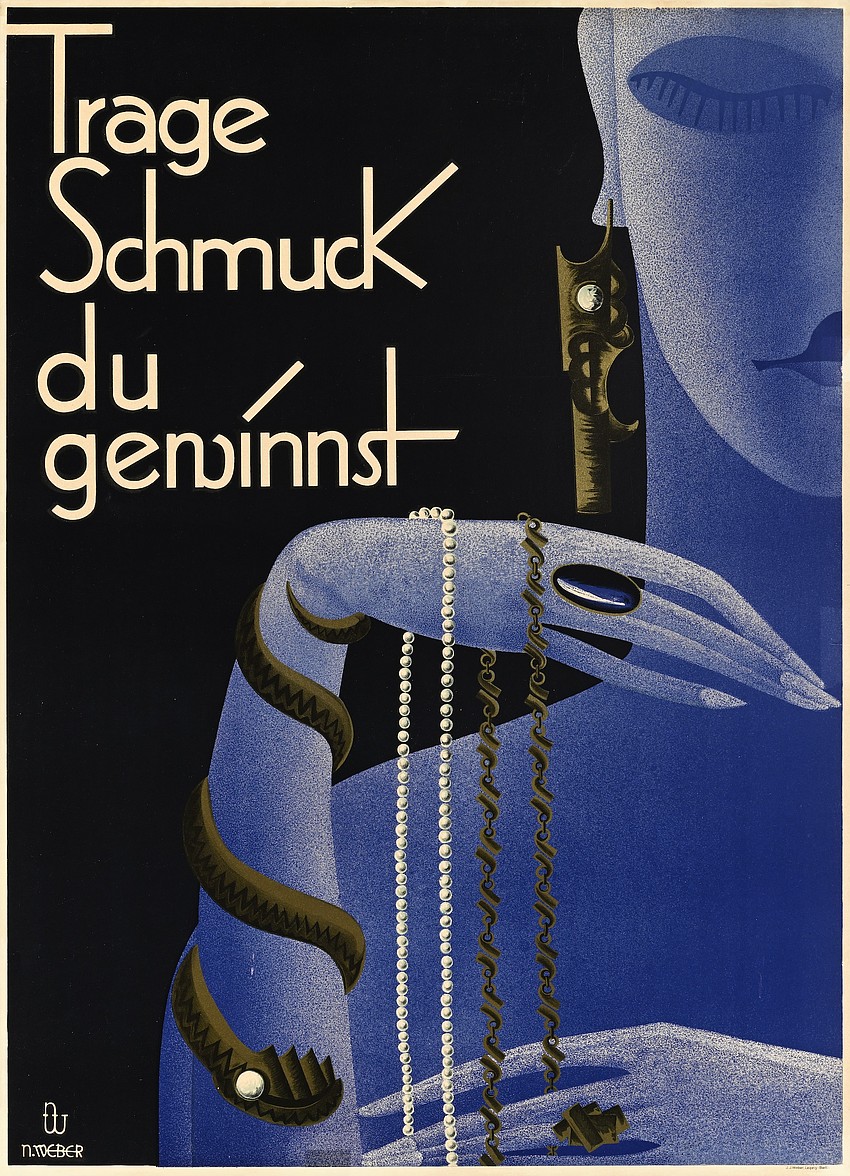
They used their home, designed by Guy Peterson, to showcase their Art Deco collection of posters, sculptures, cocktail shakers and other objects created between 1919 and 1939. They also lent art to museums such as The Guggenheim and the Victoria and Albert. From September 2023 through February 2024, posters from the Crouse Collection were displayed in a show at New York City’s Poster House called “Art Deco: Commercializing the Avant-Garde.”
In the U.S. the heyday of Art Deco coincided with Prohibition (1920-33), but there was no constraints on advertising encouraging the consumption of alcohol in France and other European countries.
Another dichotomy was that the advent of mass consumption and the worship of luxury goods occurred while the world was mired in a Great Depression following the 1929 stock market crash. Those beautiful Art Deco posters were promoting a lifestyle that was out of reach for the majority of Americans and Europeans. But like movies and fashion magazines, they provided inspiration for DIY style and glamour.
The power of speed and the excitement of racing cars and bicycles was championed in France and Italy, where Mussolini’s triumph of industrial efficiency would ultimately give way to a darker era of Fascism.
Yoon has smartly organized the Art Deco exhibition into different sections. The first room you enter is filled with advertisements for consumer products such as Oxo bouillon cubes, Twinings tea, Dubonnet fortified wine and others. “In the early 20th century, before television and the digital age, posters dominated the visual landscape, particularly in Europe,” Yoon says.
One of the leading proponents of Art Deco style was the artist A.M. Cassandre, several of whose posters are on display in the SAM exhibition. One of the most stunning displays in “Art Deco: The Golden Age of Illustration” is Cassandre’s triptych of posters for the aperitif Dubonnet.
Created in 1932, “Dubo Dubon Dubonnet” shows three illustrations of a man whose image becomes more fully formed as he drinks more of the fortified wine. Each poster is a different primary color — red, blue and yellow — and is 78-1/2 by 55 inches. Occupying a single wall in one of SAM’s galleries, the stunning display is worth the price of admission alone.
Some of the typefaces created by Cassandre, including a font called Bifur, are instantly recognizable as signatures of the Jazz Age and show up today in invitations to parties inspired by F. Scott’s Fitzgerald’s 1925 book, “The Great Gatsby.”
Speaking of Gatsby, A.D. Colin’s 1938 poster for a Paris optical store on display at SAM can’t help but bring to mind the billboard for the optician Dr. T.J. Eckleburg in “The Great Gatsby,” which graces the book’s cover and is featured movies inspired by the book. Its spectacled all-seeing eyes bore witness to the crass commercialism of the age and the carelessness of its characters.
A second larger gallery contains posters celebrating electricity, and travel by cars, trains and ships. Although Charles Lindbergh became a cultural icon in 1927 with his nonstop, solo flight from New York to Paris in his plane the Spirit of St. Louis, commercial air travel didn’t become widespread until the 1950s and 1960s.
“Drawing on avant-garde influences such as Futurism and Constructivism, these posters used bold colors, geometric shapes, sleek lines and witty visual metaphors to sell products and earn brand recognition and loyalty,” Yoon says. “But they also offered dreams and desires —the thrill of flight, the glamour of ocean travel and revolutionary transformation of modern life through technology.”
Lester T. Beall’s 1930s-era posters for the U.S. government’s Rural Electrification Administration are a stark reminder that the public works projects embarked upon by Franklin D. Roosevelt’s administration transformed the lives of Americans on farms and in small towns during the Great Depression. While residents of big cities were dancing the Charleston, drinking bootleg liquor and entertaining at home, those living in the sticks had to get by without lamps, radio and refrigerators.
Lithographs from Australia feature strongly in SAM’s Art Deco exhibition and demonstrate a simplicity and angularity that differs from posters created for U.S. and European markets. Print aficionados will appreciate A.D. McKnight’s 1918 poster, “Soaring to Success! Daily Herald - The Early Bird,” which shows an origami-like flock of birds in flight.
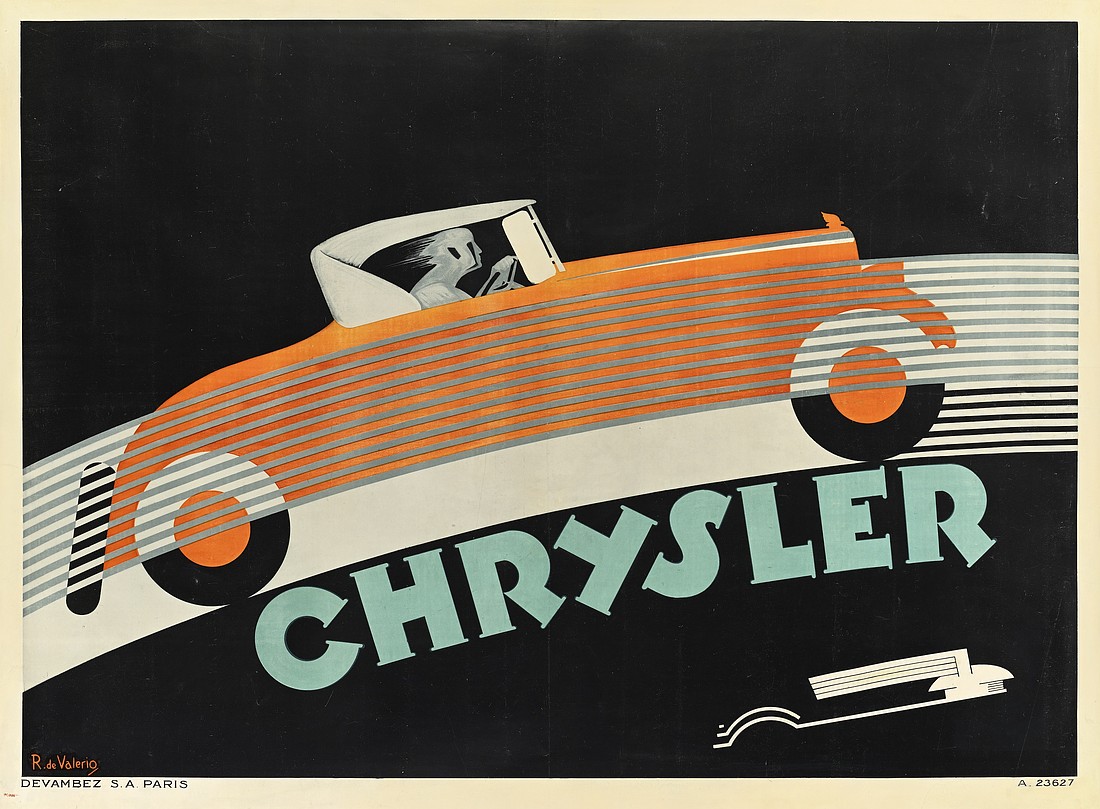
Today, Chrysler is no longer a luxury name in the automobile market, but French artist Roger de Valerio’s 1930 advertisement for the brand exudes American speed, innovation and glamour. Another work from the prolific Cassandre celebrates the inaugural voyage of the cruise ship Normandie in 1925.
“During the 1920s and 1930s, tourism surged as automobiles, railways and ocean liners made long-distance travel more accessible than ever before,” Yoon says. “Posters became essential marketing tools, offering visions of distant lands, exotic adventures and restful retreats: skiing, swimming in the sea or playing golf.”
The long gallery at SAM housing travel posters contains Art Deco furniture, including a couch and ashtray that once sat in the train station in Cincinnati, back in the days when train travel was the height of sophistication and car ownership was out of reach for many. In 1920, there was one car for every 5.3 Americans. Today, there is .85 car for every person in the U.S. and 1.83 cars per household.
Another standout is a chrome ticket counter from a movie theater in Miami Beach, today considered the capital of Art Deco architecture since many of its pastel-colored hotels have been restored to their 1920s and 1930s-era glory. The furnishings in the SAM exhibit were loaned by The Wolfsonian-Florida International University in Miami Beach.
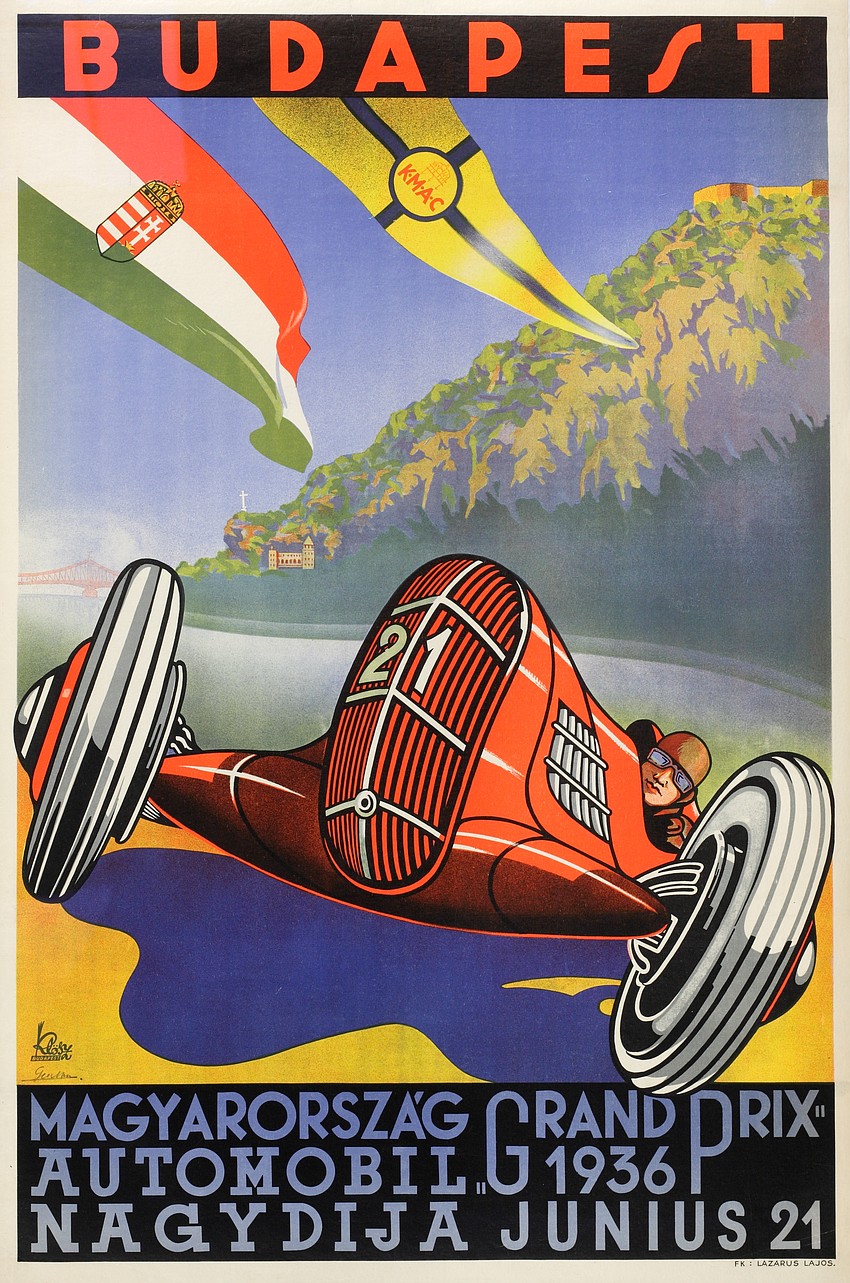
The last room of SAM’s Art Deco exhibit is dedicated to sports, including automotive and bicycle competitions. “In the 1920s and 1930s, competitive sports surged in popularity, fueling the rise of professional athletes and their fans,” Yoon notes. “Sports became a pillar of modern mass entertainment. Spectator events drew large crowds, while newspapers and the newly available radio brought sports, including major international competitions, into homes.”
Cassandre’s dynamic 1932 poster for the Coupe Davis tennis competition at the Roland Garros stadium in Paris features an oversized Dunlap tennis ball ready to burst out of the frame.
Although European athletic contests dominate the exhibition, the U.S. gets a nod with two posters created to honor Lake Placid, New York, the site of the 1932 Winter Olympics. Today the town in New York state’s Adirondack Mountains is still a U.S. Olympic Training Center, along with Colorado Springs, Colorado.
After seeing SAM’s Art Deco exhibition, you might long to have one of these iconic Art Deco images hanging on your wall at home. It’s not out of the realm of possibility. In May, Swann Auction Galleries held an auction, titled “Art Deco at 100: Iconic Posters from the William W. Crouse Collection,” that brought in $403,585, according to Art and Antiques Weekly.
Even the landmark 2013 book of the Crouse Collection posters is a collectible these days. Published by Vendome Press, “The Art Deco Poster” is out of print. The hardcover edition sells for more than $500 online. Unfortunately, the SAM exhibit will not have a companion book, Yoon says.
Like many of SAM’s exhibits, the Art Deco exhibition is worth more than one visit. Yoon has painted various gallery walls in colors that really make the posters pop. The museum’s knowledgeable docents, wearing their signature pink aprons, are always a source of interesting insights about SAM shows and are happy to engage in conversation, if that’s what you’re after.