- March 19, 2026

-
-
Loading
Loading
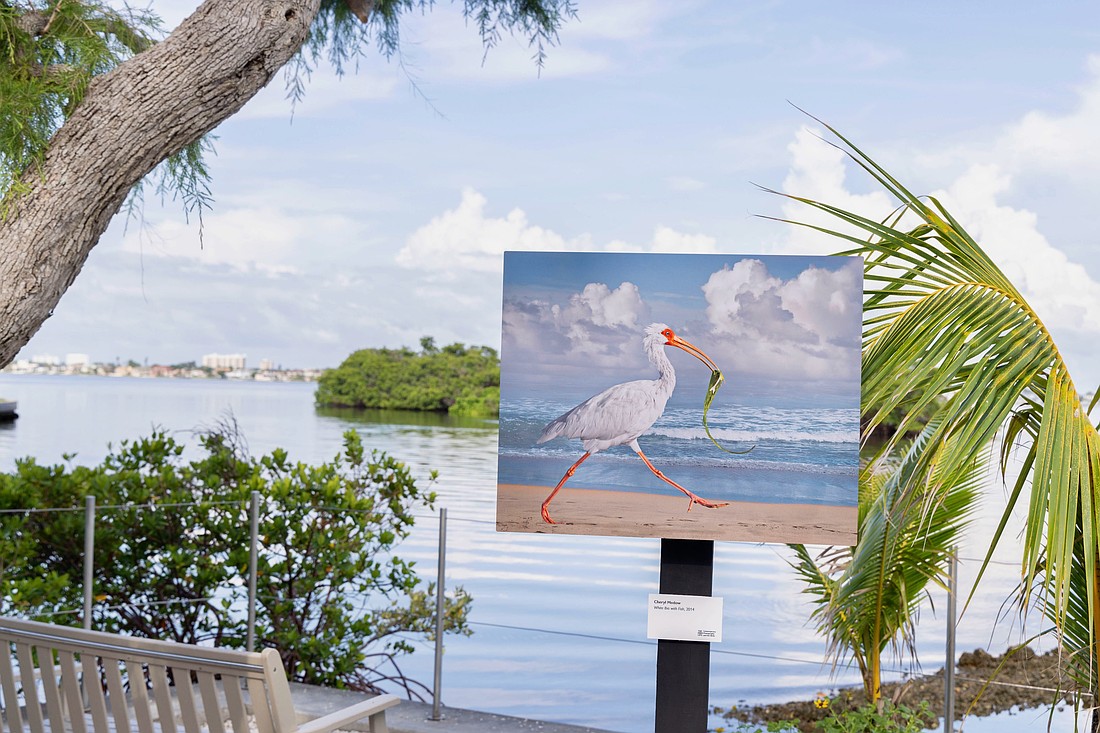
A recent survey determined that 160 species of birds can be found at Marie Selby Botanical Gardens in downtown Sarasota. But that count took place before the arrival of "The High Life: Contemporary Photography and the Birds," an exhibition of 70 photographs of birds in a myriad of locales, from the jungle to the museum.
No doubt there is some overlap between the live species at Selby's 15-acre campus overlooking Sarasota Bay and those in "The High Life," but in the exhibition you'll find feathered friends and foe that you'd never see in Sarasota, including a New York City pigeon and a Miami rooster.
The birds that have landed at Selby Gardens with the photo exhibit can found in a museum painting, a canal boat and even on a lady's hat. There was no requirement that the winged creatures in the show organized by the Minneapolis-based Foundation for the Exhibition of Photography had to be alive.
When Jennifer Rominiecki became CEO and President of Selby Gardens a decade ago, she moved to convert the botanical garden, which houses the world's largest scientifically documented collection of living orchids, to a "living museum" model. By adding art exhibits and live performances, Selby has more than doubled the number of members and visitors.
Since 2021, Rominiecki has been assisted in that mission by David Berry, a PhD who spent 10 years at The Ringling before joining Selby as vice president for visitor engagement and chief curator.
Selby recently wrapped an elaborate living tribute to George Harrison that featured "horticultural vignettes," memorabilia and music in honor of the former Beatle's healing pastime of gardening.
"George Harrison: A Gardener's Life," the ninth annual installment of the Jean and Alfred Goldstein exhibition series, ran from early February to the end of June. It was the latest blockbuster in the series to draw hordes of visitors and garner international press for Selby Gardens.
Selby's summer shows like "The High Life" are more generally more low-key and give locals a chance to enjoy an exhibition without jockeying for position for tourists taking selfies. The temperatures can be offputting in the summer, but some of the exhibit's most dazzling prints, including Junji Takasago's "Heavenly Flamingos," are inside the Museum of Botany & the Arts, which is air-conditioned.
Whether you're a tourist or a local, make it a point to get to Selby Gardens right when it opens at 10 a..m. for a lovely stroll around the grounds. Some views are obscured by construction as Selby works on its Phase Two expansion and recovers from last year's hurricanes, but "wayfinding" (museumspeak for figuring out where to go) is clear and unobstructed throughout the exhibition.
Photography fans and Selby Gardens habitués may remember a 2022 summer show called "Flora Imaginaria: The Flower in Contemporary Photography." The display of flower photographs was also organized by the Foundation for the Exhibition of Photography.
William Ewing and Danaé Panchaud, co-curators of "The High Life," were also the team behind "Flora Imaginaria."
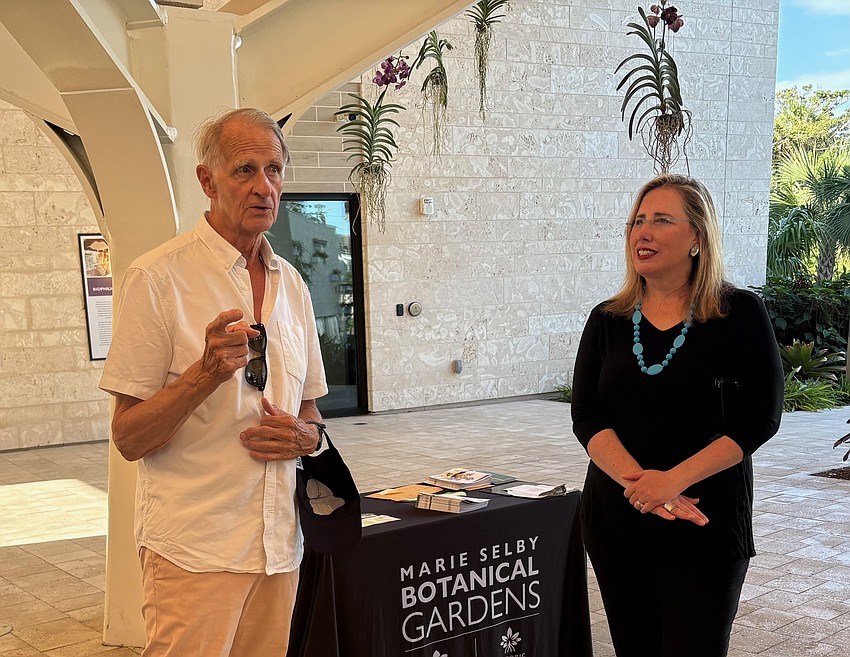
Ewing joined Rominiecki and Selby on a recent Thursday to talk about how "The High Life" took flight. (Reader advisory; Birds seem to lend themselves to corny word play, inviting a writer to get carried away on flights of fancy.)
Even Ewing couldn't resist getting in on the act, noting that the executive director of the Foundation for the Exhibition of Photography, Todd Brandow, is a former Minneapolis resident who spends a lot of time in Lausanne, where the American nonprofit has an office, but lives in Ibiza, Spain.
"He flies back and forth and he has a high life because he's always in the air, trying to sell our shows all around the world," Ewing quipped at a preview of the photo exhibit to appreciative laughter.
At any moment in time, the foundation has about 10 or 12 shows up around the world, including "Flora Imaginaria," which is currently at the Saatchi Gallery in London. "See, Selby's always first," Ewing said, noting the exhibit's 2022 run in Sarasota.
"The High Life" draws from several types of photographers, Ewing says. They include those who have done bird projects and then moved onto other areas of interest, say urban warfare, and those who specialize in birds.
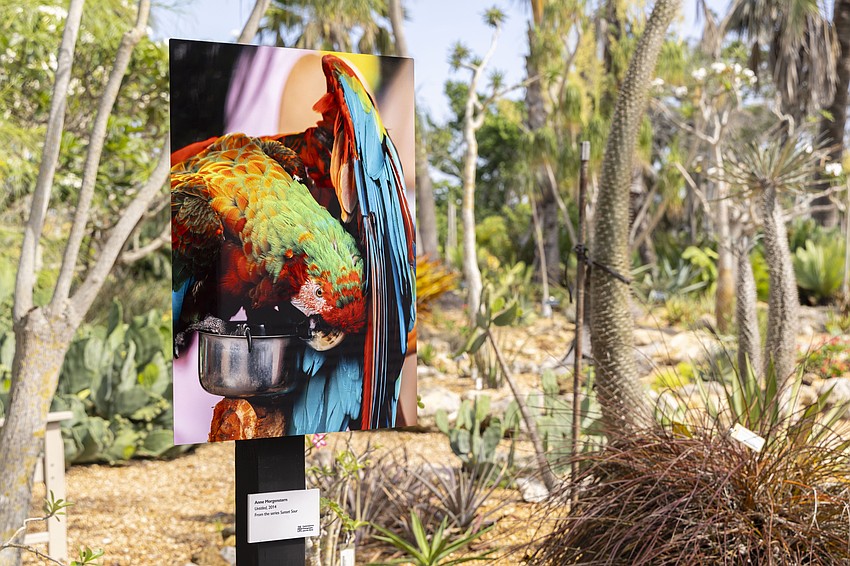
Among the latter group are those who capture images of birds in nature. These intrepid shooters spend hours "waiting in camouflage getting eaten alive by mosquitos" until they get the right shot. The other type of bird specialists bring their into the studio.
The studio photographers often mix fashion and birds, Ewing said. That's because human beings have been adorning themselves with plumage for as long as they've been around, even driving several species of birds to extinction during the Victorian era, when feathers were much in demand for hats.
"I'm not a bird person myself," Ewing says, noting that in his native Britain they're called "twitchers" so he was coming at the subject cold. When he started doing research for the exhibition Ewing found that bird photography wasn't as common as he first assumed, for a variety of reasons, including lack of interest and difficulty capturing images of creatures that camouflage themselves and that are perpetually in motion.
Ewing cited the American landscape photographer Eliot Porter as a pioneer in the field of capturing birds on film, a practice he dedicated himself to on a regular basis in the middle of the 20th century.
Porter's 1943 exhibition at New York's Museum of Modern Art, "Birds in Color: Flashlight Photographs," is considered to be the first important solo show by a photographer of birds. Ewing noted that the documentation for the show was quite apologetic, along the lines of "some people might think this is a silly topic."
But thanks to Porter, bird photography finally gained respect. In the last 30 years, the genre has exploded, Ewing says, thanks to the efforts of young photographers and advances in digital technology that allow lensmen (and women) to instantly see whether they got their shot.
The field has also been fueled by the realization that birds aren't as plentiful as they used to be. In 2019, a Cornell University study found that the American bird population has declined by 3 billion, or 30%, since 1970 because of ecosystem changes.
Amid the rising interest in bird photography, Ewing and Panchaud had no trouble finding an assortment of arresting images. "The High Life" exhibition at Selby was edited down from a book created in conjunction with the show. Published by Thames & Hudson, “Aviary: The Bird in Contemporary Photography" is a hardcover book with 223 color illustrations. It sells for $65.
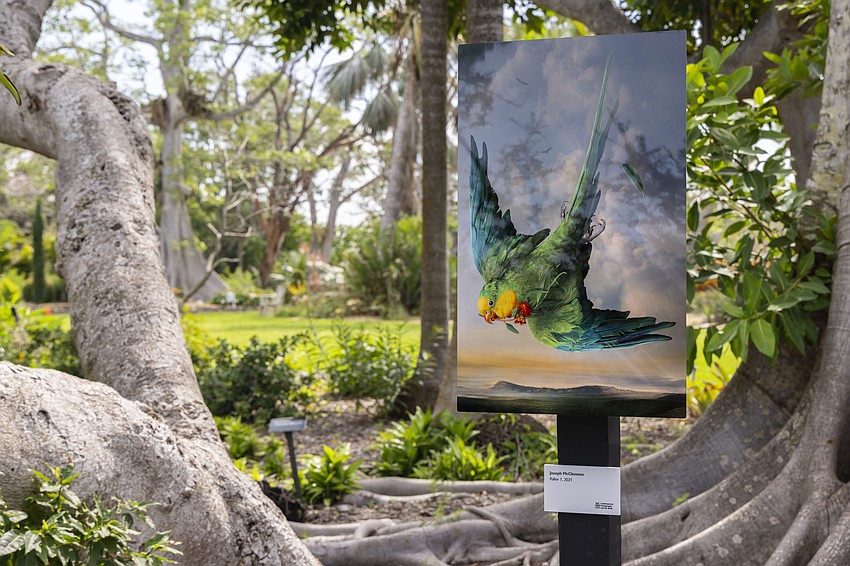
"What's fun from my point of view is figuring out what photographs work in two very distinct environments," Berry says, since part of "The High Life" is inside the Museum of Botany & the Arts while other large-scale prints have been installed along a winding path outside.
All "High Life" photos are covered with a protective coating that picks up reflections. This can be frustrating to the amateur photographer trying to capture the show's photos, particularly those outside, which show reflections of surrounding foliage and clouds, depending on the time of day.
My photos looked OK on my cellphone, but when I got back home and viewed them on on my computer screen, I could see the faintest reflection of myself. Suddenly, $65 for the companion book didn't seem like much at all.
A nice way to top off an ornithological expedition at Selby Gardens is lunch at The Green Orchid, the world's first net-positive energy restaurant, which is catered by Michael's On East.
The Green Orchid sources its produce from a rooftop garden that's planted and maintained by Operation EcoVets, a nonprofit group for military veterans, so you can feel good about yourself as you tuck into that salad.