- June 27, 2026

-
-
Loading
Loading
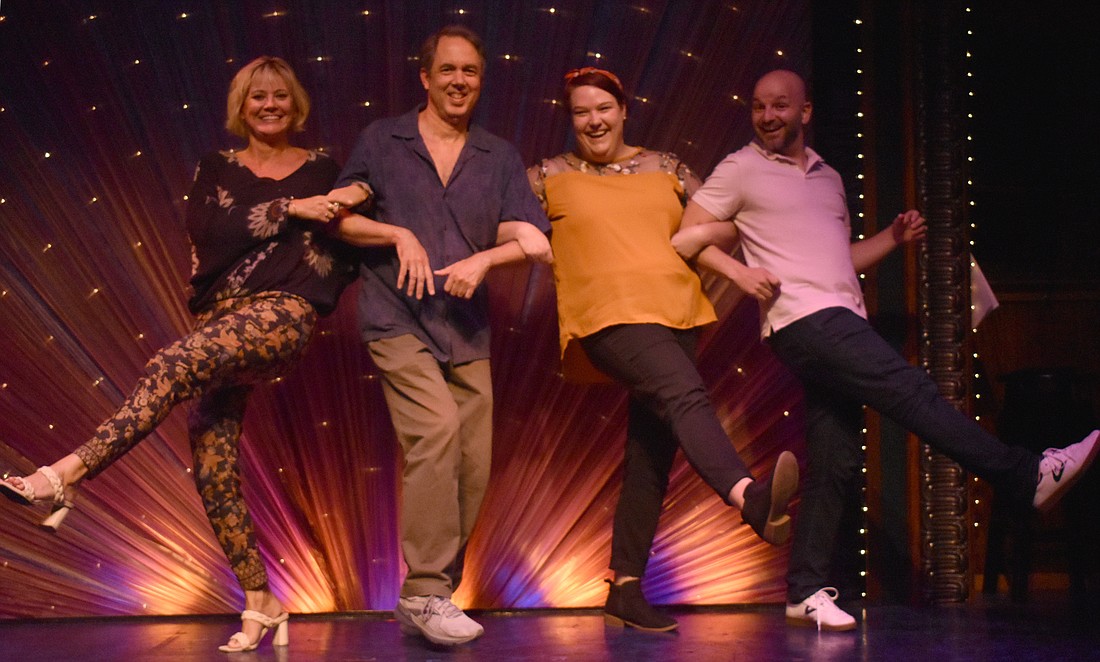
You might think that a musical sketch comedy show is written by the seat of its pants.
But you’d be wrong.
The writing staff of Florida Studio Theatre’s "Laughing Matters" series labors for a year to not just gather comedic material but also to sharpen it and make sure it doesn’t play favorites. They want as many laughs as possible, but they also want balance.
The last thing a comedic writing team wants is to take easy shots at targets that might alienate members of the audience. At the same time, they want you to laugh, even if it means laughing at yourself. That’s one of the most difficult lines to walk in a time of political polarization, but head writer Rebecca Hopkins says that challenge is really the whole point of the show.
“We really came back to this show because we see the divisiveness,” she says. “It was a big challenge to make sure we didn’t feed into that, that we did something to bring the community together and remind people that you like your neighbor. We can all laugh about this stuff, and that’s probably going to be the way we’ll find our way through it.
"Everybody thinks things have never been as bad as they are now, but people have been saying that forever.”
Hopkins, the managing director for FST, has been milking laughs out of current events forever. And the last version of "Laughing Matters," Variant 5, played in 2016. So that means that Hopkins and her writers are charged with taking the world of the past few years, framing it in a Sarasota-centric light and mining it for laughs.
And in order to do that, they begin compiling material — both alone and together — about a year in advance.
“We really started at the end of the summer,” says Hopkins of the process. “It stops and starts because we’re producing so many things here at the theater. This time last year, I committed to doing it and started thinking about it. In the summer, Sarah (Durham) and I first started working on it together. Then Jim Prosser got involved. Kevin (Allen) came in early in the process.
"And it kind of goes along for a while. By Nov. 1, we started meeting every week.”
The show, which began in February, takes a whole NASCAR pit crew to write.
Hopkins, Prosser, Durham and Allen all had their roles, as did Stephan deGhelder, Tony Hendricks and Nick Santa Maria. And when you wedge several funny people into the same room, that's when the show really begins to take shape. Durham says that the team aimed to have its first draft done by Thanksgiving, and then they had a rehearsal draft done at some point in December.
The cast doesn’t arrive until January, when the team is still shaping the show. Durham estimated that as many as 16 songs got cut out of the final version. And why does it work that way? Because the world changes, and so do the things that make people laugh.
“We have new segments throughout, but there was a joke about the Russia-Ukraine situation,” says Durham of making edits. “At the time we wrote it, it was still just conversations. Then when it actually went into turmoil, we were like, ‘We should redo that line.’ And that was a week or two after having opened. We took that joke in a completely different direction.
“When we started writing this show, we had ideas like, ‘COVID’s finally gone away.’ And then we’re getting a little farther along and we were like, ‘COVID’s not going anywhere.’ Those things had to be rewritten months before we got into rehearsal.”
Hopkins noted that it is rare for things to change once the show begins; she says another line about audience members needing masks needed to be edited because the theater’s mask policy changed.
But this isn’t an improv show, and Hopkins wants it to run as written.
“It’s not encapsulating this week,” she says. “It’s encapsulating this time period. We want it to have a life. It’s a full-fledged production. It has sets, and it has costumes. It’s not the kind of sketch thing where we’re just throwing things up. It’s fully realized.”
Sure, sometimes events change and make things less funny. And sometimes the world changes so a line isn’t factually correct anymore. But often times, says Allen, the script will change for the simple reason that a line doesn’t resonate with the cast itself.
“Once you get the cast in the room, the cast responds to the material differently, and the way they interpret it may not exactly match what you’re looking for,” he says. “We may have something that’s a banger in concept that we think is hilarious, and the cast doesn’t really connect to it. That’s OK; that’s where you as a writer have to check your ego at the door.
"We’re creating something for this community and really challenging them in a lot of ways.”
Some topics in Sarasota are easier than others to extract comedy from. You don’t have to worry about political implications when you’re joking about traffic or snowbird season. But how do the writers address political humor without making people upset in the process?
They do it by looking for the universal thing we can all accept and understand. They aren’t looking to pit citizen against citizen by picking at their political ideologies in public. Politics can’t be avoided, says Hopkins, but that doesn’t mean it has to be mean-spirited.
“They make fun of what we all agree on,” she says, noting that the show needles both Gov. Ron DeSantis and President Joe Biden in different ways. “It’s not so much about the individual policies as much as it’s about the personalities that are behind those policies.
“It’s a little bit of a trick because no matter what side of the aisle you’re on, in the DeSantis piece and the Biden piece, you can interpret it to be on your side. The pieces themselves are balanced. It’s been really funny to me to watch the different sides think, ‘Oh, that was for me.’ I’ve had multiple people tell me that DeSantis should use the song as his campaign song.”
Allen, who wrote the DeSantis song, loves the dichotomy in people’s reactions.
“I’ve had people that are pro-DeSantis come up to me and say, ‘I love what you did with that song,’” he says. “And people who are totally against him who are like, ‘I love how you guys went after him with that piece.’
"That’s one of the really cool moments I’ve had as a writer.”
After all the months and all the meetings to put the script together, what’s it like waiting to see how the jokes land? For Durham, it’s still nerve-wracking. She says that the writers stood on the balcony watching the audience at the first full dress rehearsal, and immediately they could tell where certain tables lined up on the political spectrum due to their body language.
“I still get nervous every time seeing if my jokes are going to land,” she says. “It’s like that butterfly feeling. We call them 'civilian audiences' early in the process. We know what’s landing and what’s not landing. But a joke can land so well one night, and the next night it doesn’t land. You’ve got to take that into consideration. Whether I’m writing or performing, someone told me once: ‘Anybody can make somebody sad. Anybody can make somebody angry. But to actually make someone laugh is the hardest thing to do.’”
For Hopkins, who has now presided over the process of writing six versions of "Laughing Matters," making people laugh is second nature. But she says the staff will not even begin thinking about writing another version of "Laughing Matters" for a while.
What’s interesting, she says, is that the world is circular. She wrote one song, "Crossing Tamiami," in 2001. It was all about the difficulty of getting across the road with medians on it, and now, two decades later, it’s suddenly topical again due to the roundabouts.
“Having written six of these now, it’s amazing how much the world does not change,” she says. “We’ll be trying to write about something, and I’ll be like, ‘I was writing about this 10 years ago.’ … We bring things back, and we update them.
"The rest of the world doesn’t remember that I did this song 10 years ago. We can bring it back. The same thing happens in the regular development of the cabarets. About every 10 years, you can revisit a subject matter, and you have something new to say about it.”